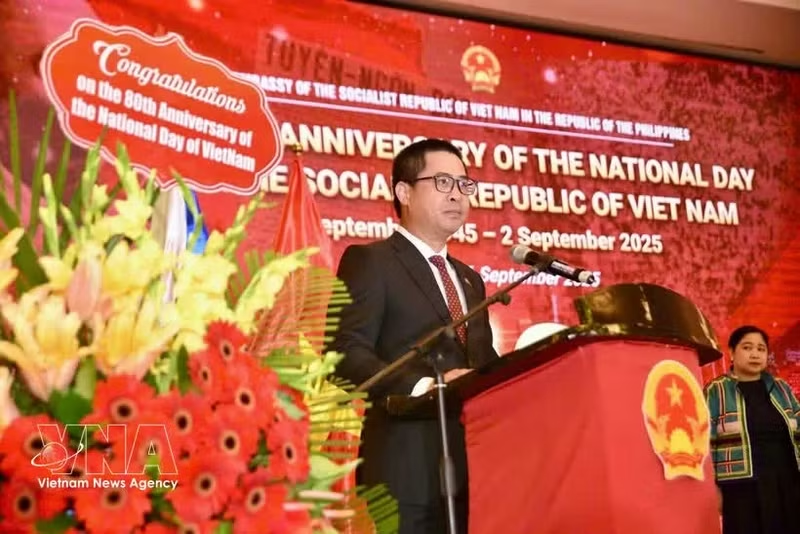
General Secretary of the Communist Party of Viet Nam Central Committee and State President To Lam’s upcoming state visit to the Philippines is a historic milestone that reflects both countries’ determination to elevate bilateral ties to a new height, according to Vietnamese Ambassador to the Philippines Lai Thai Binh.
Speaking to the Viet Nam News Agency ahead of the visit, scheduled for May 31-June 1, the ambassador highlighted the significance of the trip as the two countries are celebrating the 50th anniversary of diplomatic relations (1976–2026).
The ambassador noted that the visit marks the first official trip to the Philippines by the top leader of the Vietnamese Party and State in the past half century, underscoring Viet Nam’s consistent foreign policy of independence, self-reliance, diversification and multilateralisation of foreign relations.
He noted that the visit demonstrates Viet Nam’s high regard for the Philippines as a close neighbouring country in the East Sea/South China Sea, while reaffirming the determination to further deepen bilateral relations in a stable, effective and practical manner.
The visit is also expected to strengthen political trust, consolidate key pillars of cooperation and enhance coordination between the two countries in addressing regional and global issues.
Binh stressed that as the Philippines assumes the ASEAN Chairmanship in 2026, Viet Nam’s support and close coordination will contribute to reinforcing ASEAN unity and centrality, while promoting peace, stability, resilience and prosperity in Southeast Asia and beyond.
Regarding bilateral cooperation, the ambassador said the Viet Nam-Philippines Strategic Partnership has continued to develop positively and comprehensively across many important areas.
In politics and diplomacy, the two sides have maintained regular high-level exchanges through delegation visits, correspondence, telephone talks and meetings on the sidelines of multilateral forums, helping strengthen political trust and promote substantive cooperation.
He noted that Prime Minister Le Minh Hung’s recent participation in the 48th ASEAN Summit in Cebu created fresh momentum in bilateral relations and demonstrated Viet Nam’s strong support for the Philippines in its role as ASEAN Chair in 2026.
In defence and security, the two countries have effectively maintained dialogue and exchange mechanisms at multiple levels. To date, they have organised seven Deputy Minister-level Defence Policy Dialogues, ten Navy Consultations, three Air Force Consultations and two conferences between the Viet Nam Coast Guard and the Philippine Coast Guard.
Traditional cooperation areas such as training, search and rescue and experience sharing have continued to expand, while new cooperation fields including defence industry, logistics and military medicine are also gaining momentum.
The ambassador noted that during Vietnamese Minister of National Defence Phan Van Giang’s visit in August 2024, the two sides signed two Letters of Intent on humanitarian assistance and disaster relief at sea, and military medical cooperation.
Viet Nam and the Philippines have also strengthened coordination in combating transnational crime, addressing human security challenges, extradition and law enforcement capacity building, while increasingly focusing on non-traditional security issues.
In economic cooperation, bilateral trade has maintained strong growth momentum, increasing at an average rate of over 10% annually during 2015–2025, from 2.92 billion USD to 7.8 billion USD. Viet Nam is currently the Philippines’ 11th largest trading partner.
The structure of traded goods has become increasingly diversified, with nearly 40 key export categories from Viet Nam. Meanwhile, Vietnamese investment in the Philippines has grown rapidly in recent years, reaching more than 92 million USD in 2025 alone, accounting for nearly 70% of the total accumulated investment capital of 133 million USD.
According to the ambassador, investment projects are increasingly focused on green transformation, electric taxis and high technology, creating new momentum for infrastructure development and sustainability in the Philippines.
Tourism cooperation has also expanded significantly. The number of Philippine visitors to Viet Nam increased more than fourfold from nearly 111,00 in 2016 to over 482,000 in 2025. In the first four months of 2026 alone, Viet Nam welcomed around 236,000 Filipino visitors, up 73.4% year-on-year, enabling the Philippines to enter Viet Nam’s top 10 tourism source markets for the first time.
The ambassador attributed this growth in part to the expansion of direct air routes operated by Viet Nam Airlines, Philippine Airlines, Vietjet Air, Cebu Pacific and AirAsia.
Looking ahead, he said bilateral relations still hold substantial untapped potential given the two countries’ combined population of more than 220 million people, important geostrategic positions and complementary economies.
He expressed confidence that the target of 10 billion USD in bilateral trade is achievable if both sides continue simplifying procedures, promoting trade and improving logistics and maritime connectivity.
In food security and agriculture, he suggested the two countries move towards long-term cooperation mechanisms focused on stabilising supply chains, smart agriculture and climate adaptation.
As coastal nations, Viet Nam and the Philippines also have significant potential for cooperation in the maritime economy, including sustainable marine exploitation, maritime transport and offshore renewable energy.
The ambassador highlighted opportunities in digital workforce training, artificial intelligence, cybersecurity and fintech, noting the Philippines’ strengths in English-speaking human resources and Viet Nam’s dynamic technology ecosystem.
He also pointed to growing opportunities arising from the Philippines’ transport modernisation and energy transition, particularly for Vietnamese electric vehicle businesses such as GSM (Vingroup).
According to the diplomat, Viet Nam-Philippines relations not only bring practical benefits to both peoples but also contribute to ASEAN solidarity and the bloc’s central role in regional affairs amid increasingly complex geopolitical developments.