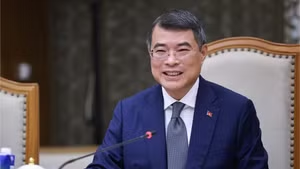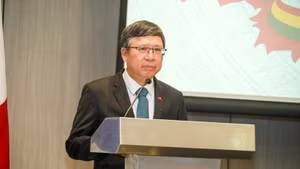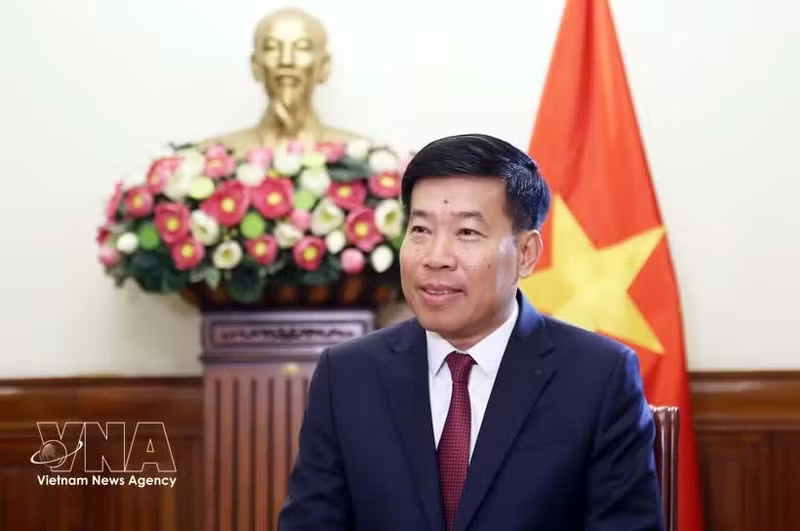
Speaking to the press ahead of the May 31–June 1 visit, Cuong noted that Viet Nam and the Philippines are two Southeast Asian nations sharing a long-standing traditional friendship and common strategic interests in maintaining peace, stability, cooperation and development in the region.
Since establishing diplomatic relations in 1976, bilateral ties have been unceasingly reinforced and developed across multiple fields, becoming increasingly substantive and effective. The establishment of the Viet Nam – Philippines Strategic Partnership in 2015 marked an important milestone, laying the groundwork for more comprehensive cooperation in a new phase, he said.
According to the Deputy FM, political trust between the two countries has continued to strengthen through regular high-level visits, exchanges and bilateral cooperation mechanisms, including the Joint Committee for Bilateral Cooperation, the Defence Policy Dialogue and the Joint Permanent Working Group on Maritime and Ocean Concerns (JPWG-MOC), helping them increase strategic discussions, share viewpoints, and effectively deal with issues on shared interest.
The two countries have also maintained close coordination at regional and international forums, particularly ASEAN, the United Nations and other multilateral forums, jointly promoted ASEAN centrality, multilateralism and respect for international law, and worked together to build a united, resilient and sustainably developing Southeast Asia.
Maritime and ocean cooperation remains a bright spot in bilateral ties as both Viet Nam and the Philippines are maritime countries and share vital interests in maintaining peace, security, safety and freedom of navigation in the East Sea/South China Sea. The two sides have promoted dialogue, confidence-building and cooperation based on international law, particularly the 1982 United Nations Convention on the Law of the Sea (UNCLOS).
Defence and security cooperation has also become increasingly substantive through delegation exchanges, training cooperation, experience sharing and coordination in maritime security, transnational crime combat, search and rescue operations, natural disaster prevention and control, and responses to non-traditional security challenges.
On the economic front, Cuong went on, the Philippines is currently one of Viet Nam’s key markets in ASEAN, particularly in agriculture and food security. Viet Nam remains an important rice supplier to the Philippines, helping support the latter’s food security while creating stable export opportunities for Vietnamese agricultural products.
However, he noted that economic cooperation still holds considerable untapped potential in areas such as trade, logistics, high-tech agriculture, digital economy, renewable energy, fisheries and marine economy.
People-to-people exchanges, as well as collaboration in education, culture and tourism, have also continued to expand, helping strengthen mutual understanding and creating a favourable social foundation for the sustainable and long-term development of bilateral relations.
The official underlined the extreme significance of the upcoming trip as it is the first visit to the Philippines by a CPV General Secretary, taking place as the two countries prepare to celebrate the 50th anniversary of diplomatic ties and as the Philippines holds the ASEAN Chairmanship in 2026. The visit reflects Viet Nam’s high regard for its friendship and cooperation with the Philippines, as well as its commitment to ASEAN and Southeast Asia.
The two sides are expected to hold in-depth discussions on major orientations aimed at promoting the Strategic Partnership in a more robust, substantive and effective manner in the new stage of development.
A key expectation of the visit is the further consolidation of political trust, he said, noting that amid complex global and regional developments, it is critically important to increase strategic exchanges, sustain high-level contacts and coordinate their stances.
In particular, the visit is also expected to create a fresh impetus for economic cooperation to become a more important pillar of bilateral relations, especially in trade, investment, logistics, high-tech agriculture, renewable energy, digital transformation and marine economy.
In agriculture and food security, Viet Nam hopes to remain a reliable partner of the Philippines while expanding partnerships to agricultural and seafood processing, high-tech applications and climate change adaptation – areas meaningful to both countries' sustainable development and their people's life.
Meanwhile, maritime and ocean cooperation will remain a central area of collaboration as both share interests in maintaining peace, stability, security, safety, and freedom of navigation in the East Sea in line with international law, especially the 1982 UNCLOS.
They are also expected to expand defence and security ties, particularly in maritime security, transnational crime prevention, search and rescue, and response to natural disasters and other non-traditional security challenges.
Viet Nam and the Philippines are set to strengthen coordination within ASEAN and multilateral frameworks in support of ASEAN solidarity and centrality, along with an open, inclusive and rules-based regional architecture, Cuong continued.
In addition, the visit will promote people-to-people exchanges and cooperation in education, culture, tourism and locality-to-locality links, further reinforcing the social foundation for long-term Viet Nam – Philippines relations, according to the Deputy FM.