However, based on a review of practical experience, the Party has candidly acknowledged limitations in its ideological work. These shortcomings directly hinder the mobilisation of spiritual resources, causing numerous sound guidelines and policies to stall during implementation.
The country is simultaneously implementing multiple strategic decisions alongside comprehensive reform initiatives; this demands ideological consensus and consistency across the entire Party, military, and population, transforming these elements into an internal engine of development.
In response to these practical needs, on August 22, 2026, the Political Bureau issued Resolution No. 25-NQ/TW on the strategy for ideological work in the new context. This marks the first time the Party’s ideological work has been defined through a dedicated resolution.
This move systematised the Party’s perspectives on building a strong organisation — politically, ideologically, and ethically — into a comprehensive strategy. It clearly outlines objectives, targets, roadmaps, and responsibilities, while ensuring coherence and alignment among Party documents regarding this work.
Resolution No. 25-NQ/TW stipulates that the quality of ideological work must be assessed based on tangible outputs, verifiable data, and practical effectiveness, rather than merely the volume of meetings, documents, or reports.
Outcomes must be linked to the evaluation of Party organisations, officials, and heads of agencies; successful practices must be replicated, while stagnation must be addressed. Crucially, the people must participate in and benefit from this process while serving as the ultimate evaluators; the value of the Resolution must be reflected in the lives and confidence of the public.
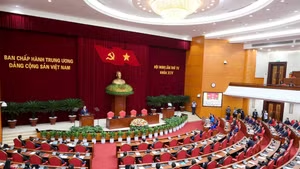
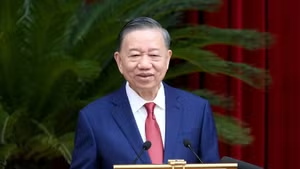
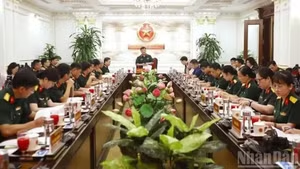
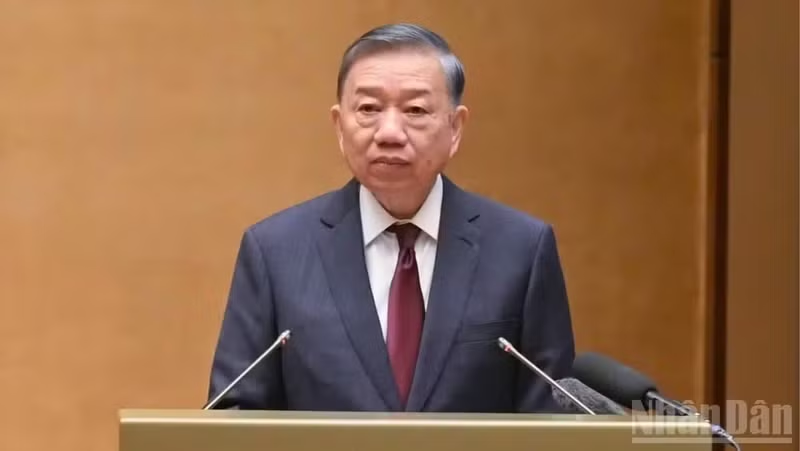
Recently, at a national conference dedicated to studying, internalising, and implementing various resolutions and directives of the Political Bureau, General Secretary and President To Lam reaffirmed the critical importance of Resolution No. 25-NQ/TW in establishing a political, spiritual, and ethical foundation and enhancing the Party's fighting strength.
In this new context, ideological work must pave the way, accompany the implementation process, and subsequently summarise practical experience to reinforce confidence. It must also protect the Party’s ideological foundation, combat erroneous and hostile views, and prevent degradation — as well as “self-evolution” and “self-transformation” — at an early stage and at the grassroots level.
According to the General Secretary and President, this is a responsibility shared by the entire Party—primarily Party committees and heads of agencies—rather than a task to be delegated solely to specialised bodies.
For the final months of 2026, the Party Central Committee called for ensuring the smooth operation of the organisational apparatus, resolving urgent bottlenecks, and achieving socio-economic targets to the highest possible degree. Looking further ahead — towards the Party's 14th tenure — the focus must be on institutionalising policy decisions, refining the decentralisation of power, reorganising spatial development, and pioneering new development models.
In response to both urgent and long-term demands, the Politburo has emphasised that ideological work must be conducted comprehensively, integrated across the economic, socio-cultural, national defence, security, and foreign affairs sectors, as well as social welfare policies. Furthermore, this work focuses on grassroots levels and residential communities, requiring synchronised and unified implementation both domestically and abroad.
Adhering closely to Resolution No. 25-NQ/TW and Plan No. 08-KH/TW of the Secretariat, Party committees at all levels are urgently formulating and issuing implementation plans guided by the motto: “Proactive – Sharp – Persuasive – Effective”.
In this spirit, beginning at the stage of formulating guidelines and policies, Party committees simultaneously assess potential ideological impacts alongside plans for dissemination, explanation, and dialogue. Several Party committees are also actively promoting the integration of sociological surveys, digital data analysis, and artificial intelligence into their ideological work.
These efforts aim not merely to generate reports but to translate forecasting results into concrete leadership decisions within agencies, localities, and units; to address public grievances early and minimise information gaps; and to foster social consensus.
To shift the focus from information management to guiding public perception, ideological work in this new era requires cadres and Party members to internalise and proactively apply the ideology, morality, methods, and style of Ho Chi Minh.
At every locality, grassroots unit, and residential community, the responsibility of cadres and Party members to set an example must be demonstrated through the effective and definitive resolution of difficult tasks, outstanding issues, and public grievances.
The results achieved in political tasks and the demonstration of public service ethics serve as the true yardstick for the quality of ideological work. By effectively implementing this, ideological work will transcend mere guidance but will permeate every action, becoming a culture of conduct and behaviour among officials, Party members, and the public.