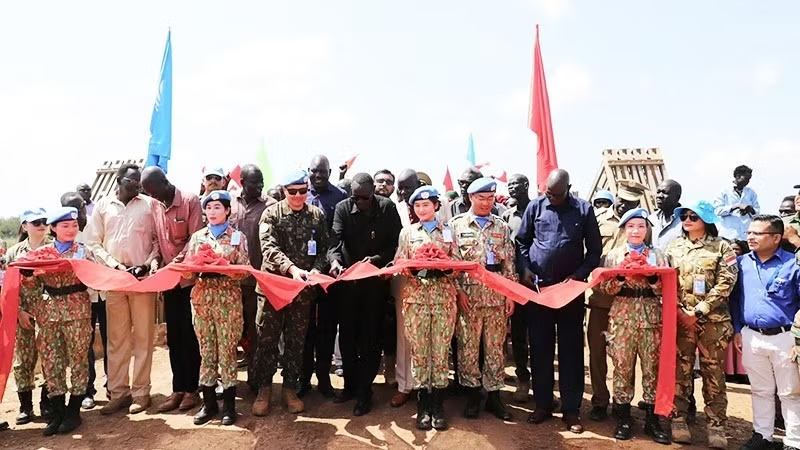
At the beginning of 2026, Major General Pham Manh Thang, Director of the Viet Nam Department of Peacekeeping Operations, spoke with Nhan Dan about key milestones, lessons learned and strategic orientations of Viet Nam’s blue-beret forces in the time ahead.
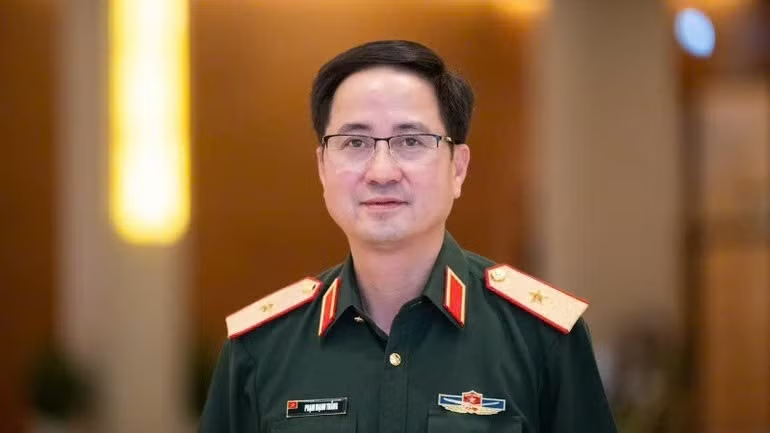
Q: After more than 11 years of presence in UN peacekeeping operations, how has the Viet Nam People’s Army affirmed its position and international credibility?
A: After more than 11 years of officially participating in UN peacekeeping activities (2014–2025), it can be affirmed that Viet Nam’s peacekeeping force has grown steadily and left a strong impression, receiving recognition and high appreciation from the United Nations, mission headquarters and the international community.
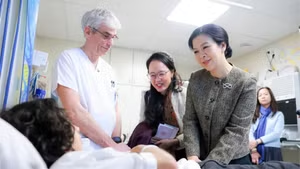
From the first individual officers serving as military observers, liaison officers and staff officers in missions in South Sudan and the Central African Republic, to the successful deployment of Level-2 field hospitals, a significant shift has been marked from “participation” to “substantive and responsible contribution”. Beyond fulfilling professional duties, Viet Nam’s peacekeepers have also demonstrated a strong humanitarian spirit through activities such as medical examinations and treatment, free medicine distribution, school construction, teaching, road building and agricultural guidance. Notably, in recent years many of our officers have been entrusted by the UN with important positions.
Q: Through the proven capacity of Viet Nam’s blue-beret forces at UN missions, how are the contributions of the Viet Nam People’s Army being perceived in international peacekeeping and stability efforts?
A: The successful performance of Viet Nam’s blue-beret forces at UN missions and headquarters primarily reflects the comprehensive maturity of the Viet Nam People’s Army in terms of capability, political resolve and international integration in the new period.
Vietnamese officers operate in multinational, multicultural environments, facing complex security challenges and heavy workloads. Meeting these demands demonstrates that our training standards, organisational capacity and human resources quality are approaching international benchmarks, while still maintaining firm political resolve and absolute loyalty to the Fatherland, the Party, the State and the people.
More importantly, each Vietnamese blue-beret soldier is not only a professional peacekeeper but also a “messenger of peace”, carrying the image, identity and fine values of the heroic Viet Nam People’s Army.
Q: From practical deployment at UN missions, what lessons have been learned in the selection and training of personnel to ensure both effective international performance and the preservation of the qualities of “Uncle Ho’s soldiers”?
A: More than 11 years of UN peacekeeping participation have provided many valuable lessons, foremost among them the lesson of human factors as the decisive element of success.
First, selection must be rigorous and comprehensive, with political standards and moral qualities as the foundation, while also emphasising professional competence, foreign language skills, health and the ability to work in an international environment. We must not only select those who are “good at their jobs” but those with sufficient integrity, capability and resilience to represent the image of the nation and the army.
Second, training must be synchronised and closely aligned with mission realities, combining professional training, operational skills and international law with political, ideological, moral and lifestyle education. This ensures personnel are not only professionally competent but also steadfast in the face of all difficulties and challenges, enabling them to adapt quickly to international working environments.
Third, fostering resilience and upholding the qualities of “Uncle Ho’s soldiers” in multicultural settings far from home is a constant requirement. Strong political resolve, dedication to peace, compassion, humility and a high sense of responsibility have helped Vietnamese blue-beret soldiers overcome hardships and fulfil their missions.
Q: Amid increasingly complex global and regional security challenges, what strategic priorities has the Viet Nam Department of Peacekeeping Operations identified to enhance quality and professionalism in the coming period?
A: The foremost priority is building a high-quality human resource pool for Viet Nam’s peacekeeping forces in the direction of being “regular, elite and modern”, fully meeting UN standards. At the same time, political and ideological education will continue to be strengthened to ensure personnel maintain firm resolve, moral integrity and disciplined conduct.
On that basis, Viet Nam will proactively expand the scale, forms and areas of participation, both at unit and individual levels, with a focus on preparing candidates for senior positions at UN missions and headquarters. In parallel, international cooperation will be intensified through experience exchanges and support in training, equipment and science and technology, gradually enhancing self-reliance and meeting the increasingly demanding requirements of peacekeeping operations.
![[In Pictures] General Secretary and President To Lam and his spouse visit and present books to Royal Library of Belgium](https://en-cdn.nhandan.vn/images/3NY4Z6Du1Md1PrS_s0ZZOrwc5xDfq4rRua69depr-TBkwatGjBcD9lagzrI2BmGDo4nKYA9qjKDjuB3-yYloL_1KbNBr00klMZQFyHQxQ6Jq6GzFfAiY0m5agKw6jNtArN4QnVntX8RQeUmD7pdCq7nwvn3e235v3kufpokBN_s/1-tong-bi-thu-chu-tich-nuoc-va-phu-nhan-tham-tang-sach-cho-thu-vien-hoang-gia-bi.jpg.avif)