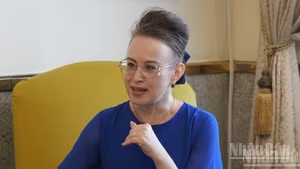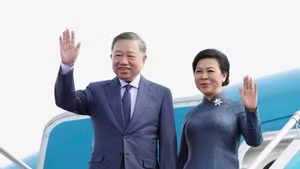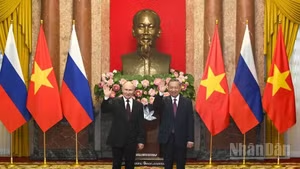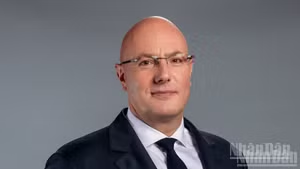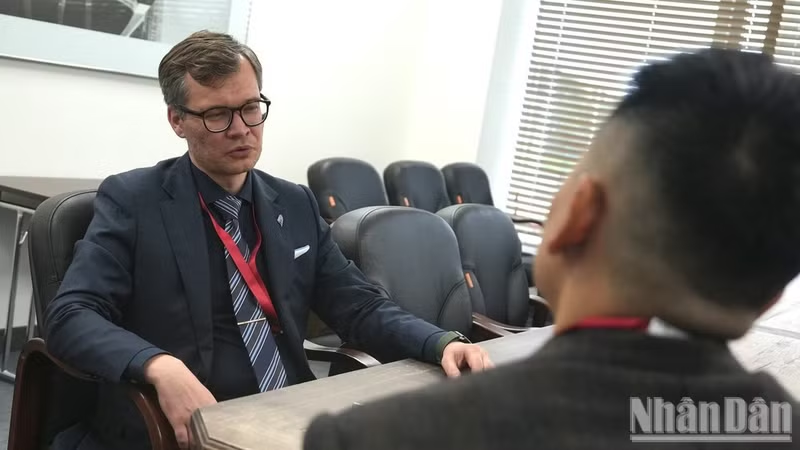
Ahead of General Secretary and President To Lam’s state visit to the Russian Federation from September 7 to 9, Evgeny Vlasov, President of the Russia–Viet Nam Friendship Association in the Primorye region, Vice President for International Relations at Far Eastern Federal University (FEFU), and Director of the Institute for Oriental Studies at FEFU’s School of Regional and International Studies, said Viet Nam–Russia relations are experiencing robust growth.
Speaking to a Nhan Dan newspaper correspondent based in Russia, Evgeny Vlasov said the foundation of the comprehensive strategic partnership forged over decades paves the way for Viet Nam and Russia to further expand and deepen cooperation across a wide range of fields.
As President of the Russia–Viet Nam Friendship Association in the Primorye region, Vlasov said that people in Vladivostok harbour a profound interest and deep affection for Viet Nam. The recent renaming of a bus stop at the President Ho Chi Minh Park on Borisenko Street as the “Ho Chi Minh Park” bus stop stands as a tangible testament to this affinity.
Vlasov also emphasised to resounding endorsement by lecturers at FEFU’s Institute for Oriental Studies for the decision to present General Secretary and President To Lam with a prestigious international peace award. He said the award acknowledges the policy of peace, harmony, and multilateralism that Viet Nam is pursuing.
Assessing Viet Nam’s role, Vlasov said Viet Nam serves as a crucial anchor in championing the principles of multilateral cooperation, equality, respect for the independence and sovereignty of countries, and equal interaction in the region. Viet Nam’s role in the Association of Southeast Asian Nations (ASEAN) continues to expand, while its position in the Asia-Pacific Economic Cooperation (APEC) forum has also been significantly strengthened.
Vlasov particularly praised General Secretary and President To Lam for executing his declared policy agenda.
Expanding cooperation from the central level to localities
Ahead of General Secretary and President To Lam’s state visit to Russia, Vlasov voiced optimism that the friendship and trust between the senior leaders of the two countries would inject renewed vigour into cultivating relations between their localities.
Vlasov said that economic growth centres in Viet Nam such as Ho Chi Minh City, Da Nang, and Nha Trang have immense untapped potential to forge direct cooperation with Russian localities, including those in the Far East.
According to Vlasov, Vladivostok–Hai Phong and Vladivostok–Ho Chi Minh City are twinned cities. This model should be expanded, with heightened dialogue and engagement between Vietnamese localities and Russian regions and localities.
Vlasov proposed capitalising on the individual strengths of each locality to develop specific cooperation models. For example, one locality could focus on agriculture, while another could develop logistics, healthcare, or emerging fields.
This approach, he said, would not only diversify cooperation but also breathe new life into bilateral trade. At present, Viet Nam–Russia economic relations remain significantly focused on traditional forms of cooperation, while many promising sectors remain underutilised.
Businesses, the State, and universities must operate synergistically
Another proposal advanced by Vlasov is to strengthen coordination among businesses, the State, and higher education institutions.
He advocated cultivating a paradigm in which “businesses, the State, and the university community become a mutually supportive system.”
He explained that businesses have capital and market demand but may lack human resources; universities have the capacity to train personnel and generate intellectual capital; while the State plays a regulatory role and creates a secure, stable climate for cooperative relations.
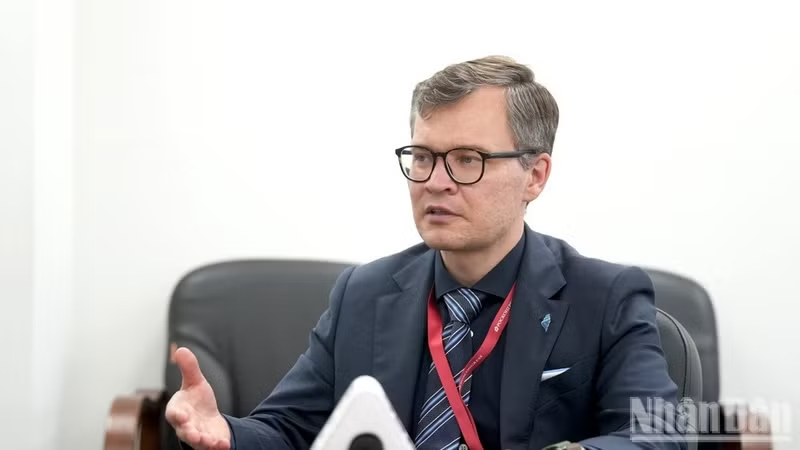
According to Vlasov, interaction among these three stakeholders would translate collaborative potential into tangible initiatives and lay the foundations for long-term cooperation.
For Vietnamese businesses seeking to enter the Russian market, Vlasov recommended that they should not operate independently but instead forge strategic partnerships in local markets and in specific fields.
He explained that a partner with a good understanding of the market can help businesses navigate differences in culture, legislation, and business practices, thereby mitigating barriers to entry. The same approach can also be applied to Russian businesses operating in Viet Nam.
Vlasov noted that businesses often expect quick results, but business cooperation takes time to mature. Therefore, a systematic approach and government support policies are particularly important, especially for small and medium-sized enterprises.
Lacking immediate returns to sustain operations, small and medium-sized enterprises may have to withdraw from the market. It is therefore necessary to establish support mechanisms and create favourable conditions for businesses to weather the nascent phases in order to maintain their presence and expand cooperation.
Alongside businesses and regulatory agencies, Vlasov underscored the role of the Vietnamese community in promoting Viet Nam–Russia relations.
According to him, the two countries need people who have a thorough understanding of each other’s markets, cultures, and characteristics to serve as bridges for cooperation. This could help businesses in the two countries understand each other better while circumventing friction caused by divergent business landscapes.
Transport connectivity remains a vital prerequisite, he said. Maritime, rail, and air transport links create connections between the two countries and should continue to be bolstered to support trade, investment, and people-to-people exchanges.
Vlasov also expressed his hope that the bonds of friendship and political trust between the leaders of the two countries would permeate every tier of bilateral engagement.
According to him, the signing of new agreements by the leaders is only the starting point. When friendship is built at every level, from those directly implementing cooperation to ordinary people, the results of cooperation, as well as the scale of trade and economic growth, will be profoundly transformed.