Once a little‑known martial art that quietly survived in small dojos and local sports centres, Viet Nam’s jujitsu has now emerged onto the international spotlight with convincing world and Asian gold medals. That journey began before 1945 when jujitsu was introduced to Viet Nam, but it has only truly accelerated over the past decade or so. From a handful of localities sustaining practice, jujitsu has now spread to nearly 20 provinces and cities nationwide.
Localities such as Bac Ninh, Thai Nguyen, Son La, Lao Cai, Quang Ninh, Phu Tho, Thanh Hoa, Hue, Da Nang, Dong Nai, as well as Ha Noi and Ho Chi Minh City have become strong development centres for the sport. Thousands of practitioners together with hundreds of elite competitors are creating a broad foundation for Viet Nam’s jujitsu.
The sport has not only developed its athlete base but has also built a quality system of coaches and referees, including two officials certified to international standard by the World Jujitsu Federation. National championships and the national clubs cup are held annually and form part of Viet Nam’s official sporting calendar, helping jujitsu move beyond grassroots activity towards professionalisation.
The sport has not only developed its athlete base but has also built a quality system of coaches and referees, including two officials certified to international standard by the World Jujitsu Federation.
Those advances were quickly reflected in international results. In 2009, Viet Nam’s jujitsu made headlines with a gold medal at the Asian Indoor Games when Viet Nam was the host.
In 2014, the national team went on to win two silver and four bronze medals at the Asian Beach Games in Thailand. A year later, Vietnamese athlete Nguyen Thi Lan made history at the 2015 Ju-Jitsu World Championships held in Bangkok, Thailand.
Since 2016, Viet Nam’s jujitsu has consistently won medals at regional and continental competitions, before a turning point in 2018 with one gold and two silver medals at the World Youth Championships in the United Arab Emirates and a bronze at the Asian Games (ASIAD) in Indonesia. The most significant imprint came during the 2025–2026 period when Viet Nam’s jujitsu exploded onto the international scene.
At the 2025 World Jujitsu Championships in Thailand, the Vietnamese team won eight golds, seven silvers and ten bronzes, finishing third overall behind Kazakhstan and the team of independent athletes. That performance saw Viet Nam overtake several jujitsu powerhouses such as Germany and Brazil, and marked the most successful campaign in the sport’s history.
Just months later, at the 2025 Asian Jujitsu Championship in Jordan, Viet Nam again finished third overall with seven golds, two silvers and six bronzes.
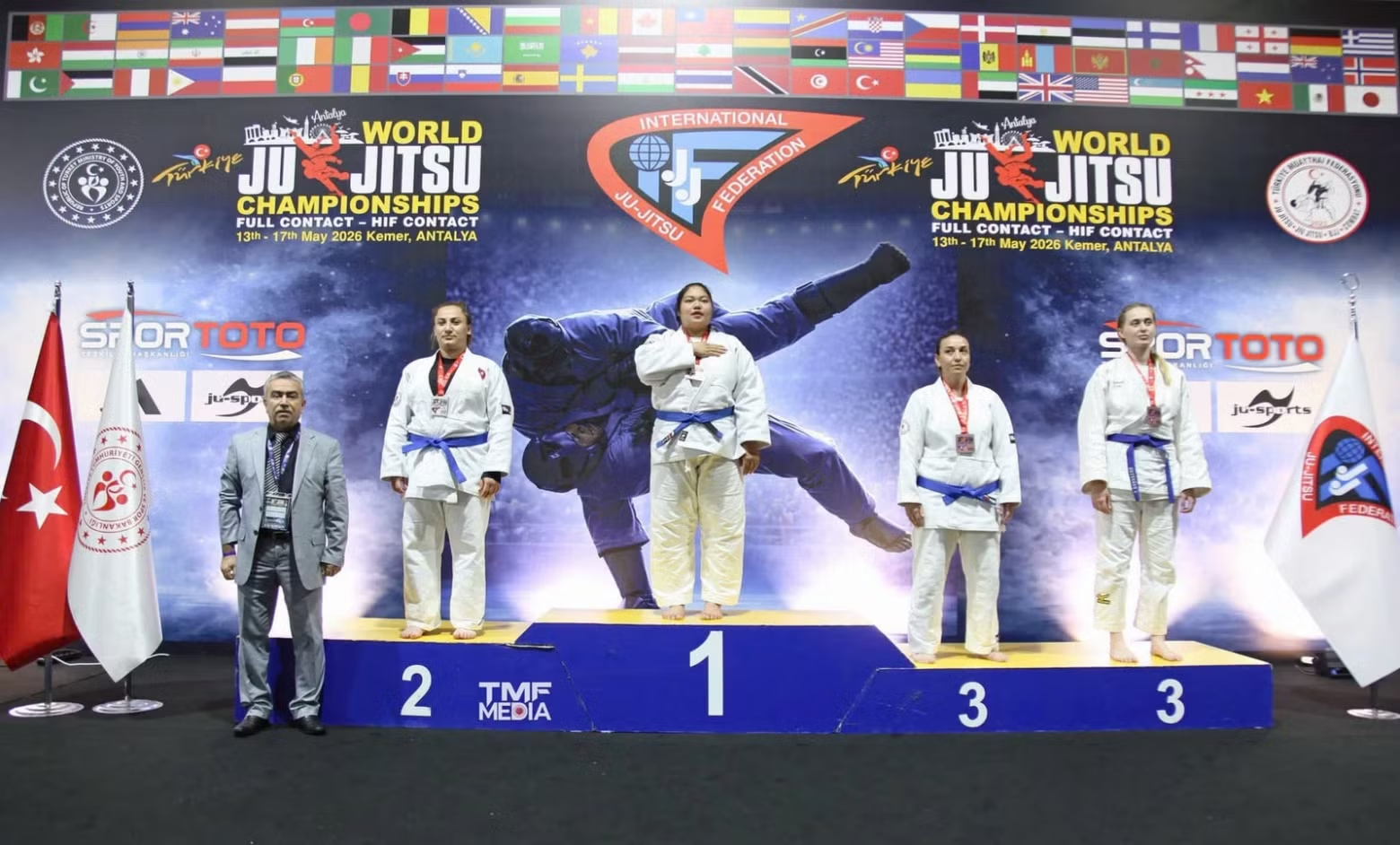
Most recently, at the 2026 World Jujitsu Contact Championships, which took place from May 14–17 in Antalya, Türkiye, the Vietnamese team captured 14 golds, three silvers and two bronzes to take the team title ahead of strong rivals such as Kazakhstan, Turkmenistan and hosts Türkiye.
Names like Nguyen Thi Thanh Truc, Hoang Thi Nhat Que, Phung Thi Hue, Dao Hong Son and Tran Hong An are becoming the new symbols of Viet Nam’s combat sport scene.
Behind this rapid rise lies a systematic organisational build‑up and an ambition to integrate Viet Nam’s jujitsu internationally.
On April 14, 2020, the Ministry of Culture, Sports and Tourism issued a decision recognising the Steering Committee for the establishment of the Viet Nam Jujitsu Federation, chaired by Nguyen Cong Cuong. In less than a year the committee brought together 119 individuals and 20 organisations nationwide to lay the federation’s foundations.
On October 23, 2020, the Ministry of Home Affairs officially authorised the establishment of the Viet Nam Jujitsu Federation, marking an important milestone for the sport.
The Viet Nam Jujitsu Federation has set out goals to develop jujitsu widely from district to provincial levels; to introduce the sport into schools in localities with strong participation; to raise the standard of national competitions; and to invest in key athletes’ training abroad to progressively improve standards.
At the founding congress, President Nguyen Cong Cuong set out goals to develop jujitsu widely from district to provincial levels; to introduce the sport into schools in localities with strong participation; to raise the standard of national competitions; and to invest in key athletes’ training abroad to progressively improve standards. Those directions quickly bore fruit as Viet Nam’s jujitsu repeatedly reaped results at the SEA Games, continental and world levels.
It is noteworthy that Viet Nam’s success in jujitsu has come not only from its management system but also from remarkable individuals. Prominent among them is Nguyen Thi Thanh Truc, 21, who is emerging as one of the most promising talents, repeatedly winning the women’s over‑70kg title.
Hoang Thi Nhat Que, a Nung ethnic athlete from Thai Nguyen Province, has a rare journey from archery to jujitsu and now boasts more than 70 domestic and international medals. Dao Hong Son has affirmed his class with a world title in the under‑56kg division after two SEA Games victories. These faces demonstrate that Viet Nam has a generation of talented, resilient competitors capable of challenging the world’s leading powers.