From this traditional foundation, soft power is undergoing a strong transformation into a vital component of modern national power, contributing to enhancing Viet Nam’s international standing and prestige. In the era of nation’s rise, soft power is not only being promoted but is also directly shaping new “posture” and “strength” for the country, forming a strategic foundation for shaping the development environment and improving national competitiveness. At the same time, the requirement is to effectively create, integrate, and transform soft power into strategic advantages serving sustainable development and firmly protecting the Fatherland in the new context.
Viet Nam’s soft power is not a concept borrowed from modern theories; rather, it is a historical entity forged, tested, and elevated throughout the course of nation-building and defence, reaching its peak during the national liberation struggles of the 20th century. It represents a unique convergence of national values, cultural identity, patriotism, the will for independence, and the righteousness of a nation that refuses to submit to any form of imposition. At decisive moments in history, when material balance tilted heavily in favour of the opponent, soft power became the endogenous force that reversed the situation, transforming disadvantages into strategic advantages.
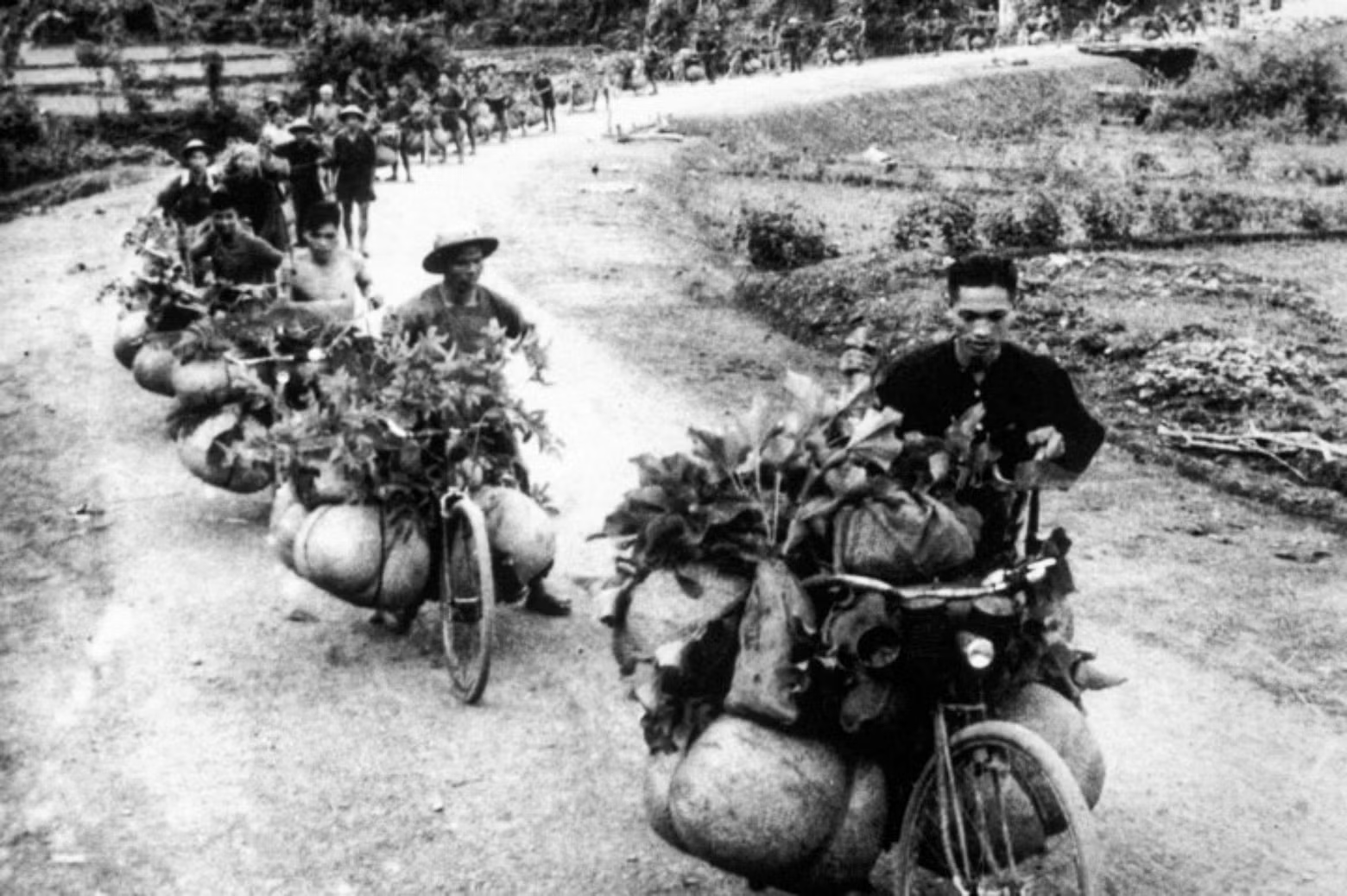
This has been clearly affirmed and demonstrated through historical practice. In the Dien Bien Phu Campaign, victory was determined not only by military art but also by the strength of political will, the spirit of “determined to sacrifice for the survival of the Fatherland”, and the absolute unity between the Party, the Army, and the people. The image of tens of thousands of frontline civilian labourers, roads carved out by sheer determination, and artillery pieces hauled by human strength across mountains and forests was not merely an expression of material power, but a concentrated symbol of Viet Nam’s soft power at its highest level — whereby the people’s will, faith, and righteousness converged into a force capable of breaking all strategic calculations of the adversary.
During the Spring 1975 General Offensive and Uprising, Viet Nam’s soft power reached its peak when it was integrated, coordinated, and transformed into smart power. This was the seamless combination of political will, strategic leadership, the ability to create and seize opportunities, and the widespread confidence in victory across society — crystallised from boundless dedication and sacrifice along with the spirit of selflessness for independence and freedom of the entire nation, while resonating with the support, solidarity, and companionship of progressive, peace-loving forces around the world.
It was precisely the convergence of internal national strength and the external forces of progressive humanity that created a vast field of righteousness, increasing both material and psychological pressure on the opponent. This invisible power not only rapidly disintegrated the opponent’s defence system and accelerated its internal collapse but also enabled decisive military offensives to be carried out with speed, scale, and effectiveness beyond all expectations, bringing the war to a close with a victory of epochal significance.
Beyond historical significance, these victories established a distinctive model of power for Viet Nam, in which soft power is not merely supportive but plays a leading role in shaping, enhancing, and amplifying overall national strength. This serves as a profound theoretical and practical foundation for further developing Viet Nam’s soft power in the new era, when competition no longer takes place solely on visible battlefields but increasingly intensifies in the realms of perception, values, and belief.
In a world moving at an unprecedented pace, where power competition is shifting from physical to cognitive spaces, Viet Nam’s soft power is emerging as a new axis of strength, expanding both in breadth of influence and depth of resilience. Notably, it is not only the country’s development achievements that matter, but also how these achievements are transformed into credibility, trust, and influence in a volatile international environment. A nation that maintains political stability while sustaining economic growth, effectively managing global shocks, and confidently pursuing proactive integration naturally becomes a model of strategic attractiveness.
Viet Nam’s international prestige is no longer a passive outcome but is being actively shaped through its increasingly prominent role in multilateral institutions, as well as through an independent, balanced, flexible, yet principled diplomacy. This presence enables Viet Nam not only to participate in shaping the rules but also to build the image of a responsible, reliable country capable of contributing to solving global issues. At the same time, Vietnamese cultural values and people are spreading with renewed intensity, no longer confined by geographical boundaries but amplified through tourism, education, media, and especially an expanding digital community.
More notably, the emergence of a new power space — digital technology and artificial intelligence — has become an accelerator for soft power. In this space, the ability to tell the national story, shape perceptions, and build trust becomes decisive. Soft power is therefore no longer in a supporting role but is gradually moving to the centre, directly contributing to shaping national position, expanding influence, and creating sustainable strategic advantages in a deeply transforming world order.
The strategic requirement today goes beyond inheriting and promoting accumulated values; it demands a fundamental shift in development thinking, in which soft power must be elevated to become a core pillar of modern national power, directly shaping new “posture” and “strength” in the era of nation’s rise. In the context of a rapidly changing world order, in which strategic competition increasingly revolves around values, culture, trust, and influence, proactively developing and effectively utilising soft power has become both inevitable and urgent.
Viet Nam’s soft power — rooted in history, culture, national values, righteousness, and the capacity to mobilise the entire nation — continues to be strengthened in the context of deep integration and global digital transformation.
The 14th National Party Congress set out a strategic task: “to promote Viet Nam’s soft power to help create new ‘posture’ and ‘strength’ for the country”. This marks an important development in the Party’s theoretical thinking, reflecting a shift from viewing soft power as a supplementary indirect resource to recognising it as a direct component of national competitiveness and position within the international system.
The strategic focus is no longer on the fragmented promotion of existing values, but on elevating soft power to a central component of national power, closely integrated with defence, security, and development, and operating as a strategic driver to create new “posture” and “strength” for Viet Nam’s breakthrough advancement. This represents a pivotal transition — from value accumulation to proactive influence creation and from spontaneous diffusion to strategically designed, organised, and controllable development.
When soft power is restructured at the national level, it not only enhances prestige but also directly expands development space, repositioning Viet Nam within the global power landscape. Through this process, the capacity to shape a favourable international environment gradually takes shape, generating strategic proactiveness, increasing leadership capability, and opening new breakthrough development trajectories in the nation’s era of ascent.
To truly become a strategic driving force for Viet Nam’s breakthrough, the development of soft power must centre on building a comprehensive development content system, in which constituent elements are integrated at the national level with theoretical depth and global outreach capacity. Foremost is the need to define and shape a clear national value system rooted in an advanced Vietnamese culture rich in national identity, combining historical traditions with the quintessence of humanity, serving as the guiding axis for development and influence.
On that basis, it is essential to continue perfecting the socialist-oriented political system, ensuring legitimacy, effectiveness, efficiency, and constructive capacity, thereby strengthening social trust and enhancing international attractiveness; simultaneously developing a smart economy linked with digital transformation, green transition, and deep integration into global value chains, turning development achievements into tangible sources of influence. Science, technology, and innovation must become central drivers in generating new competitive advantages and enabling knowledge diffusion globally.
In parallel, it is necessary to build a modern, flexible, and humane diplomacy, effectively implementing the principle of making more friends and fewer enemies, and proactively contributing to global security mechanisms, thereby affirming Viet Nam’s role as a responsible nation. Notably, developing a defence posture that is peaceful, self-defensive, and righteous is not only a pillar of national protection but also a source of soft power capable of building strategic trust. When all these elements are integrated into a unified system, guided by strategic thinking and operated with modern tools, Viet Nam’s soft power will truly transform into new “posture” and “strength”, opening a breakthrough development trajectory and elevating the country’s position in the new world order.
To elevate Viet Nam’s soft power from potential resource to strategic momentum capable of shaping new “posture” and “strength”, a comprehensive, synchronised, and practical set of solutions is required.
First, it is necessary to refine strategic thinking and national institutions on soft power in a unified and consistent manner from central to local levels, positioning soft power as a central pillar of national power, planned, organised, and operated through clear policy mechanisms capable of cross-sector coordination and mobilising the entire society.
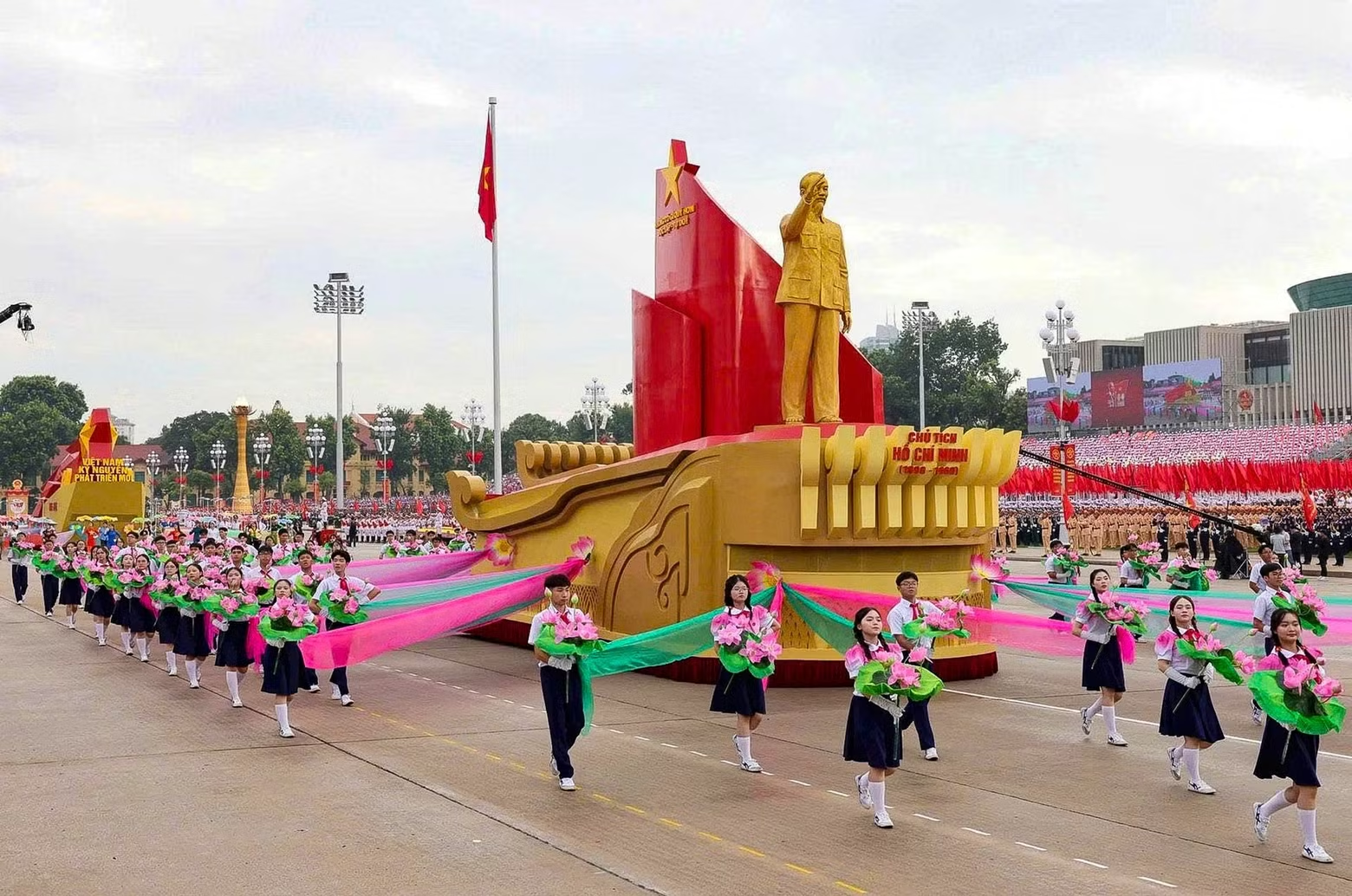
Second, it is essential to create an ecosystem for developing culture, people, and knowledge with a focus on fundamentally reforming education and training, improving human resource quality, and inspiring national development aspirations as a powerful spiritual driver, turning each individual into an agent capable of generating and spreading Vietnamese values.
Third, it is necessary to build national strategic communication capacity, master the digital space, and shift from passive reception to proactive creation and leadership of information, especially through strong application of artificial intelligence and data technologies to shape a consistent, systematical and globally competitive national image.
Fourth, it is important to intensify diplomatic activities, particularly cultural diplomacy and people-to-people diplomacy, and proactively participate in multilateral mechanisms, not only to expand relations but also to transform soft power into tangible influence, building strategic trust and enhancing Viet Nam’s position in the global power structure.
Fifth, it is essential to establish an effective integration mechanism between soft power and defence, security, economy, and science-technology, thereby forming a model of “Vietnamese smart power” capable of high adaptability and competitiveness in the global environment. When these solutions are implemented in a synchronised and strategic manner, Viet Nam’s soft power will not only spread but also transform into real strength, creating strong development momentum and opening a breakthrough trajectory in the new era.
Viet Nam’s soft power — tempered through history and continuously developed and elevated in the new era — is the key to unlocking a breakthrough development trajectory for the nation. When properly positioned, soft power not only spreads values but also directly creates new “posture” and “strength”, transforming potential into real capacity, prestige into power, and identity into global competitive advantage.
National values, culture, people, political-economic-social institutions, science and technology, defence, security, and foreign affairs are integrated into a unified strategic whole, forming a comprehensive foundation of power capable of adaptation and leadership in the new world order. This is also the path for Viet Nam to achieve breakthrough development, affirming its position, resilience, and stature as a strong, self-reliant, confident nation with wide-reaching influence in a new era of development.