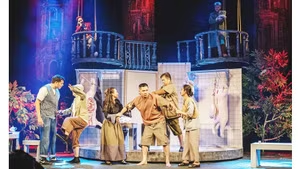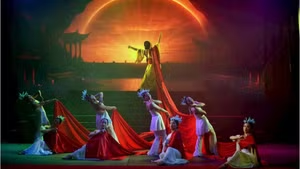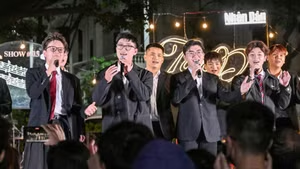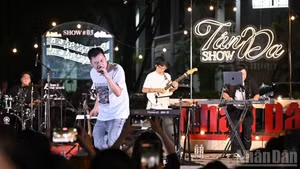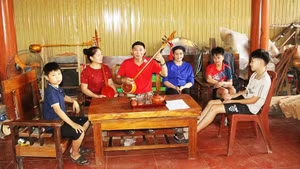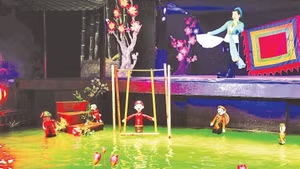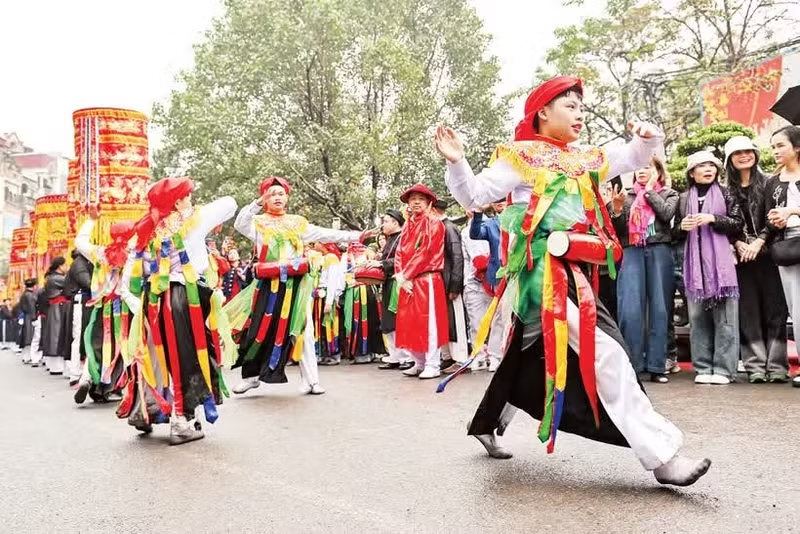
When folk songs, ancient dances, and traditional theatrical performances continue to be preserved and present in community life, it is a clear sign that the cultural flow of the nation is being maintained and enriched.
Reinvigorating traditional arts
Bringing traditional arts into harmony with contemporary life is being actively implemented by many localities through creative models, notably by linking them with festivals, heritage spaces, and community cultural activities.
Within the structure of Vietnamese culture, traditional arts originate from community life and are closely tied to people’s daily activities. From Quan Ho folk songs along the Cau River, Xoan singing at communal houses in the ancestral land, Hue folk chants, Ly melodies of the central region, to Don ca tai tu music and songs in the Southern region, each form is crystallised from a specific cultural environment, reflecting the mindset, lifestyle, and aesthetic values of each region. They contain folk knowledge, moral values, and the memories of generations. Many of Viet Nam’s heritages recognised by UNESCO, such as Ca tru, Xoan singing, and Bai choi art, are vivid evidence of the global value of Vietnamese culture.
However, in modern society, as new forms of entertainment develop strongly alongside the influx of foreign cultural trends, traditional arts face numerous challenges: traditional performance spaces are gradually shrinking, and the number of artisans is ageing and declining, while a portion of young people tends to drift away from traditional values. In this context, the requirement is not only to preserve but also to revitalise traditional arts so that they can continue to exist vividly in modern society.
Cultural heritage, including traditional arts, is not only “memory” but an important internal resource that helps nurture identity and create national soft power.
In recent years, many localities have proactively explored creative models to bring traditional arts back into community spaces. A typical example is in Hoi An Ancient Town (Da Nang City), where Bai choi performances are regularly organised. Under the shimmering lantern light, Bai choi songs resonate, offering visitors a unique cultural experience and helping them better understand the spiritual life of residents in the central region.
Similarly, in Hue City, programmes featuring royal court music, Hue folk singing on the Huong River, and court Tuong performances are held regularly for visitors, thereby creating conditions for the heritage to be practised daily. In Bac Ninh Province, known as the cradle of Quan Ho folk songs, many traditional Quan Ho villages such as Viem Xa, Thi Cau, Dao Xa, and Y Na still maintain Quan Ho singing activities at communal houses, during festivals, and cultural events.
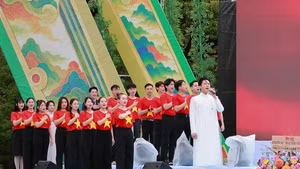
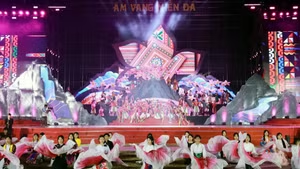
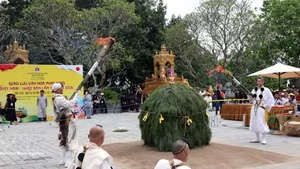
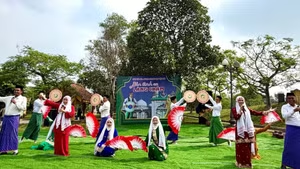
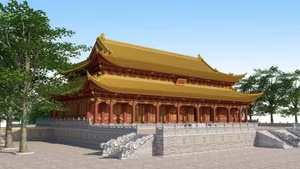
Recently, the programme “Journey to heritage regions”, organised by Bac Ninh Province’s Department of Culture, Sports and Tourism from March 24–30, connected destinations with traditional art experiences, contributing to promoting the local culture in a vivid and effective way. In Ninh Binh Province, the Hoa Lu Festival in 2026, scheduled from April 25 to 27, with various activities exploiting traditional artistic materials, is also a meaningful highlight, helping introduce the people and land of Ninh Binh, rich in identity, to international friends.
In northern mountainous provinces such as Lang Son and Cao Bang, Then singing and Tinh lute performances are being restored and promoted through community tourism. In the Central Highlands, the gong cultural space is regularly maintained in traditional festivals. In the southern region, Don ca tai tu music and songs are gradually regaining their place in people’s cultural life.
According to reports from local tourism sectors, the exploitation and promotion of traditional arts have created distinctive cultural products, providing competitive advantages and contributing significantly to attracting millions of visitors each year. This shows that when placed in the right cultural space, traditional arts can create strong appeal for the public and gain additional motivation and resources for development.
Assoc. Prof. Dr. Dang Van Bai, Vice Chairman of the National Cultural Heritage Council, shared that the preservation of heritage, including traditional arts, needs to be approached in an open spirit, meaning that they are not only preserved in their original state but also given conditions to adapt to modern life, becoming an organic part of contemporary society and directly contributing to socio-economic development.
Sharing the same view, Prof. Dr. Bui Quang Thanh, former Deputy Director of the Viet Nam National Institute of Culture and Arts, analysed that heritage must be practised vividly within the community and in the cultural life of the community itself.
The preservation of heritage, including traditional arts, needs to be approached in an open spirit, meaning that they are not only preserved in their original state but also given conditions to adapt to modern life, becoming an organic part of contemporary society and directly contributing to socio-economic development.
Assoc. Prof. Dr. Dang Van Bai
Vice Chairman of the National Cultural Heritage Council
However, the process of integrating traditional arts into contemporary life has revealed certain shortcomings. In some places, there have been signs of oversimplification, excessive stage adaptation, or commercialisation of heritage. Traditional arts are turned into “performance items” used for illustration, creating excitement, or serving tourism, but lacking cultural depth, thereby diminishing their original value.
In addition, the issue of a successor workforce remains a major challenge. Many forms of traditional arts require long and rigorous training, as well as passion and dedication, while income and working conditions are not attractive enough for young people. Without appropriate incentive policies and training mechanisms, the risk of disruption in transmission is inevitable.
In response to this reality, experts recommend implementing a range of synchronised solutions. First, it is necessary to continue improving mechanisms and policies for traditional arts, while creating environments for heritage practice through maintaining festivals, community cultural activities, and developing creative spaces.
At the same time, traditional arts should be introduced into schools in an appropriate manner, helping younger generations access and develop a love for heritage from an early age. Dr. Tran Thi Minh Thu from the Viet Nam Institute of Culture, Arts, Sports, and Tourism (VICAST) said that if future generations are not given access and the opportunity to experience the value of national arts from a young age, then no matter how much effort is made in preservation, traditional arts will gradually lose their place in society.
From a macro perspective, promoting international cooperation is also considered a necessary direction. Assoc. Prof. Dr. Bui Hoai Son, a National Assembly deputy, pointed out that international cooperation not only helps promote traditional arts but also facilitates the exchange of knowledge and preservation experience among countries, contributing to affirming the position of Vietnamese culture on the global map and raising public awareness of heritage values.
From a development perspective, revitalising and spreading traditional arts in daily life is not only about cultural preservation but also a strategy for building national soft power. A culture rich in identity, nurtured and promoted in modern life, will create a solid foundation for sustainable development.