Over the past seven decades, there is no doubt that sport in Vietnam has seen big steps forward and recorded certain success. Despite such encouraging achievements, many shortcomings and limitations persist in Vietnamese sport, and new breakthroughs are required to renovate and boost the national sport and physical training development.
On top of the region, but not strong enough
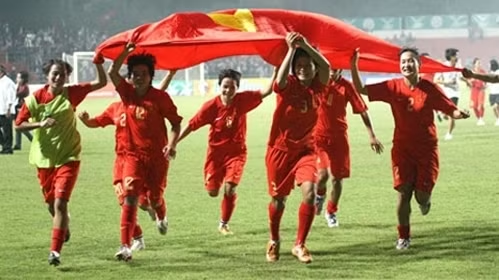
Looking back at the stages of the nation’s athletic development, Vietnam was once a strong sporting nation – not only at the regional level but also in the continental arena. Vietnam was one of the founders of the Southeast Asian Peninsula Games Federation and it has achieved consistent success at the region’s biggest sporting event, the Southeast Asian (SEA) Games. The names of many Vietnamese athletes have gone down in the nation’s sporting history for their sparkling achievements on the regional, continental and world stages.
The positive transformation of Vietnamese sport has kept pace with the country’s development during nearly three decades of doi moi (renewal). Within Southeast Asia, the Vietnam team has risen from a seventh-position finish among the nine participating countries at the 15th SEA Games (1989), to the top spot at the 22nd SEA Games 14 years later. Since, Vietnam has always finished in the top three medal-winners. Now, Vietnam is on its way to reaching success at the continental and world level in terms of high-performance sports such as athletics and swimming. Talented swimmers like Nguyen Thi Anh Vien and Hoang Quy Phuoc have broken onto the regional swimming scene, rounding up a glut of gold medals at the 26th and 27th SEA Games. At the Asian Games (ASIAD), Vietnam has come a long way from the lone bronze medal in shooting won during its first two ASIADs in New Delhi (1982) and Beijing (1990). The Vietnam sport contingent has continuously brought home precious gold medals in taekwondo, karate, gymnastics, billiards and snooker in subsequent competitions, with its best overall finish of 15th out of 45 participating countries at the 2002 Busan ASIAD. The Olympics have also witnessed Vietnam’s growing strength, with one silver medal won by taekwondo artist Tran Hieu Ngan at the 2000 Sydney Olympics and another won by weightlifter Hoang Anh Tuan at the 2008 Beijing Olympics. This remarkable progress is a fitting reward for the unceasing efforts made by the sport sector.
However, many challenges lie in wait for the sport and physical training sector, particularly now that regional and international sports have developed so drastically. While other countries in the region have increased their investment, determined to seek international medals, Vietnam is standing still, suffering from the so-called ‘achievement disease’ at the ‘local festival’ and has yet to find the way forwards on the continental and world-class levels. In the past, Vietnamese sport lacked the planning and effective strategies necessary to ensure long-term and sustainable development. Ineffective investment made it impossible for the country to improve its sporting achievements at the ASIAD and the Olympics. Since the two silver medals won by Hieu Ngan and Anh Tuan, Vietnam has not tasted Olympic success, even at the 2012 London Olympic Games, which received the largest-ever Vietnamese contingent (18 athletes).
Reaching the upper echelons of world sport requires the drastic renovation of the sport and physical training sector. As the selected host of the 18th ASIAD in 2019, Vietnam plans to organise the Games for the controversial amount of US$150 million and hopes to win 10-15 gold medals and finish between 6th and 10th among the participating countries. This objective is considered unreachable by many sport experts. In the nation’s sporting history, Vietnam has never won more than four gold medals at a single ASIAD edition. The number of gold medals has even exhibited a downward trend – from four at the 2002 Busan ASIAD to three at the 2006 Doha ASIAD and just one at the 2010 Guangzhou ASIAD. The lofty goal for 2019 will only come true if the sport sector takes drastic measures to renovate and improve the quality of athlete training in the next five years. Easier said than done.
Specific development strategies needed
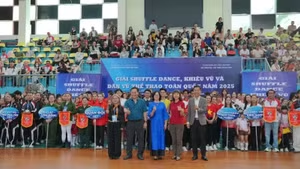
The five-year period is too short for Vietnam to train a team of qualified athletes who could make the country’s dream of 10-15 gold medals come true. Therefore, the best way for the sport sector to do this may be to invest in young athletes, with 50 key athletes and a group of others capable of claiming ASIAD medals despite the high cost of training and a question mark about its efficiency. It is high time for Vietnamese sport to thoroughly consider a sustainable development strategy. Improving people’s physical fitness must be given the top priority at present, in a move toward a healthy and professional sporting infrastructure. The government has approved the National Sports and Physical Training Development Strategy until 2020, with a vision to 2030, which is intended to accelerate the development of mass sports to serve high-performance sports. Accordingly, mass sports will attract the participation of 28% of the total population by 2015 and 33% by 2020.
Vietnam also needs to learn from other countries in the region and across the continent that have transformed into strong sporting nations despite their low starting points. Japan is a typical example of one such spectacular transformation. Japan’s sport development policies are attached to the objective of ‘sports for everyone’, connecting high-performance and amateur sports to popularise sports in the community and discover which sports are worth investing in. In addition to Japan, other Asian countries like China, Thailand, Singapore and Malaysia have also recorded amazing sport breakthroughs by bringing into full play the development strategy of ‘sports for all’.
In order to address the shortcomings in management and investment, the National Sport Development Strategy until 2020 has indicated ten key sports that need to be prioritised: track and field, swimming, weightlifting, taekwondo, lightweight wrestling, shooting, karate, women’s boxing, badminton and table tennis. It also indicated 22 others of second priority: football, volleyball, judo, wushu, sepak takraw, fencing, gymnastics, pencak silat, archery, cycling, bodybuilding, rowing, billiards & snooker and vovinam. This is a reasonable step towards realising the sport sector’s development goal – focusing investment on high-performance sports of ‘real value’ at continental and world arenas.
Following its transformation, we are all looking forward to a bright future for Vietnamese sport despite the many challenges waiting ahead. These difficulties and obstacles are not small but they can be conquered.