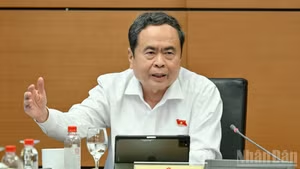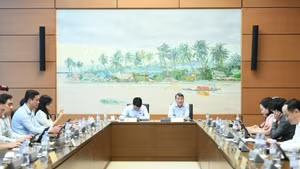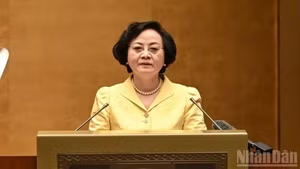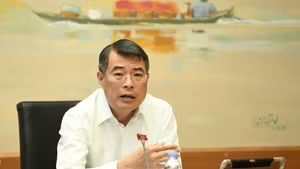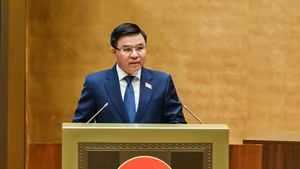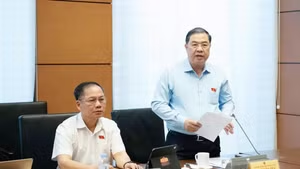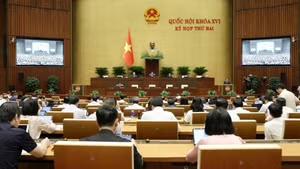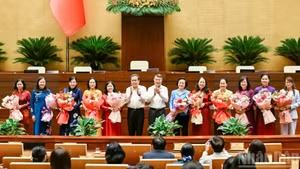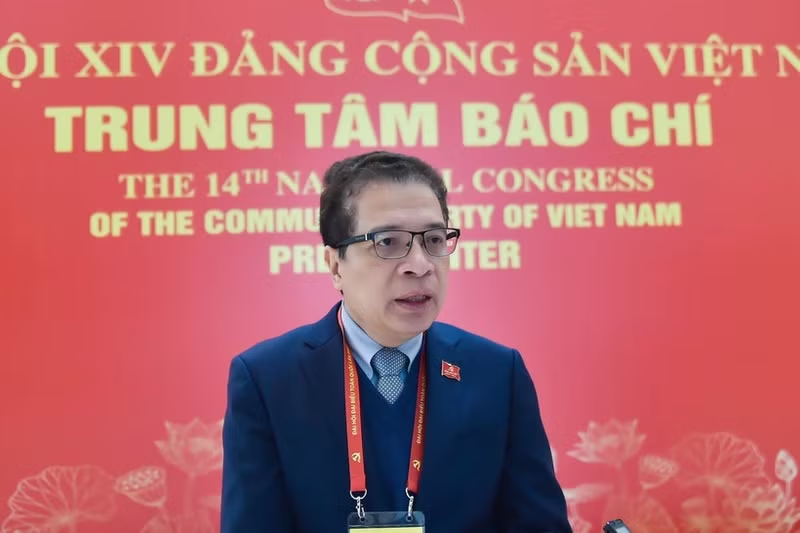
Speaking to the Viet Nam News Agency (VNA) on the sidelines of the Congress, Ambassador Dang Minh Khoi, a delegate from the Party organisation of the Ministry of Foreign Affairs, underlined that since the establishment of the country, the Party and State have always attached great importance to foreign affairs, which have been given a worthy position.
Over the past eight decades, particularly in recent years, diplomacy has made significant contributions to national development.
He recalled that in the early years of nation-building, President Ho Chi Minh himself served as the first Minister of Foreign Affairs, at a time when Viet Nam faced immense difficulties. Under his leadership, diplomacy helped secure critical achievements so that the country managed to surmount every difficulty. It supported the signing of important agreements, including the 1954 Geneva Accords and the 1973 Paris Peace Accords, and later played a vital role in breaking embargoes to pave the way for national development.
Khoi added that over 40 years of Doi moi (Renewal), diplomacy has joined other sectors to help promote national development. In the current context, an extremely crucial task for foreign affairs is to ensure a peaceful and stable environment for national development.
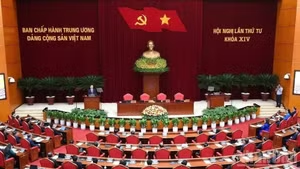
The draft documents of the 14th National Party Congress and the Political Report presented by Party General Secretary To Lam clearly identify foreign affairs and international integration as a "key and regular" task, on a par with national defence and security safeguarding.
This designation, he said, not only reflects the Party’s confidence in diplomacy but also places heavier responsibilities on the foreign service.
One of the foremost requirements is building a contingent of diplomatic personnel capable of meeting the demands of the new situation.
Another critical task is to accurately assess and forecast international and regional developments in order to provide timely and sound advice for the Politburo and the Party Central Committee. In a world marked by mounting uncertainties and fast-evolving challenges, this is a major test for Viet Nam’s diplomacy, requiring both sharp analysis and flexible responses to ensure the country’s development trajectory remains on course.
The ambassador also emphasised that in order to achieve fast development in the coming period, including double-digit growth, foreign affairs must play a proactive role in mobilising external resources while internal strength remains the decisive factor.
The Political Report presented at the Congress has made it clear that the ultimate goal of development is the happiness and well-being of the people. To that end, economic growth must go hand in hand with breakthroughs in science and technology. This places diplomacy at the forefront of engaging with new and fast-changing fields, making its mission both demanding and highly significant.
Strengthening relations with neighbouring countries, major powers and traditional partners also remains a core duty. According to Khoi, the most important for foreign foreign affairs is to build trust and enhance substantive cooperation with partners. In the current global context, high-ranking leaders play a critically important role in diplomacy. That requires the Ministry of Foreign Affairs further enhance its advisory role in promoting Viet Nam’s relations with all partners.
He further highlighted that while “diplomacy for development” has been stressed at multiple Party congresses, the 14th Congress places stronger emphasis on science and technology as a new driving force for faster and more robust development. This, he said, demonstrates the Party and State’s higher level of trust in the diplomatic sector, coupled with greater expectations for results.
Heavy responsibilities are also placed on Vietnamese ambassadors and heads of representative missions abroad. Operating on the frontlines, they are expected to closely monitor host countries' developments, provide timely policy recommendations, and actively promote external relations. At the same time, caring for the overseas Vietnamese community is also a crucial task of embassies and diplomatic missions, contributing directly to the overarching goal of ensuring people’s well-being.
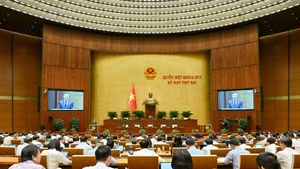
Commenting on the thematic presentation “Proactively and actively implementing the key and regular task of strengthening external relations and international integration to serve the country's strategic goals" delivered by Deputy Foreign Minister Nguyen Manh Cuong at the Congress, Khoi said it reflected the collective resolve of the entire diplomatic sector to fulfil its tasks.
He expressed confidence that following the Congress, the foreign service will swiftly translate the Congress's resolutions into concrete action, thereby better meeting expectations and realising its commitments to the Party.
The ambassador also underscored the significance of the Politburo’s Resolution No. 59 on international integration in the new context, describing it as a significant document that synthesises past policies while reflecting new assessments of the current situation.
After more than four decades of Doi moi, Viet Nam now enjoys growing prestige, credibility and a network of partners eager to deepen cooperation. The resolution, he stressed, demonstrates the Party and State’s accurate judgement of the evolving situation and provides appropriate policy orientations for the new stage of development.