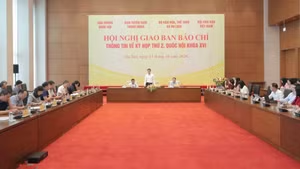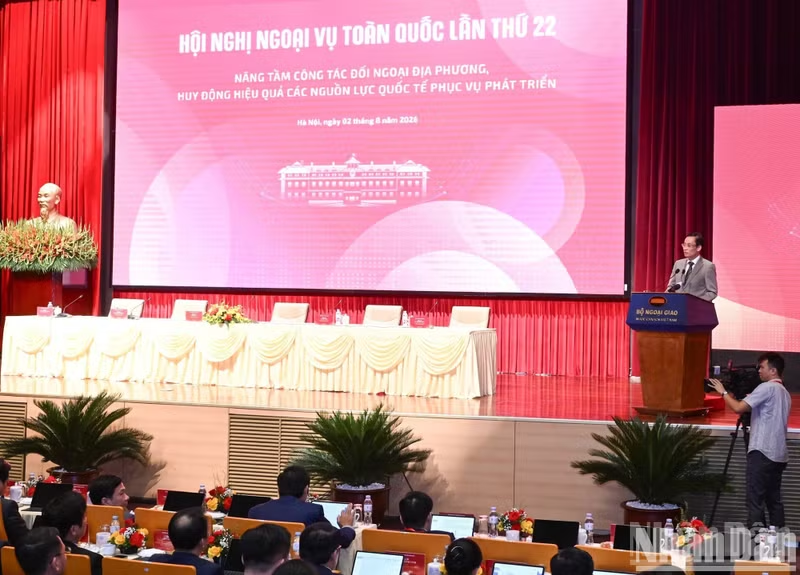
The 22nd national conference on foreign affairs was held in Ha Noi on August 2 within the framework of the 33rd Diplomatic Conference.
The conference brought together more than 500 delegates, including representatives from ministries, central agencies, sectors, localities, local external affairs agencies, Vietnamese representative missions abroad, and leaders of the Ministry of Foreign Affairs.
Addressing the conference, Minister of Foreign Affairs Le Hoai Trung emphasised the role of local foreign affairs in realising the nation’s development goal, affirming that the national target of achieving 10% growth is a substantive requirement, with local foreign affairs playing an important role in realising this goal.
According to him, in practice, no country, locality, organisation, or enterprise has achieved successful development without engaging in international integration through appropriate forms.
He noted that in the context of profound global changes, intensified strategic competition, and rapid advances in science and technology, foreign affairs must continue to innovate, proactively adapt, and closely accompany the country’s development process.
The Minister stressed that foreign affairs and international integration are the responsibility of the entire political system, not only the diplomatic sector.
He highlighted four criteria for evaluating the effectiveness of local foreign affairs: delivering concrete outcomes, creating practical value, ensuring implementation progress, and earning public trust.
Based on these criteria, Minister Trung outlined four key orientations for local foreign affairs in the coming period: improving strategic planning and integrating foreign affairs into local development strategies; strengthening development-oriented diplomacy to transform international partnerships into tangible resources; enhancing management and coordination mechanisms among localities, ministries, sectors, and representative missions abroad; and building capable external affairs agencies and personnel to meet new requirements.
He also called on Vietnamese representative missions abroad to further support localities in expanding cooperation and mobilising international resources, while encouraging local authorities to promptly share challenges and proposals with the Ministry of Foreign Affairs for coordinated solutions.
Presenting the central report, Deputy Minister of Foreign Affairs Ngo Le Van said local foreign affairs have undergone important changes, shifting from expanding partnerships to improving effectiveness, and from seeking external support toward proactively identifying needs and mobilising international resources.
Localities have contributed to implementing the Party’s foreign policy through the three pillars of Party diplomacy, State diplomacy, and people-to-people diplomacy. They have signed, renewed, and maintained 900 international agreements, organised more than 2,500 international conferences and seminars, and attracted thousands of international cooperation opportunities.
External affairs have supported local economic development, investment promotion, market expansion, participation in global value chains, foreign non-governmental assistance mobilisation, cultural promotion, digital transformation cooperation, and human resource development.
During 2024–2026, the Ministry of Foreign Affairs and Vietnamese representative missions abroad coordinated closely with localities, organising hundreds of working sessions, international connection events, and training programmes. More than 420 cooperation agreements with international partners were supported.
However, Deputy FM Van pointed out challenges facing local external work, including uneven awareness of their role in development strategies, limited institutional capacity, human resource constraints, difficulties in digital transformation, and the need for strong coordination mechanisms.
At thematic sessions of the conference, delegates discussed measures to enhance economic diplomacy, cultural diplomacy, international cooperation, and the capacity of local external affairs agencies.
Participants agreed that local external affairs must shift from expanding networks in terms of quantity toward creating practical value, with concrete results serving as the key measure of effectiveness.
Representatives from localities shared experiences in attracting high-quality investment, promoting exports, leveraging cultural heritage for development, and improving mechanisms to implement international commitments.
At the closing session, leaders of the Ministry of Foreign Affairs presented Certificates of Merit and insignia for the Cause of Vietnamese Diplomacy to collectives and individuals with outstanding contributions to local external work.