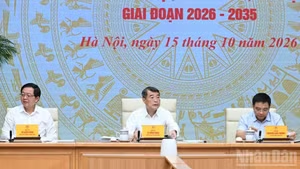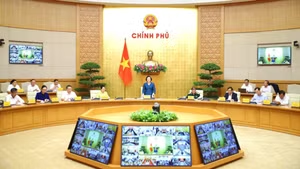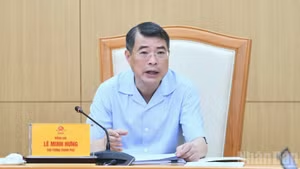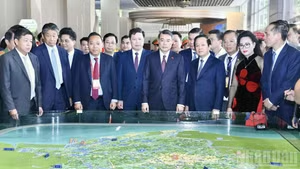
The meeting was also attended by Politburo members: Prime Minister Le Minh Hung, National Assembly Chairman Tran Thanh Man, and Permanent member of the Party Central Committee’s Secretariat Tran Cam Tu, among others.
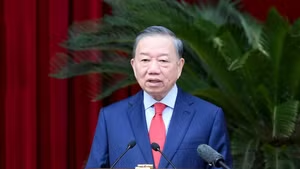
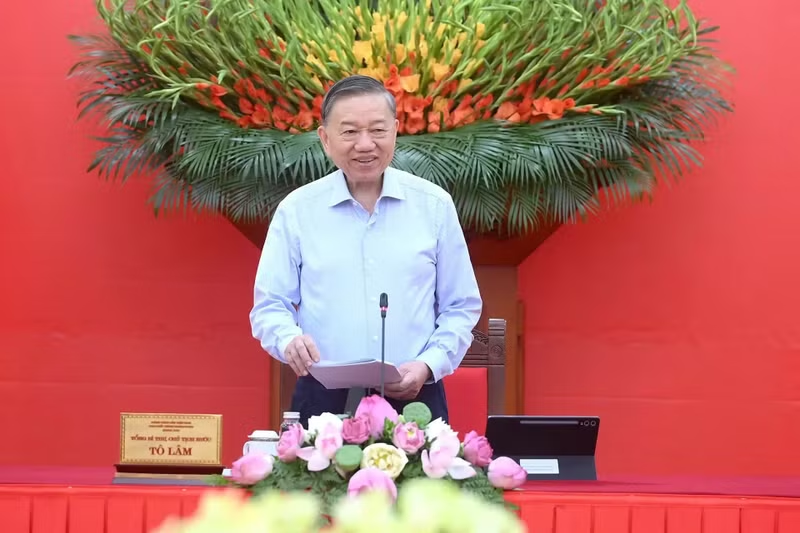
Addressing the meeting, General Secretary and President Lam assessed that foreign affairs and international integration efforts since the 14th National Party Congress have achieved important and substantive results. However, he noted that significant tasks remain ahead amid a rapidly changing and increasingly complex international environment.
He underscored that Viet Nam’s development goals for 2030, with a vision to 2045, require foreign affairs and international integration to become more proactive, with stronger forecasting capacity, timely and accurate policy advice, and swift action.
Describing the meeting as the launch of a new coordination mechanism for these works across the entire political system, the top leader called for discussions on the committee’s functions, responsibilities, working regulations, coordination mechanisms, the 2026 work programme and priority tasks in both the immediate and long terms.
Prime Minister Hung, who is also the steering committee’s standing deputy head, said the Government Party Committee has promptly developed and carried out action programmes to implement key Party resolutions and policies in foreign affairs and international integration.
According to the Prime Minister, the Party’s orientations are already clear, and the key challenge now is effective implementation. He stressed that the committee bears substantial responsibilities, with the Ministry of Foreign Affairs, as its standing body, playing a central coordinating role.

Highlighting the importance of diplomacy in supporting development and achieving double-digit economic growth, the Government leader said the committee’s work programme should prioritise maintaining traditional markets, expanding into new ones, attracting high-quality foreign investment, ensuring energy security and strengthening Viet Nam’s strategic autonomy. He called on Vietnamese representative missions abroad and ambassadors to take a more proactive role in delivering tangible outcomes that support the country’s development goals.
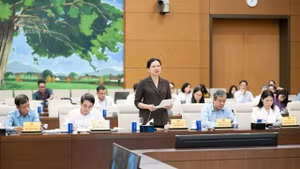
NA Chairman Man, who is also deputy head of the steering committee, stressed the need to complete and promulgate legal frameworks governing the three pillars of Viet Nam’s external relations – Party diplomacy, State diplomacy and people-to-people diplomacy – during the 2026–2030 period. He also called for stronger oversight of the implementation of international treaties and agreements and for continued legal reforms to align domestic regulations with international commitments, particularly those under new-generation free trade agreements.
Meanwhile, Permanent member of the Secretariat Tu, who is also the steering committee’s deputy head, highlighted the importance of enhancing the effectiveness of foreign affairs and international integration in expanding Viet Nam’s development space. He emphasised the strategic role of Party diplomacy in strengthening political trust and providing long-term orientation for bilateral and multilateral relations, while urging more concrete results in relations with ruling parties around the world.
At the meeting, Politburo member and Minister of Foreign Affairs Le Hoai Trung presented draft foundational documents for the committee’s operations and outlined the ministry’s responsibilities as the standing body. He noted that international integration has become an increasingly important driver of development, contributing to Viet Nam’s macroeconomic stability, growth, competitiveness and global standing.
General Secretary and President Lam said the committee should serve as a strategic leadership and coordination mechanism capable of addressing major, emerging and cross-sectoral issues that exceed the authority of any single agency.
He assigned the Ministry of Foreign Affairs to finalise the committee’s operational documents based on feedback from participants, ensuring clear authority, procedures, focal points, responsibilities and monitoring mechanisms in line with the principle of “six clarities”: clear persons, tasks, timelines, responsibilities, outputs and authority.
For the second half of 2026, he instructed relevant agencies to complete the committee’s foundational documents, conduct a comprehensive review of the implementation of major international commitments and agreements, organise a one-year review of the implementation of the Politburo’s Resolution No. 59-NQ/TW on international integration in the new context, and begin preparations for a new comprehensive foreign affairs strategy at a higher level.