Over the past years, the Party and State have consistently advocated building a modern, transparent and fair tax system, creating a favourable environment for businesses and promoting sustainable economic growth. However, the implementation of new policies always has a certain delay, requiring management agencies to listen in a timely manner to feedback from the grassroots and proactively adjust to align with the actual situation. Law on Value Added Tax No. 48/2024/QH15, passed by the National Assembly on November 26, 2024 and taking effect from July 1, 2025, is an important document in perfecting tax policies, but during the implementation preparation process, many shortcomings have been clearly revealed, especially in the fields of agriculture, animal feed exports, and tax refund conditions.
Major shortcomings from agricultural product production and export
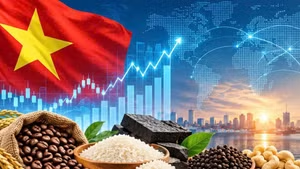
According to the provisions of Law on Value Added Tax No. 48/2024/QH15, enterprises must pay 5% input value-added tax on agricultural products traded through commercial stages, and then receive a tax refund when exporting. The value-added tax (VAT) that is collected and then refunded for products whose majority of output is intended for export (such as catfish, pepper, coffee, etc.) results in wasted time and capital being tied up for enterprises, while credit institutions do not disburse this tax amount when providing working capital loans, creating financial pressure and reducing business efficiency, especially in the context of the economy being heavily affected by natural disasters, particularly storms and floods in many major production areas. Rotating thousands of billions of VND in VAT while waiting for refunds prevents enterprises from being proactive in securing capital needed for purchasing, processing, and exporting.
Industry associations have clearly reported this situation. According to estimated data from some sectors in the agricultural field, in the last six months of 2025 alone, the 5% VAT that coffee enterprises must temporarily pay is estimated at about 5,000 billion VND; the food sector at about 2.016 billion VND; and the pepper and spice sector at about 2.162 billion VND. These are all key export sectors with large inventories and a strong need for rapid capital turnover.
In addition, the current regulations also create inequality between domestic goods and imported goods. Imported agricultural and aquatic products are not subject to VAT when entering Viet Nam, while domestic goods must bear tax at the commercial stage. This increases the costs of domestic enterprises, gives an advantage to imported goods, negatively affecting domestic agricultural production, which is already heavily impacted by natural disasters.
Another issue that is no less serious is the tax policy applied to animal feed. Animal feed is not subject to tax, so it is not eligible for deduction or refund of input VAT, leading to increased costs for animal feed manufacturers and higher selling prices, which in turn affects livestock farmers. In addition, this regulation does not ensure fairness and may reduce competitiveness compared with imported animal feed products, since imported animal feed is not subject to VAT, causing considerable disadvantages for domestic enterprises.
Another major difficulty reported by enterprises is that the conditions for VAT refunds require buyers to receive refunds only when the sellers have declared and paid tax. In practice, enterprises exporting goods are entitled to input VAT refunds, but the refund process is delayed because they must wait for confirmation that the sellers have declared and paid tax, creating difficulties and risks for the enterprises requesting VAT refunds. This is because the enterprises requesting VAT refunds have no legal or technical tools to check the tax compliance status of the sellers at the time of preparing the tax refund dossiers. This regulation has also been reported by several organisations and individuals as inconsistent with the responsibility obligations of each party, since buyers and sellers are different entities with separate and independent responsibilities.
Delays in processing tax refund dossiers lead to many consequences: cash flow is blocked, business plans are disrupted, and enterprises face difficulties in fulfilling export contracts. In the context of agricultural exports needing strong support from the state to maintain growth and expand markets, continuing to maintain this regulation may cause many enterprises to lose their competitive opportunities.
Amending the law under a shortened procedure with three key groups of revisions
In response to the difficulties mentioned above, and based on careful consideration of the feedback and recommendations from associations, enterprises, and the Ministry of Agriculture and Environment, together with the severe impact of storms and floods on agricultural production in many regions, the Ministry of Finance has determined that it is necessary to amend and supplement several provisions of the Law on Value Added Tax No. 48/2024/QH15 to help address the consequences and ensure stable production and business activities.
Clause 2, Article 26 of the Law on Promulgation of Legal Documents allows a draft law to be submitted at an ongoing session of the National Assembly if the issue arising from practice is urgent. The application of the shortened procedure in this case reflects the flexibility and timeliness of the government in addressing policy issues that directly affect socio-economic life.
On November 26, 2025, the Minister of Finance, authorised by the Prime Minister, signed Submission No. 1090/TTr-CP to the National Assembly and the National Assembly Standing Committee, requesting consideration and approval of the Draft Law amending and supplementing several articles of the Law on Value Added Tax. The amendment aims to ensure dual goals: removing difficulties for enterprises and ensuring compatibility and consistency among existing legal documents.
This draft law focuses on three key areas: First, reinstating the provision that products from cultivated crops, planted forests, livestock, farmed or caught aquatic products that have not been processed into other products or only undergone simple preliminary processing, when traded through commercial stages, shall not be subject to declaration and tax payment but shall be eligible for input VAT deduction.
With this provision, enterprises will not have to pay the 5% input VAT on agricultural products traded at the commercial stage, addressing the situation in which VAT is collected and then refunded for products whose majority of output is intended for export, such as catfish, pepper, and coffee, which are key export strengths of Viet Nam. This will help reduce financial pressure and enhance business efficiency for enterprises.
Second, the VAT policy will be adjusted for products from cultivated crops, planted forests, livestock, and farmed or caught aquatic products that have not been processed into other products or have only undergone simple preliminary processing and are used as animal feed, ensuring compliance with the law on animal feed. With this amendment, animal feed production and business establishments will not have to pay the above-mentioned 5% VAT, helping enterprises reduce production costs and in turn increase competitiveness against imported animal feed products.
Third, the condition requiring buyers to receive tax refunds only when sellers have declared and paid tax will be removed. Eliminating this provision will help shorten tax refund times, allowing tax refunds for exporting establishments to be carried out according to regulations without the need to wait for confirmation that the sellers have declared and paid tax.
The Draft Law amending and supplementing several articles of the Law on Value Added Tax is a strategic step that reflects the government’s determination to improve tax policy in a way that supports enterprises, ensures fairness between domestic and imported goods, and creates conditions for agricultural production to recover after natural disasters. This amendment also demonstrates the proactive spirit of the management agencies in grasping practical realities and promptly adjusting policies to meet the needs of the economy in a period of significant fluctuations.