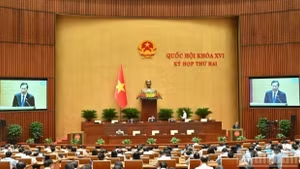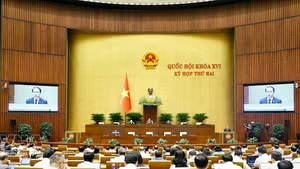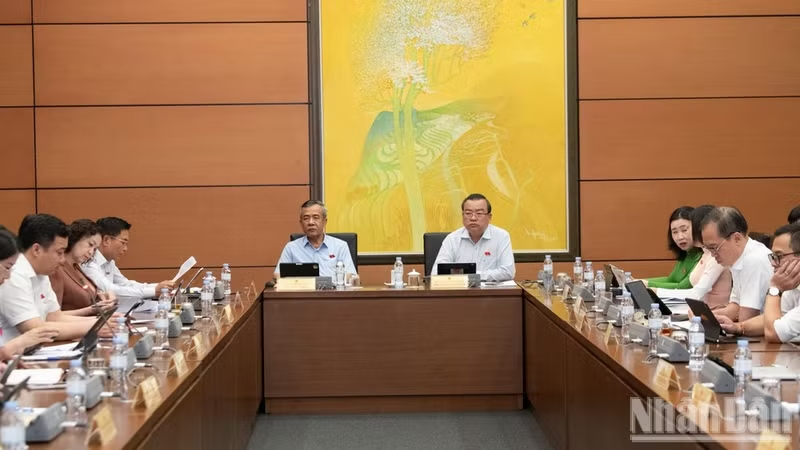
The National Assembly is scheduled to discuss reports on three draft laws – the revised Penal Code, the revised Criminal Procedure Code, and the revised Law on Organisation of Criminal Investigation Agencies on August 20 as part of its first extraordinary sitting.
The amendments to the Penal Code focus on four major areas - revising and supplementing provisions on offences and penalties; revising provisions on grounds for exclusion, postponement and exemption from criminal liability and the statute of limitations for criminal prosecution; and ensuring consistency, feasibility and sound legislative drafting.
A key proposal is to narrow the scope of application of the death penalty for six offences. The current Penal Code prescribes the death penalty as the highest punishment for 10 offences. The Government proposes abolishing the death penalty for six, namely rebellion; rape of persons under 16; illegal drug trafficking; crimes against humanity; war crimes; and terrorism aimed at opposing the people's administration, which is expected to be incorporated into the offence of terrorism.
The death penalty will remain applicable to treason, murder, terrorism and illegal drug production. The move is intended to institutionalise the Party's policy, align Viet Nam's legislation with progressive international trends, and enhance the country's position in international judicial cooperation, extradition and mutual legal assistance in criminal matters.
The draft also broadly doubles fines and monetary thresholds used to determine offences and sentencing brackets, taking into account changes in prices, wages, incomes, per-capita GDP and socio-economic conditions.
Notably, it expands grounds for exclusion of criminal liability in research, testing and application of new technologies, as well as controlled testing of new technologies, processes, solutions, products, services and business models in technology development and innovation. Similar provisions would apply to defence and security missions and crime prevention and control by the armed forces.
The draft further introduces provisions allowing the postponement of criminal prosecution to give offenders time to remedy consequences under specified conditions. Accordingly, exemption from criminal liability could apply where a person whose prosecution has been postponed has fully remedied the consequences and generated economic, social, defence or security benefits. During the processing of crime reports and denunciations, criminal liability could also be waived where grounds for exemption exist, helping avoid unnecessary procedural steps while ensuring a humane and humanitarian criminal justice policy.
Nine new offences are also proposed, focusing on areas, including economic management, cybersecurity, high technology, the environment, public safety and the proliferation of weapons of mass destruction. The draft also adds new objective acts to existing offences, particularly those involving information technology, telecommunications networks, economy, trade and intellectual property.
These provisions are aimed at closing loopholes in criminal laws and preventing crimes from going unpunished, while meeting the requirements of international integration and strengthening crime prevention and combat in the new context.
During the morning sitting, the National Assembly also debated in plenary the National Target Programme on cultural and socio-economic development, rural development, and ethnic minority and mountainous areas for 2026-2035, which will integrate four existing national target programmes into a single programme.