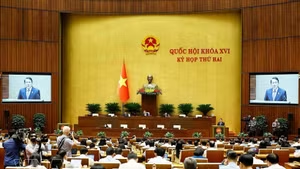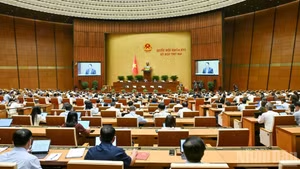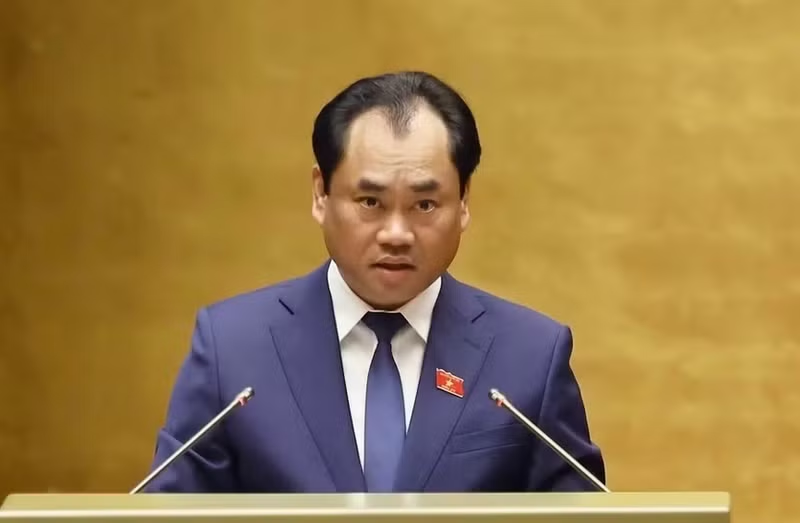
The 16th National Assembly continued the second phase of its first extraordinary session on August 19, hearing reports on the policy orientations for amending the 2024 Land Law.
Authorised by the Prime Minister, Minister of Agriculture and Environment Trinh Viet Hung presented the Government’s proposals on the amendments.
After nearly two years of implementation, the 2024 Land Law and its guiding documents have brought significant improvements to State management on land. However, practical implementation has exposed shortcomings, particularly inconsistencies with the two-tier local administration model and newly amended laws. The Government therefore considers the amendment urgent to institutionalise new Party guidelines, remove institutional bottlenecks and unlock land resources for socio-economic development.
The Government has identified three major objectives: promptly institutionalising Party policies on land, private-sector development and national digital transformation; addressing urgent practical obstacles to unlock resources and support the goal of double-digit economic growth; and building a modern, streamlined and effective land management system through stronger decentralisation and administrative reform.
It has also approved seven major policy groups, covering land-use planning; land allocation, leasing, auctions and project bidding; land recovery, compensation and resettlement; land-related finance and pricing; land users’ rights and obligations and land consolidation; administrative reform, digital transformation and decentralisation; and stronger inspection, supervision and measures against land abandonment, pollution and degradation.
The draft law also incorporates three key areas: institutionalising the Party’s guidelines under Resolution No. 21-NQ/TW; codifying pilot and special mechanisms adopted by the National Assembly and Government; and revising land management powers and responsibilities to suit the two-tier local administration model, with greater authority delegated to grassroots administrations.
The NA’s Committee for Economic and Financial Affairs strongly agreed on the necessity and urgency of the amendments, targeting its entry into force on March 1, 2027. The committee called for continued improvements to both the draft law and policy framework before they are submitted to the National Assembly’s second session.
It also urged a substantive shift toward modern land governance, with stricter management of rice-growing land, forests and defence and security land, while allowing more flexible management of other land categories in line with socio-economic development needs.
Regarding land recovery, the committee stressed the need for clear criteria for projects deemed genuinely necessary for national or public interests, and ensuring that people’s lawful rights are protected, particularly in cases involving urban development and resettlement.
On land-related finance, it called for reasonable land pricing mechanisms to support production and business, attract investment and allow land price frameworks to be adjusted flexibly in line with changing conditions.