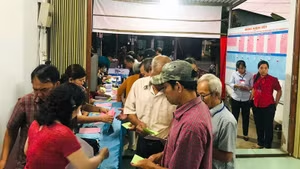
Going door to door
Under weather that alternates between scorching sunshine and steady rain, the mountainous commune of La Da, viewed from the hillside, is lined with bright red flags along both sides of the main road. Alongside this, loudspeaker announcements resound across the area, reminding residents of the nation’s great day and the upcoming election.
While the rain falls, Bo Rong Dam Kham (an ethnic K’ho), head of Polling Station No. 1 in La Da Commune, busily completes preparations for the polling location, preparing and decorating the polling station and checking election materials and ballots. As soon as the rain stops, Kham and other members of the polling team visit each household to guide residents on voting procedures and provide information about candidates.
“Ethnic minority residents often go into the forest to gather produce or work on their fields. They usually leave home before sunrise and only return late in the afternoon. This affects voting participation, so we regularly remind them because people often cannot clearly remember specific dates or days of the week,” Kham shared.
In addition to direct outreach, the polling team also sends information about candidates and voting procedures through social media platforms. Bo Rong Thi Huong (an ethnic K’ho resident of La Da Commune) said that by joining a Zalo group, people have gained a clearer understanding of the election process and how to cast their votes to choose trustworthy and responsible representatives. This also reflects the community’s sense of responsibility and their aspirations for the development of their hometown.
In coastal areas, fishermen often embark on long fishing trips lasting up to 20 nights. Each day, when the control station of Thanh Hai Border Guard Station signs departure permits for fishing boats heading offshore, officers remind fishermen to remember the election day. At the same time, officials from Phu Thuy and Phan Thiet wards visit fishing ports to conduct outreach with fishermen.
While refuelling his vessel before heading offshore, Tran Ho (Phu Thuy Ward) said that in previous years his fishing trips lasted more than 15 days, but this time he would only go out for a week so that he could return to the mainland before election day. “The election only comes once every five years, so I take voting very seriously. I want to choose representatives who are passionate and truly care about the locality,” he said.
Technology lends a helping hand
Having taken part in four election terms, Bo Rong Dam Kham said that this time the administrative system has only two tiers, meaning voters will cast ballots for three levels instead of four as in previous elections, thereby reducing the workload. Notably, thanks to the application of technology, households now participate in village social media groups, enabling information and communication to be updated continuously and promptly.
Pham Van Quyen, head of Quarter 1 in Thanh Hai (Phu Thuy Ward), said that due to the coastal area’s large fishing community, polling teams regularly remind residents to return home in time for voting day. At the same time, many people have purchased houses in the locality to run hotels; some maintain household registration but do not live locally, while others have sold their homes yet still retain their registration. Therefore, the neighbourhood works with ward police to use data from the VNeID system in order to contact each case and ensure voting is conducted in accordance with regulations. Technology, he noted, has become a “powerful assistant” helping ensure the nation’s great day unfolds smoothly.
In La Da Commune, which is home to ethnic groups such as Tay, K’ho, Muong, Nung, Thai, Hoa, and Khmer, Nguyen Minh Phuong, Secretary of the Commune Party Committee, said that the mountainous terrain and scattered settlements mean village offices are often several kilometres from residential clusters. Many residents who migrate seasonally for agricultural work are unfamiliar with their polling locations. The commune therefore regularly informs residents of village polling sites. Before voting day, officials will station themselves on roads leading to the forest to remind ethnic minority residents heading to their fields that it is election day. In some cases, polling hours may start as early as 5 a.m. or end as late as 9 p.m. to accommodate the daily routines of ethnic minority communities.
As the newly organised two-tier local government system begins operating, many commune-level officials are newly appointed, often transferred from district level, making it difficult to immediately grasp local demographic characteristics. Nguyen Minh Phuong noted that the commune has therefore coordinated with experienced former officials who participated in previous elections to assist with this year’s process. Given the uneven population distribution, large geographic area, high proportion of rural residents, and many ethnic minorities, the commune has strengthened election communication through content and formats tailored to different groups, using multiple languages suitable for ethnic minority communities.
Tran Quoc Tuan, Vice Chairman of the People’s Committee of Bac Binh Commune, said the locality has implemented a wide range of communication activities through loudspeakers, mobile broadcast vehicles, banners, and billboards, while also sending officials to households for direct outreach. In particular, respected figures and religious dignitaries among the Cham community have served as important links between authorities and the community working with the authorities to convey election information. For households living near mountainous areas more than 10 kilometres from polling stations, the commune coordinates with police to provide transport so residents can travel to vote.
With more than 10% of residents working in the fishing industry, Tran Nguyen Loc, Chairman of the People’s Committee of Phan Thiet Ward, said that from March 1 to 8 the ward had continuously urged fishermen and boat owners to return to shore before election day. During the peak communication period from March 9 to 13, mobile loudspeaker vehicles will travel throughout coastal neighbourhoods. At the same time, the locality works with the management board of Phan Thiet Fishing Port and the Border Guard through radio communication to remind fishermen to return before voting day.
Polling teams have worked tirelessly, travelling across mountains and coastal communities to ensure every voter is informed. Each ballot cast reflects the people’s confidence, contributing to making the nationwide day of unity even more meaningful and embodying aspirations for the development of the homeland.