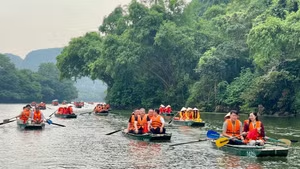
Recently, the Department of Culture, Sports, and Tourism of Cao Bang Province conducted a survey in Doai Duong Commune in preparation for the launch of an experiential tourism route. This is encouraging news for residents of Doai Duong Commune and those seeking to develop tourism in the area. "We plan to develop this tour so that visitors can explore and learn about local culture through Thong Hue Market, a unique market of the Tay and Nung ethnic communities in Cao Bang,” said Luong Dinh Duy, Head of the commune's Department of Culture and Social Affairs.
"Following, visitors will visit Long Vuong Temple, an ancient and sacred shrine dedicated to Nam Hai Long Vuong (the Dragon King of the Southern Sea). They will then walk along the Bac Vong River, whose clear waters wind through peaceful villages and provide local residents with water for domestic use and agricultural production. The final stop will be Thoong Ma Waterfall, at the source of the Bac Vong River, approximately 1km from the commune centre," he added.
The experiential tour will take at least half a day. After a lunch break, visitors can continue their journey for approximately 35km to Ban Gioc Waterfall. Alternatively, the tour can be organised in the reverse direction.
Located in the southern part of Cao Bang Province, Doai Duong Commune is home to three ethnic groups who live together in solidarity and harmony: the Tay ethnic group accounts for 50% of the population, the Nung 49%, and the Kinh 1%. They are together building their homeland and contributing to the development of the country.
Taking us on a tour of Thong Hue Market, Nong Thanh Huu, an official from the commune's Department of Culture and Social Affairs, said: "Like many other localities in Cao Bang, Thong Hue Market is held six times a month, on the 2nd, 7th, 12th, 17th, 22nd and 27th days of the Gregorian calendar. At each market session, local residents bring a wide variety of highland produce to exchange and sell."
For people from the capital, who are accustomed to small, bland cabbages, a visit to Thong Hue Market is sure to be a surprise. They will be amazed to see large, tightly packed cabbages with diameters of nearly two handspans, making them particularly appealing. All the produce on sale is grown by local residents on high mountain slopes, without the use of preservatives or growth stimulants. Everything they grow themselves or gather from the forests is brought to the market for sale. Highland markets are not merely places for trading goods; they are also social gathering places where people meet, exchange stories, enjoy a glass of wine and sample local specialities in a lively and cheerful atmosphere.
Leaving Thong Hue Market, Nong Thanh Huu took us to Long Vuong Temple, dedicated to Nam Hai Long Vuong, the water deity believed to govern rivers and waterways and bring abundant harvests and peaceful lives to local residents. According to local customs, the temple is also a place where couples who have difficulty having children come to entrust their hopes and wishes.
The temple occupies a site believed to bring together all the elements of "Long-Huyet-Thuy-Sa" (Dragon-Acupoint-Water-Sand). Its rear faces the slopes of Tam Tien Mountain, while its front overlooks the Bac Vong River. In 2015, local residents rebuilt Long Vuong Temple on the foundations of the original shrine thanks to funding mobilised through social contributions, giving it its present architectural appearance. On July 15, 2019, the temple was recognised by the Cao Bang Provincial People's Committee as a provincial-level historical and cultural relic site. It is also part of the eastern tourism route of the Non Nuoc Cao Bang UNESCO Global Geopark.
According to local customs, a religious ceremony is held every leap year and lasts for three days. It features rituals deeply rooted in spiritual beliefs, with prayers for favourable weather, prosperity and good fortune, particularly for the blessing of children. The Long Vuong Temple Festival has become a venue for social interaction, sharing, and strengthening community bonds, helping preserve and promote traditional cultural values.
In recent years, Provincial Road DT206 has been widened and upgraded. Travelling from the centre of Doai Duong Commune to Thoong Ma Waterfall, visitors can enjoy picturesque scenery featuring small waterfalls and waterwheels beside lush green fields.
In recent years, Provincial Road DT206 has been widened and upgraded. Travelling from the centre of Doai Duong Commune to Thoong Ma Waterfall, visitors can enjoy picturesque scenery featuring small waterfalls and waterwheels beside lush green fields.
"Thoong Ma Waterfall is a large watercourse running down steep rocky mountainsides and dividing into several tiers. The highest tier is more than 10 metres tall. In the local language, its name means 'lucky waterfall'. Local people believe that during the rainy season, when the water cascades down in white torrents and glitters in the sunlight, it resembles the gleam of gold and silver. This has also led them to regard it as a waterfall that brings wealth and good fortune. The considerable differences in elevation create the waterfall's majestic appearance, with torrents of white water stretching like a soft silk ribbon through the vast mountains and forests, concealing a wild and magnificent beauty," said Luong Dinh Duy.
Luong Thi Thoa, Vice Chairwoman of the Doai Duong Commune People's Committee, said that to develop the tourism tour along the Bac Vong River, the locality is implementing various activities to encourage visitors to stay longer. Through social media platforms such as Facebook, Zalo, and TikTok, we introduce the scenery and places to stop along the route in different seasons, giving visitors more opportunities to enjoy the area.
One of these attractions is Thoong Loc Homestay, which preserves the natural beauty, indigenous culture, and simple rhythms of life in the mountains and forests. In addition, the commune has two large restaurants, each capable of serving 50-60 visitors at a time, as well as two guesthouses in Thong Hue town.
"We first came up with the idea of developing community-based tourism in 2024. In April 2026, we officially opened the homestay to welcome visitors wishing to experience the Bac Vong-Ban Gioc tourism route.
With a capacity of 70 guests, the homestay comprises two separate buildings and an original seven-compartment traditional stilt house serving as a communal space where visitors can relax. Weekends are usually the busiest times, attracting both domestic and international tourists who can enjoy a range of activities, including cycling around the valley and cycling uphill along routes of 5-10km with assistance from local guides. Visitors can also go stand-up paddleboarding from the homestay to Thoong Ma Waterfall and back.
In the evening, the communal space becomes a venue for community activities, with campfires, Then folk singing performances by local artisans and exchanges with local young people," shared Phung Van Chung, Director of the Dong Tien General Services and Community Tourism Cooperative and owner of Thoong Loc Homestay.
Spending a day in Doai Duong, immersed in the unspoilt beauty of this mountainous region, visitors do not necessarily need to begin their journey at famous check-in spots. They can simply follow small paths through the mountains and forests, pass through peaceful villages accompanied by the sound of flowing streams, and discover a different side of Cao Bang. This is a journey that is neither rushed nor bound by rigid itineraries, allowing visitors to take their time, truly appreciate their surroundings, immerse themselves in nature and experience the simple daily life of local people in a distinctive and captivating setting.
In the near future, the natural gifts of the area will provide a foundation for Doai Duong Commune to continue exploring and developing community-based tourism, gradually harnessing its potential and advantages in terms of landscapes and culture to promote socio-economic development and improve local people's living standards.