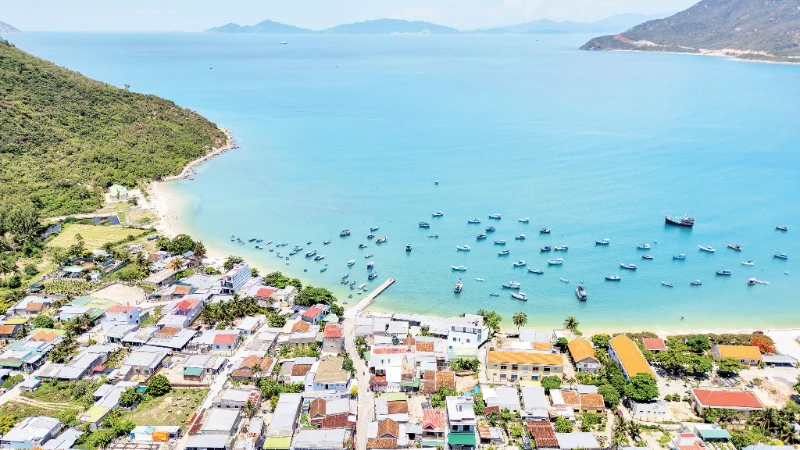
Long accustomed to fishing and farming, the villagers are now confidently learning about, investing in, and engaging in tourism by leveraging the strengths of their homeland.
In October 2023, the People's Committee of Khanh Hoa Province issued Decision No. 2356/QD-UBND recognising Ninh Van Commune (formerly part of Ninh Hoa Town) as a locality with potential for developing community-based tourism. This serves as a foundation for officially incorporating community tourism into the local economic structure, creating conditions to preserve and promote local strengths and advantages while increasing the income of residents.
Shifting from traditional occupations
Travelling to Ninh Van today is easy via a scenic mountain pass cutting across the natural boundary between Van Phong Bay and Nha Phu Bay. Few tourists know that this road was only opened in the early 2010s; previously, locals mainly travelled by sea. The road has brought greater numbers of traders, visitors, and relatives to Ninh Van, who are captivated by the scenery, atmosphere, and rhythm of life in this quintessentially Vietnamese fishing village.
Recognising the increase in visitors and the growing need for accommodation, in 2019, while building his new house, Le Van Bao decided to set up a few rooms for rent. Having worked as a fisherman for many years, once specialising in diving and fish hunting, he was initially unfamiliar with tourism services. However, the economic benefits encouraged him and others in Ninh Van. “I invested about 400 million VND at first. Seeing that business was good, I expanded to five self-contained rooms. During peak times, we host around 50 guests per month on average, with room rates ranging from 200,000 to 300,000 dong per night. This has become our main source of income. After seeing our success, others followed suit,” Bao shared.
From these spontaneous beginnings, the community-based tourism model in Ninh Van has taken clearer shape, offering a sustainable livelihood for locals and helping preserve traditional lifestyles and cultural heritage. Fully aware of this, local authorities established the Ninh Van Community-Based Tourism Management Board and issued regulations along with support policies for residents.
According to Head of the Board Nguyen Tra Nhat Tien, there are currently 19 households involved, offering dining, accommodation, and tour services. Members receive free support in marketing, customer referrals, purchasing appropriate equipment, professional training, and English language classes. “We always listen to and accompany the locals in developing the local economy. For now, households are still maintaining their traditional jobs while also serving tourists. Locals are not only service providers but also cultural ambassadors who preserve the local customs, traditions, and lifestyle and introduce them to visitors,” Tien said.
This is one of the factors that make Ninh Van appealing: visitors enjoy authentic experiences and “live like a local”, discovering customs that are rarely found in mass tourism. Hang Lam Kiet, born in 1994, was one of the pioneers in organising tours for diving and spearfishing — a traditional occupation of Ninh Van people —combined with coral viewing, camping, and enjoying seafood caught by the tourists themselves.
To run the model professionally and safely for both tourists and operators, Kiet and his colleagues pursued training and obtained international diving and lifeguard certifications. “We offer services like coral diving and fish hunting through freediving, snorkelling, and even scuba diving for certified guests. All activities are reported to the border guard post, and we commit not to harm the natural coral reefs. When we have customers, the income is relatively good compared to the local cost of living, though it remains unstable,” Kiet noted.
Preserving soul of the village amid tourism flows
How to attract a stable stream of visitors remains a challenge for any tourism model. The creative efforts in Ninh Van’s community tourism highlight the need for more systematic organisation with the coordinating role of local authorities. The Ninh Van Community-Based Tourism Management Board has installed information boards, signage, and community tourism guidance panels. It also works with locals to actively build a website, fanpage, and social media groups to promote their homeland.
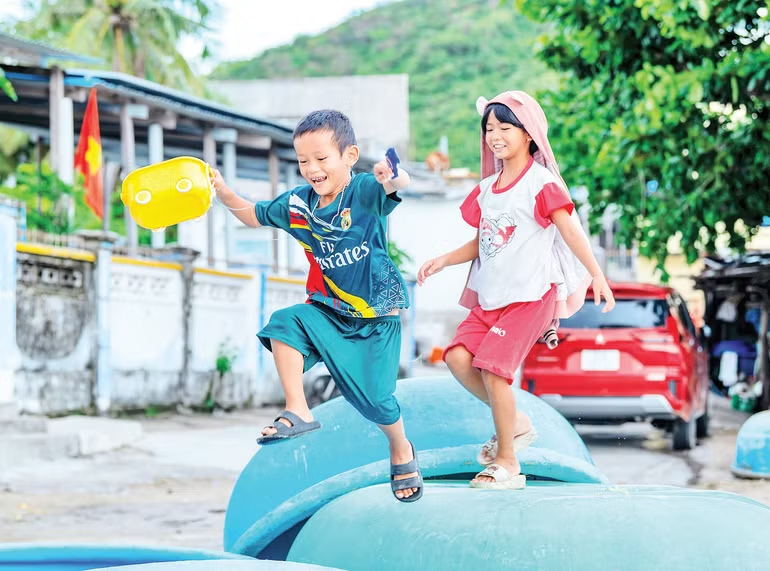
(Photo: MY HA)
Dinh Nhat Truong, born in 1992, grew up in Tay Hamlet, formerly Ninh Van Commune, in a family of traditional fishermen. Although now working in Nha Trang, he regularly returns home and makes the most of every opportunity to promote beautiful images of Ninh Van online. “To me, Ninh Van is where I grew up and matured — beautiful memories of a poetic and peaceful coastal area always stay with me. I’ve always wanted to contribute something positive and sustainable to my homeland,” Truong shared.
He created the Facebook group “Ninh Van Locals”, aiming to showcase local life, culture, and natural beauty; connect families looking to develop homestays, restaurants, and tourism experiences; and provide updates on community events, weather, environmental conditions, and infrastructure. It also serves as a repository for tourists to explore, make enquiries, and connect directly. To date, the group has over 4,000 members and receives considerable attention from visitors through simple stories, photos, and video clips capturing Ninh Van’s scenery and people.
According to Bao, many guests are drawn in thanks to location listings on apps like Google Maps and the appeal of peaceful, pristine, and gentle images shared online. However, business owners still need to further improve service quality to retain visitors.
In 2024, his establishment was one of the households granted 30 million VND by the local tourism management board to improve infrastructure. Alongside other board members, he participates in environmental protection, regular sanitation, ensures security and fire safety, and helps create a clean, green, and beautiful landscape.
The Ninh Van Community-Based Tourism Management Board also continues to devise new recreational activities, all while ensuring the preservation of local scenery and life. As the head of the board, Nguyen Tra Nhat Tien said: “We’ve encouraged locals to organise more tours, such as cycling excursions, camping, and ‘a day in the life’ experiences as fishermen or farmers. These include welcoming fishing boats at the early morning wharf, going to market, spearfishing, harvesting garlic and peanuts, and visiting the national historical site — the C235 ship memorial (part of the Ho Chi Minh Trail at sea). Both domestic and international visitors are very enthusiastic about these.”
In agreement with the policy of maintaining the village’s original identity, Truong further proposed: “To ensure the tourist experience is cohesive and to make community-based tourism a true economic driver, residents need training in communication, hospitality, accommodation management, first aid, and legal matters. The locality should also develop an ‘eat-play-stay’ experience map and establish a team of local guides — people of the village who understand and can tell its stories.”
Le Van Hoa, Deputy Director of the Department of Culture, Sports and Tourism of Khanh Hoa Province, stated that the Khanh Hoa Provincial Party Committee issued Resolution No. 34-NQ/TU (dated December 22, 2023) on promoting cultural heritage values in tandem with sustainable tourism development in Khanh Hoa to 2025, with orientation to 2030. “Implementing the tasks and solutions outlined in the resolution, we always encourage local communities to actively participate in heritage management, align community benefits with heritage preservation and promotion, develop community tourism, and drive socio-economic development, improving both material and spiritual wellbeing. This ensures a harmonious relationship between cultural and economic growth,” Hoa affirmed.
The story of Ninh Van presents a thoughtful direction for many localities across the country: development does not always require grand plans or massive investment but can start from within the community, from people who understand the land, the craft, and the culture of their village. Amid the national push for green economic growth and new-style rural development integrated with heritage preservation and improved quality of life, the lesson from Ninh Van is highly instructive: place people at the centre, culture as the foundation, and locality as the brand; in doing so, even the smallest coastal village can find a broad new path forward.