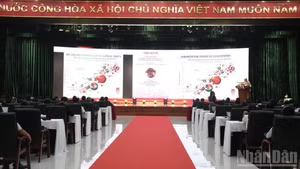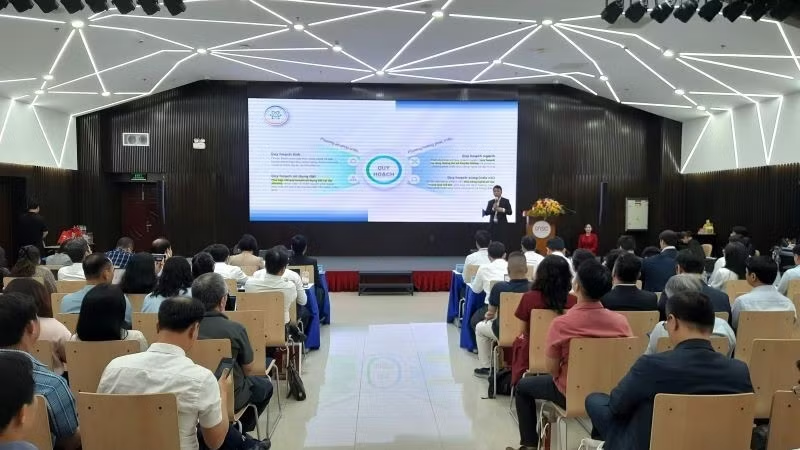
The Department of Information Technology Industry (Ministry of Science and Technology), the Foreign Investment Agency (Ministry of Finance), the Quality Tech Solution Complex (QTSC), and the Ho Chi Minh City Digital Transformation Consulting and Support Centre (DXCenter) jointly organised the seminar “Promoting investment in concentrated digital technology zones” in Ho Chi Minh City on December 5.
The seminar aimed to introduce the potential, advantages, incentives, and cooperation opportunities for investment in concentrated digital technology zones — a strategic model for driving digital economic development and innovation in Ho Chi Minh City.
It also served as a platform connecting State management agencies, investors, technology enterprises, research institutes, universities, and investment support organisations, towards building a sustainable, dynamic, and internationally integrated digital technology ecosystem.
Delivering the opening remarks, Nguyen Khac Lich, Head of the Department of Information Technology Industry, noted that since 2006, when the model of concentrated information parks was institutionalised and the Government issued Decree No. 154/2013/ND-CP, Viet Nam laid the first bricks for what has become today's system of concentrated digital technology zones.
To date, this system has produced impressive results, with eight concentrated digital technology zones established in Ha Noi, Ho Chi Minh City, Da Nang, and Can Tho.
These zones have attracted more than 630 digital technology enterprises employing over 42,000 high-quality labourers. Land-use efficiency reaches around 10 million USD per ha per year, a remarkably high level compared with other functional zones.
“These figures demonstrate that concentrated digital technology zones are not only places for enterprises to operate, but also spaces where value is created, knowledge is nurtured, and innovation is strongly promoted,” Nguyen Khac Lich emphasised.
He added that the world is witnessing a profound shift from information technology to digital technology, from application to innovation, from standalone software to converged ecosystems of artificial intelligence (AI), data, semiconductors, and breakthrough technologies.
In this context, Resolution 57-NQ/TW on promoting breakthroughs in science, technology, innovation, and national digital transformation identifies the development of concentrated digital technology zones as one of the core solutions for advancing science, technology, innovation, and national digital transformation.
This is not merely a policy; it is a strong message that Viet Nam is ready to move fast and take the lead in the digital technology era.
At the event, delegates agreed that developing concentrated digital technology zones is not about expanding industrial real estate; rather, it is about building an ecosystem where every enterprise, from startups to global corporations, can innovate, test ideas, grow, and reach the world.
Within such zones, enterprises gain access to optimal digital infrastructure, benefit from unique preferential mechanisms, experiment with new technologies in sandboxes, and work in an environment of continuous innovation.
Investing, developing, and operating within concentrated digital technology zones means accompanying Viet Nam on its journey to build next-generation digital industrial infrastructure, the foundation for national breakthroughs over the next 30 years.
Within the framework of the seminar, the organisers also held a technology exhibition showcasing and introducing digital transformation solutions, data centre infrastructure, AI, Internet of Things (IoT), cybersecurity, technological applications, and smart-city solutions, creating a space for networking and sharing implementation experiences among technology enterprises, investors, and local representatives.