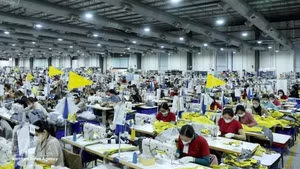
At present, the locality is focusing on building an ecological agriculture sector, modern rural areas and a civilised farming community. Dong Thap has favourable conditions to create value chains linking raw-material zones with processing areas, and agricultural production with supporting industries, thereby increasing export value, generating higher added value, and achieving strong, comprehensive and sustainable development in a new phase.
Foundations for rising up
During the 2020-2025 period, agriculture continued to assert itself as a pillar of Dong Thap’s economy, making an important contribution to national food security and agricultural exports. Food output was maintained at around four million tonnes, while agricultural and aquatic exports in 2025 were estimated at 2.4 billion USD, accounting for a large share of the province’s total export turnover.
The agricultural structure has shifted in a positive direction. Agriculture’s share of the economic structure declined from 38% in 2020 to 34.9% in 2025, reflecting a trend towards more in-depth development, improved quality and higher value added.
The province has focused on restructuring agricultural production in an ecological and sustainable direction, forming and developing key product lines such as rice, fruit, aquatic products, ornamental flowers and lotus.
Models of green agriculture, circular agriculture and low-emission agriculture have gradually taken shape, while mechanisation, the application of science and technology, and digital transformation in agriculture have been strongly promoted.
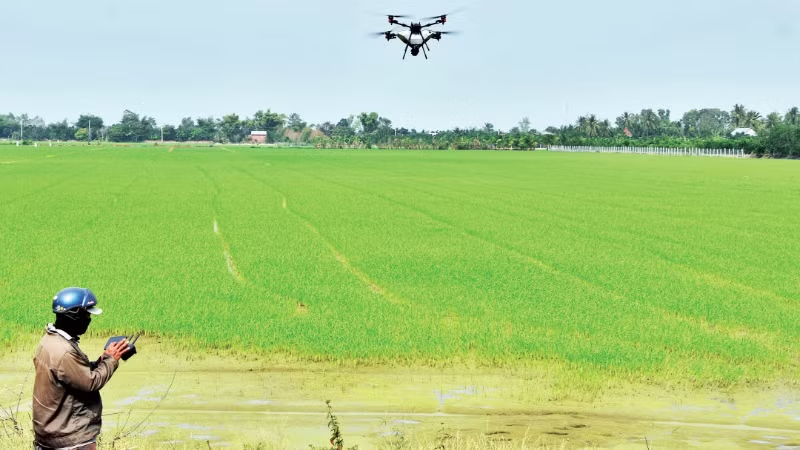
Tran Van Canh, a farmer in Dong Thap Province, was watching workers operate drones to spray fertiliser on his 2.5 hectares of rice fields. He said: “In recent years, machinery and technology have gradually replaced manual labour in farming. Rice farmers are no longer as hard-pressed as before. From land preparation, sowing and fertilising to spraying, harvesting and transporting rice, everything is now done by machines.”
Rural areas in Dong Thap have seen many positive changes and are becoming increasingly orderly and modern. Rural infrastructure continues to be upgraded, meeting the requirements of production development and improved living standards.
Communal roads have been upgraded to ensure that four-wheeled vehicles can reach commune centres. During the 2020-2025 period, Dong Thap completed the task of building new-style rural areas at the provincial level.
Farmers in Dong Thap are gradually shifting from a purely production-oriented mindset to an agricultural economic mindset. By 2025, the number of workers in agriculture, forestry and fisheries is estimated at more than 600,000, accounting for 31% of the province’s labour force. The proportion of trained workers has increased steadily.
Movements to build professional farmers and excellent production and business farmers have been widely implemented, becoming a strong driving force encouraging farmers to actively participate in cooperative economic organisations, boldly apply technical advances, and adopt digital transformation and e-commerce in agricultural production.
Emphasising depth and sustainability
In the coming period, Dong Thap has identified ecological agricultural development as a key direction, forming specialised production areas that meet export standards and strengthening connections between producers and consumers.
The province aims to build modern, prosperous rural areas with infrastructure systems that ensure synchronised connectivity and harmonious development alongside urban areas, while fostering a civilised farming force with adequate skills, a cooperative spirit, responsibility and strong capacity to respond to market fluctuations and climate change.
According to Le Ha Luan, Director of the Dong Thap Department of Agriculture and Environment, the province will focus on raising awareness and renewing thinking in developing ecological agriculture, modern rural areas and civilised farmers; improving institutions, mechanisms and policies in line with new development requirements; organising production and developing commodity agriculture; forming specialised production zones; and applying sustainable processes to the province’s key product lines.
Modern rural development will be linked with appropriate urbanisation through rural planning that establishes development centres aligned with the advantages of each area, upgrades rural infrastructure connected with urban areas, and builds a civilised, knowledgeable and professional farming workforce through training, capacity building and the transfer of science and technology.
An action programme of the Dong Thap Provincial Party Committee to implement the resolution of the first Provincial Party Congress for the 2025-2030 term identifies the development of an ecological, modern, high-tech agriculture sector linked with processing industries, value chains and export markets.
Agriculture will be restructured in a green, modern, sustainable and multi-value direction; circular production will be promoted in conjunction with climate change adaptation; concentrated raw-material zones will be formed; and effective linkage and cooperation models will be replicated in association with rural digital transformation and the development of agricultural tourism.
Conditions will be created for farmers to link production along value chains, act as satellites for large enterprises or develop into private enterprises, contributing to the formation of a new production force in agriculture.
According to Ngo Chi Cuong, Secretary of the Dong Thap Party Committee, agriculture is identified as a crucial foundation for the province’s sustainable development. The agricultural sector is being comprehensively restructured to maximise product value through high technological content and circular production and processing chains.
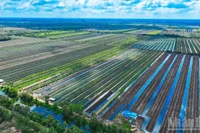
Dong Thap is implementing a project to make the province a pioneer in ecological agriculture, modern rural areas and civilised farmers, with a focus on reorganising development space across ecological zones in close connection with markets, processing industries and the completion of corresponding technical infrastructure.
Dong Thap prioritises developing the Dong Thap Muoi region and upstream areas of the Tien River into centres for rice, lotus and freshwater aquaculture production, forming large-scale raw-material zones with synchronised mechanisation and advanced farming practices, and investing in a rice processing complex in the Thuong Phuoc International Border Gate Economic Zone.
In aquaculture, the province plans to expand farming in favourable areas, develop concentrated, high-tech and biosecure farming zones, and turn Dong Thap into a national centre for high-quality freshwater fish breeding, deep processing and pangasius exports.
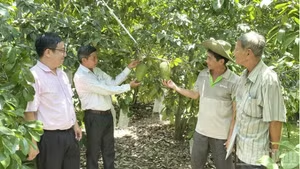
Fruit-growing areas for key crops such as durian, mango, jackfruit, longan and guava are being restructured to improve quality and food safety and expand export markets. Efforts are being stepped up to issue planting-area codes and packing facility codes, apply VietGAP and GlobalGAP standards, and encourage investment in post-harvest preservation and processing technologies to raise value added. Sa Dec flower village is being elevated into a national high-tech ornamental flower centre, combining production with research, new variety breeding and tourism development.
The national target programme on building new-style rural areas will be implemented in a more in-depth and sustainable manner, improving rural living standards, disseminating knowledge on digital transformation, enhancing the application of high technology in production, and introducing artificial intelligence tools to farmers.
The effectiveness of the Farmers’ Club model will be further promoted, helping to build a professional farming workforce with an economic mindset and modern management skills, towards the development of advanced and modern new-style rural communes.