According to the researcher Hoang Thieu Son, the most ancient place that features ‘Long’ in its name is the capital, Hanoi. However, it is not ‘Thang Long’ (Ascending Dragon), its name given by King Ly Cong Uan, as it is commonly assumed. Hanoi in the old days was designated as ‘Long Do’ (Dragon’s Navel) because the land is central and sunken.
Professor Tran Quoc Vuong says that in 1010, King Ly Cong Uan left Hoa Lu in Ninh Binh province to relocate the capital in the ‘dragon’s navel’ and renamed it ‘Thang Long’, which in his opinion is the most beautiful name of Hanoi.
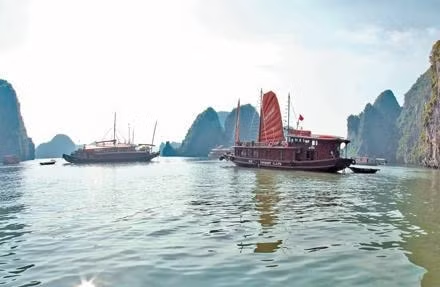
In addition to ‘Thang Long’, Vietnam also has Ha Long Bay, or the 'Bay of the Descending Dragon', in Quang Ninh province and to the east of Ha Long is Bai Tu Long (Little Dragon Bowing to His Mother). To the southeast is Cat Ba Island, which was formerly called Phu Long (Floating Dragon).
Off the coast of Quang Ninh is the Bach Long Vi (Tail of a White Dragon) archipelago. Bach Long Vi is also the former name of Tra Co commune on Tra Binh Island which is the home of Ngoc (Pearl) Cape, associated with a legend about a dragon with a pearl in its mouth landing at the site.
The names of many mountains in Vietnam include the words ‘Long’ or 'Rong' (which also means 'dragon'), perhaps the most well-known being Ham Rong (Dragon’s Jaw) that stands along the Ma River in Thanh Hoa province, where over 100 US aircraft were shot down during the war against US imperialism.
Scholar Hoang Thieu Son says the oldest ‘Long’ mountain in Vietnam is Long Doi in Duy Tien district in the northern province of Ha Nam, where King Le Dai Hanh used to join the springtime ploughing festival. He thinks ‘Long Doi’ may mean a ‘Hill of Dragons’.
Quang Ninh also has Long Tu (Dragon’s Moustache) Mountain, which is named after a kind of grass growing there while Do Son district in Hai Phong city has Long Chau (Dragon’s Eye) island, which is also the name a lighthouse that is located there.
Two other mountains with ‘Long’ in their names are Long Truong and Long Ma Phu Do in the central province of Ha Tinh. Located in the northwest of Ha Tinh city, the Long Tuong range looks like a mother dragon surrounded by her children. Long Ma Phu Do in Duc Tho district are two adjoining mountains, one is tall and pointed like a horse’s head (Long Ma) while the other is lower and looks like a horse carrying a map and bibliography on its back (Phu Do).
Quang Binh is home to Thanh Long (Blue Dragon), a blue limestone mountain and on the northern bank of the Gianh River is Minh Hoa district, which has the Long Ti (Dragon’s Nose) range.
At the foot of the Hai Van mountain pass in Phu Loc district, Thua Thien Hue province, lies a serpentine mountain range known locally as ‘Rong’ (Dragon). The province also has another tourist destination named Kim Long (Gold Dragon).
In the Mo Duc district of Quang Ngai province, there are three mountains called ‘Long’ including Long, Long Cot and Lac Long.
Travellers will notice many other places labeled Rong or Long, such as Ham Rong mountain in Thanh Hoa province, Ham Long pagoda in Binh Dinh province, Long An in Bien Hoa and Duong Long in Ha Tien.
There are innumerable ‘dragon’ places in the south and southern eastern region such as the four-hectare Cuu Long (Nine Dragons) delta, Long An province, Long Dinh town in Tien Giang province, Long Ho district in Vinh Long province, Long My district in Can Tho province, Long Xuyen city in An Giang province and Long Phu district in Soc Trang province.
‘Long’ is also a favourite name for rivers, which are long and sinuous like a true dragon. The Mekong is the largest ‘dragon’ river, flowing through five countries and separating into nine branches as it flows to Vietnam, which is why it is called ‘Cuu Long’ (Nine Dragons). When the first section of the Tien River enters Dong Thap province in Vietnam, it flows around Cai Vung Island, also known as Long Son.
There are many 'dragons' in Vietnam and throughout its history. The upcoming Year of the Dragon is a perfect time to discover these places and learn about their connections to the long and fascinating history of our country and its magical legends.