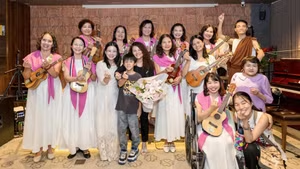
In recent years, Ha Noi has been one of the pioneers in promoting the ao dai as a signature tourism product. Most recently, the Ha Noi Tourism Ao Dai Festival 2025 took place in November, with a highlight parade featuring around 1,400 participants along major streets of the capital.
The festival attracted tens of thousands of visitors who came to experience, take photos, and interact at various destinations across Ha Noi, thereby spreading the city's beautiful image and affirming its commitment to heritage promotion.
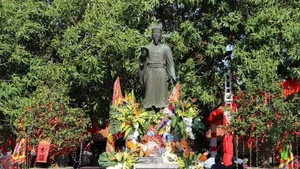
Another special activity that drew great interest was the re-enactment of the procession honouring the founder of the Trach Xa tailoring craft, a thousand-year-old village recognised as a National Intangible Cultural Heritage. The vibrant cultural space surrounding Hoan Kiem Lake and Dong Kinh Nghia Thuc Square, where crowds dressed in ao dai walked gracefully, became an impressive scene for both domestic and international tourists. Alongside the ao dai, the movement to revive ancient attire has also grown strongly.
Since 2022, the national Viet Phuc Festival “Bach Hoa Bo Hanh” has spread widely among young people, each edition drawing thousands of participants. The event contributes to preserving and promoting the rich varieties of traditional Vietnamese garments throughout history.
In addition is the “Touching Ha Noi Autumn” bus tour, which offers visitors the opportunity to wear ao dai while strolling through the city, taking photos at heritage sites, and learning stories about architecture and customs. The steadily rising number of visitors demonstrates the potential of tourism products linked to traditional attire — unique, attractive, and culturally rich.
In Ho Chi Minh City, the 11th Ao Dai Festival 2025 proved highly appealing, drawing 3.6 million visitors over a month, including nearly 600,000 international guests.
According to Nguyen Thi Kim Oanh, Head of Communications at the Southern Women’s Museum, the ao dai is not only a cultural symbol but also holds the potential to develop into an iconic commercial and tourism product, associated with photo tours at heritage sites as well as visits and shopping experiences at craft villages and artisan streets.
“The ao dai is not only a cultural symbol but also has the potential to develop into an iconic commercial and tourism product, associated with photo tours at heritage sites as well as visits and shopping experiences at craft villages and artisan streets.”
Nguyen Thi Kim Oanh, Head of Communications, Southern Women’s Museum.
In recent years, the city’s tourism sector has introduced many “wearing culture” experiences: wearing ao dai for photo shoots at French architectural landmarks, joining design and tailoring workshops, and attending ao dai fashion shows paired with music. Designer and painter Si Hoang, Chairman of the Institute of Vietnamese Costume Research, noted that although Viet Nam has no official national costume regulation, for many years Vietnamese people have worn the ao dai as a tradition, and most international friends recognise it as an unmistakable symbol of Viet Nam.
Notably, the establishment of the Vietnam Ao Dai Culture Association on August 9 in Ha Noi is considered a significant milestone, setting the direction for building a cultural–tourism ecosystem around the ao dai and traditional attire, ensuring that research, promotion, and commercialisation take place in a methodical and coherent manner.
In reality, tourism linked to traditional clothing has strong appeal when professionally organised. Japan, the Republic of Korea, China and Thailand have all left their mark with models combining ticket incentives, costume and accessory rental services, photography at heritage sites and participation in cultural activities. Images of tourists wearing kimono, hanbok, hanfu, etc., shared widely on social media help promote destinations and generate income for local communities.
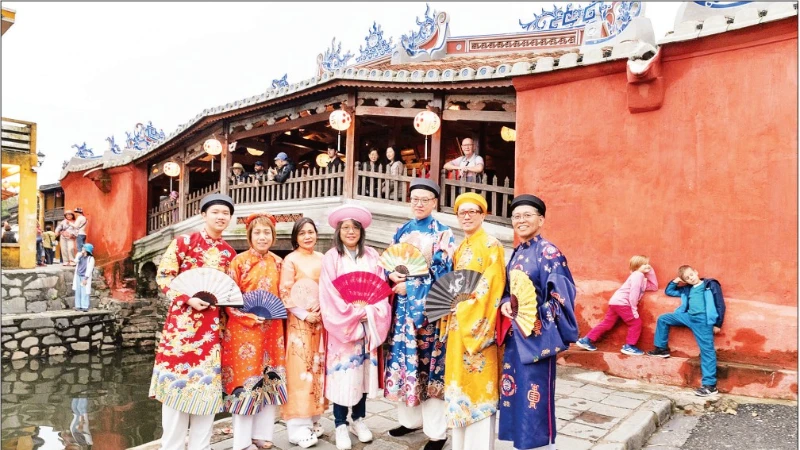
In Viet Nam, incentives encouraging traditional clothing in tourism have been applied in several areas. For example, the Complex of Hue Monuments offers free or discounted tickets for visitors wearing ao dai during certain holidays; the Thang Long Imperial Citadel has expanded ancient-costume experiences, attracting large numbers of young people over the past two years. Experience tours are becoming increasingly diverse, including ao dai–cyclo tours in Nha Trang (Khanh Hoa), ao dai–bicycle tours in Hue, and Vietnam ancient attire tours exploring Hoi An Ancient Town (Da Nang). Many experts believe that officially recognising the ao dai as a cultural heritage and national costume would create a legal basis for proposing UNESCO recognition.
In an increasingly competitive tourism landscape, developing tourism products based on local cultural values — such as traditional attire, cuisine and folk performances — holds strategic significance. Experiences of wearing ao dai or traditional costumes while strolling streets, riding cyclos or exploring heritage sites have demonstrated the unique appeal of traditional clothing. In doing so, each journey becomes a channel for introducing the beauty of Viet Nam to international friends in a simple yet deeply emotional way.