This script has officially received its name in the latest update of Unicode (Unicode 17.0), becoming part of the global digital language system.
The characters now recognised by Unicode are known to the Tay Do people as Lai Tay — a script once regarded as the soul of the community, used for transcribing ritual texts, recording ancient stories, and preserving local knowledge.
From mountain hamlet to the world
In September, on behalf of the research team, Cong Danh announced that Lai Tay, one of the two traditional scripts of the Tay Do people, living primarily in the districts of Quy Chau, Quy Hop, and Que Phong in Nghe An, had been officially included in Unicode 17.0. It took three years (2022–2025) for Unicode to review, approve and encode the script through their submitted proposals.
In Unicode 17.0, the block designated for the script is named TAI YO. Initially, the team wanted to name the block LAI TAY, matching the traditional name, but Unicode rules prohibit block names that contain words meaning “script” in that language (in this case, “lai” means “script”, “tay” means “Thai” in Tay Do). Thus, they agreed on the name tai yo. The TAI YO block includes 55 Lai Tay characters (glyphs) encoded within the range 1E6C0–1E6FF (covering 64 code points).
According to Cong Danh, Unicode is the international standard designed to serve as the single character set for all the world’s languages, including ideographic and complex character systems.
The 1998-born linguist added that without Unicode, typing Lai Tay in Word using a custom font would only display correctly on devices with that font installed. Unicode, by contrast, allows users to type Lai Tay on Facebook, mobile phones, and other platforms without needing any special fonts. This situation mirrors that of the Thai scripts used by ethnic Thai groups in northern Viet Nam, which were officially encoded in Unicode in 2009 (Unicode version 5.2).
Keeping flame alive for future generations
Dr Nguyen Ngoc Binh, Head of the Linguistics Department at the University of Social Sciences and Humanities under Viet Nam National University, Ha Noi, said that encoding Lai Tay helps local people better understand their writing system and heritage. It also enables the preservation of ancestral knowledge recorded in ritual texts, epics, and folk songs, and, importantly, opens new avenues for safeguarding the languages of small ethnic communities such as the Tay Do.
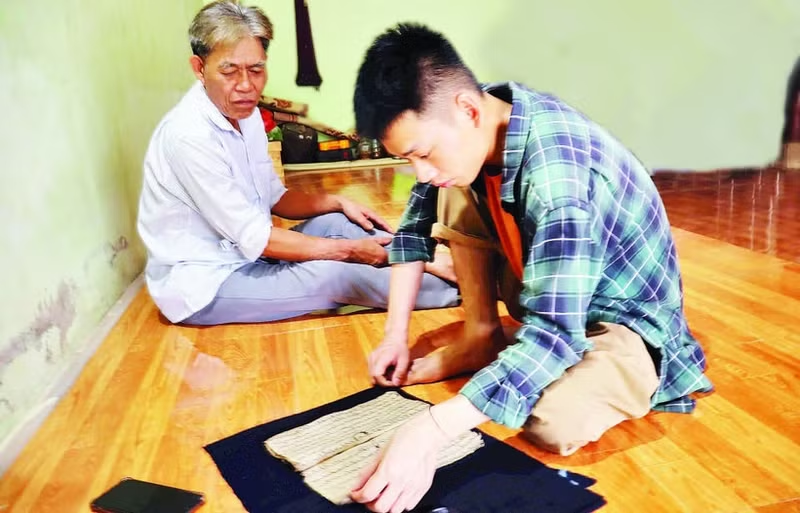
Looking back, it was a long journey, and something of a destiny, for Danh, Khoi, and Frank van de Kasteleen to meet through their shared interest in the Lai Tay script. In the 1990s, young Danh spent his days in Dong Minh Village, unaware that Lai Tay even existed until Professor Tran Chi Doi, former Head of Linguistics at the same university where Danh would later study, and linguist Michel Ferlus visited the village seeking help from locals to interpret a manuscript.
That first encounter sparked a curiosity that steadily grew, especially as Danh’s great-grandfather had been a mo (ritual practitioner) and the family had once lost an old manuscript. Not knowing what had been written in it remained a lasting regret. From that moment, Danh resolved to learn more about his people’s script. Destiny seemed to pave the way, from his postgraduate studies in linguistics to the eventual work of encoding the Lai Tay script.
Khoi, born in 1990, graduated in information technology from Ha Noi University of Science and Technology, but also developed a passion for ancient writing systems. Before meeting Danh, he had studied the writing traditions of the Thai people and noticed clear differences between the scripts used in Viet Nam’s northwest and those in Nghe An, a discovery made through reading works by artisan Sam Van Binh of Quy Hop Commune. By chance, he came across Danh on social media. They decided to collaborate, aiming to bring Lai Tay into Unicode even before meeting in person in 2021 at the Viet Nam National Village for Ethnic Culture and Tourism in Dong Mo, Son Tay (Ha Noi).
The journey, however, lasted three years. Danh spent a long period collecting and transcribing manuscripts from within and outside the community, including documents photographed from materials held by the École française d’Extrême-Orient in Paris. The process was slow; some community manuscripts lacked key characters, others were damaged, and some residents were reluctant to share them. However, "many a little makes a mickle."
After numerous trips to Que Phong, Quy Chau, and Quy Hop, Danh gathered materials from verse epics, ritual texts, and folk songs, even discovering large epics of around 5,000 lines copied in pieces. Ultimately, he identified all 55 characters required.
Meanwhile, Khoi photographed and processed the manuscripts before submitting them to Unicode. Through the Unicode Consortium, they connected with van de Kasteleen, a Dutch colleague who supported the procedural aspects of the proposal. Khoi explained that to gain approval, they had to draft a preliminary proposal in July 2022, comparing Lai Tay with Thai scripts and those used in Viet Nam’s northwest. After multiple revisions and a formal presentation before the Unicode committee, the long-awaited result finally arrived: Lai Tay was officially included in Unicode 17.0 on September 9.
They have also proposed a digital input method for the script, although further adjustments are still required. In the future, even if Lai Tay is no longer widely used, making it more visible will help linguists, researchers, and communities to better understand the traditional culture of the Tay Do people in Nghe An. Danh and Khoi also plan to work on encoding Lai Pao, the script once used along the Pao River by communities in the districts of Tuong Duong, Con Cuong, and Ky Son in Nghe An.
Language can be passed down orally, but without writing, literature splinters into variants and may eventually fade away. For Danh, the existence of a script sparks curiosity and motivates people to learn the writing system in order to learn the language. And he hopes that one day, Lai Tay will be used across the community, not only by ritual practitioners or respected elders, but by everyone.