To reach Ho Le, one must navigate knee‑deep mud and steep cliffs, cross deep streams, and face sudden landslides that can threaten lives. Despite these hardships, teachers continue their mission to plant seeds of knowledge among local ethnic minority children.
Their greatest motivation lies in the bright smiles and clear eyes of pupils arriving at class each day. Every letter the children write is a reward more precious than any official recognition.
Boundless love and dedication
The kindergarten class for three‑to‑five‑year‑olds at Ho Le Primary School has more than 20 children, each with different backgrounds but sharing the same aspiration to attend school. All parents hope their children will one day read and write fluently.
Ho Van Nguyen, a pupil in the class, wears a tiny bell tied to his foot; with every step, it gently rings. His parents, afraid he might get lost in the forest, tied the bell to keep him safe. Nguyen has never missed a class. Whether in rain or strong winds, his mother carries him across streams and rugged slopes to reach school.
Vo Thi Van, Nguyen’s teacher, said that every soft chime of the bell feels like a reminder that, no matter how difficult the journey, dreams and love will guide a child towards knowledge.
As a remote mountainous satellite school, Ho Le is far from Khe Sanh Commune and is one of the most isolated learning points in Quang Tri Province. The school comprises both kindergarten and primary levels. The primary school has seven teachers; the kindergarten has two. Each teacher typically handles two to three classes of mixed ages.
They also serve as homeroom teachers, school healthcare staff, and even maintenance workers who repair roofs and walls after storms.
People often say the road to Ho Le challenges not only strong legs but also the hearts of those who plant seeds of knowledge. Only dedication for the profession, love for the children, and belief in education’s power to transform lives keep teachers connected to this remote village for decades.
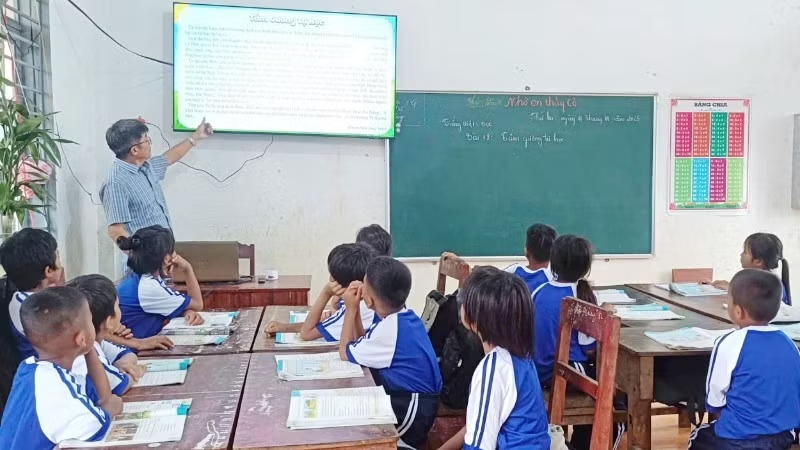
Combined lessons often take place in one classroom with two different curriculums. Teachers must organise lessons so that when one group is doing exercises, the other listens to explanations. Every activity is carefully prepared, from materials to teaching methods. The greatest challenge is ensuring every pupil receives proper attention and does not feel left behind.
Only dedication for the profession, love for the children, and belief in education’s power to transform lives keep teachers connected to this remote village for decades.
Nguyen Van Sanh, principal of Ho Le satellite school, said that for ethnic minority pupils, Vietnamese is like a door to a new world. They grow up speaking only the Van Kieu language.
Initially, pupils face many challenges learning Vietnamese. Teachers therefore foster a love for the language through songs, games, and stories linked to daily life. Pupils are encouraged to tell short stories in Vietnamese, even if only a few sentences.
To build confidence, teachers learn the Van Kieu ethnic language and visit each pupil’s family to strengthen trust and family–school partnerships. Thanks to their perseverance and affection, pupils gradually open their hearts, see teachers as family, and begin learning Vietnamese.
Ho Van Vui, a second‑grade pupil, could speak only a few Vietnamese words when he first arrived. After a year, he can now confidently tell stories and recite poems in class. This shows that with love, responsibility, and patience, all language barriers can be overcome.
Sharing hardships, warm meals, and hope
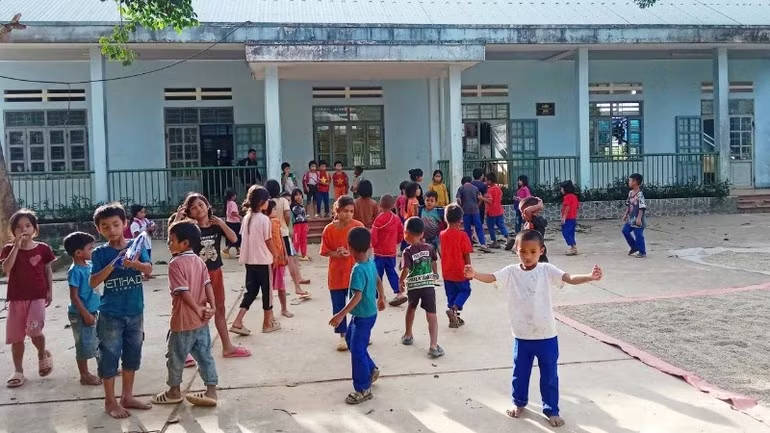
Principal Nguyen Van Sanh still remembers his first journey across muddy paths and steep passes to reach Ho Le. Each rainy season, floods cut off the village, making it impossible to deliver food and supplies.
Teachers worry most about pupils’ safety, as they must cross many streams. A single heavy rain can cause water levels to rise above head height.
When floods strike during lessons, pupils must stay at school for safety. On such days, teachers share every meal and every warm blanket with their pupils.
During prolonged floods, teachers and pupils remain at school for days, cooking rice and collecting rainwater. Once, floodwaters rose so high that all paths were blocked, leaving only a small amount of rice. Teachers rationed each meal, cooking porridge to ensure the children had enough to eat.
Parents prepare simple lunches for their children each day, and pupils receive a sponsored breakfast each week. Despite difficult living and learning conditions, the children remain obedient, sincere, and shy with strangers.
The greatest wish of teachers in Ho Le—and in hundreds of remote mountainous villages across Quang Tri Province—is that pupils attend class regularly and confidently speak, write, and use Vietnamese.
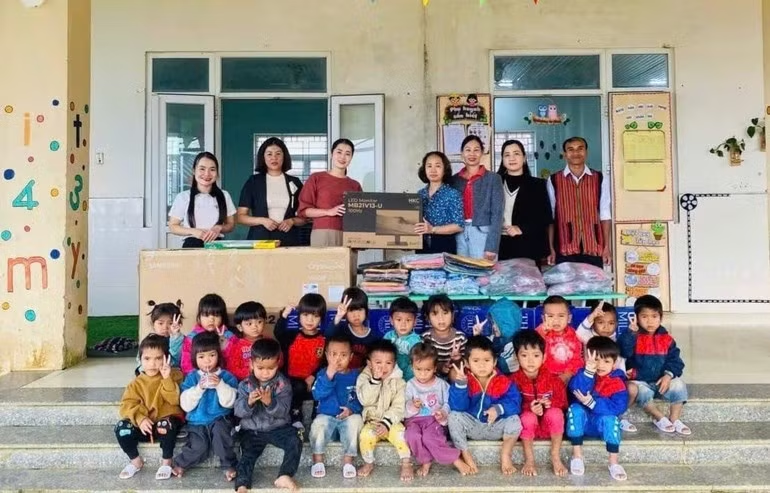
Recently, Nhan Dan Newspaper presented 10 desktop computers and two televisions to Ho Le School, bringing great joy to teachers and pupils.
In the past, parents in Ho Le were reluctant to send their children to school, believing they would eventually return to farm work. Thanks to persistent encouragement from teachers, villagers now recognise the importance of education. More children attend school, learn to communicate, and nurture dreams. Parents now pay greater attention to their children’s learning, spending more time helping them study.
The greatest wish of teachers in Ho Le—and in hundreds of remote mountainous villages across Quang Tri Province—is that pupils attend class regularly and confidently speak, write, and use Vietnamese.
It is hoped that Ho Le and neighbouring villages will have more devoted teachers and better learning facilities. Then, the seeds of knowledge sown today will blossom into a brighter future for these communities.