Mounting pressures in the East Sea and challenges at home
Between 2022 and 2025, the situation in the East Sea has continued to harbour destabilising factors. Sovereignty disputes remain unresolved, while some countries persist with unilateral actions and unreasonable claims.
Such actions not only contravene international law and the United Nations Convention on the Law of the Sea 1982 (UNCLOS), but also directly threaten the safety and livelihoods of fishermen.
Across ASEAN, member states are simultaneously reinforcing maritime sovereignty, intensifying communication to protect the marine environment, tackling illegal, unreported, and unregulated (IUU) fishing, and expanding cooperation in marine scientific research.
Regional forums, including the ASEAN Maritime Forum, have stressed the importance of sustainable management of marine resources, thereby strengthening positions to defend sovereignty rights and legitimate jurisdictional claims of coastal nations, including Viet Nam.
Fisheries remain a cornerstone of the marine economy, yet for many years, development was largely spontaneous, resulting in an exploitative fleet that exceeded sustainable levels.
Domestically, Viet Nam possesses a maritime area of more than 1 million sq. km, a coastline stretching 3,260 km, numerous islands, and key fishing grounds. Fisheries remain a cornerstone of the marine economy, yet for many years, development was largely spontaneous, resulting in an exploitative fleet that exceeded sustainable levels.
By October 2025, the country had approximately 80,800 registered fishing vessels of 6 m and above; total catch output reached 2.84 million tonnes, more than 2.2 times higher than in 2001. However, marine fishery resources have declined sharply, from 4.3–4.5 million tonnes in 2016 to around 3.6–3.95 million tonnes in 2024.
Awareness of legal compliance among some fishermen remains limited, with violations in foreign waters still occurring. These infractions directly affect the nation’s reputation and hinder efforts to lift the European Commission’s (EC) “yellow card”.
Communication campaigns drive behavioural change and shape future direction
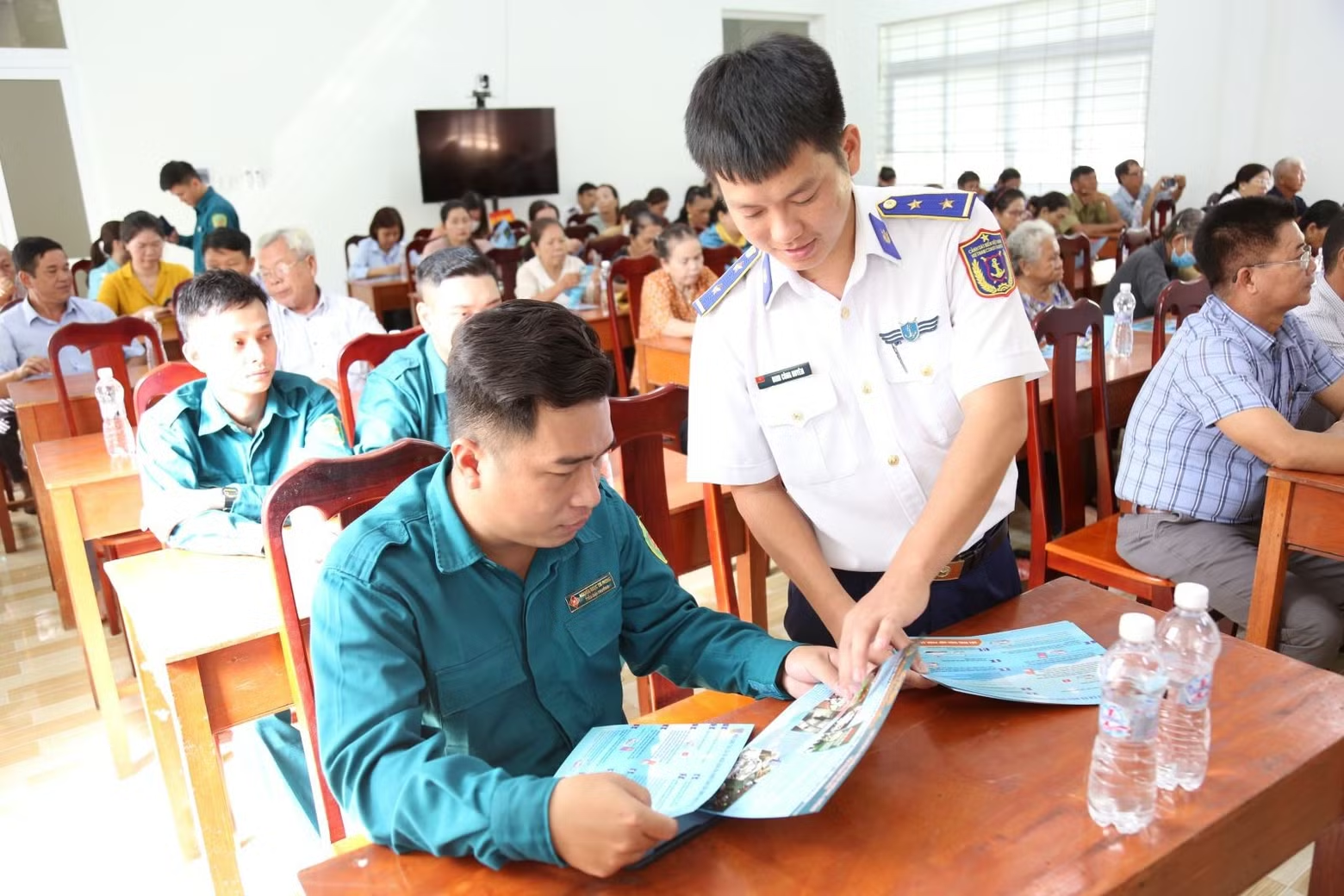
Confronted with these challenges, communication work to safeguard maritime and island sovereignty in the fisheries sector has been implemented in a systematic and coordinated manner.
The Ministry of Agriculture and Environment has issued numerous directives and communication plans, instructing coastal localities to implement them uniformly and promptly.
Notably, the 2025–2030 IUU Fishing Communication Plan has been approved, focusing on raising awareness, changing behaviour, and ensuring transparency to lift the EU’s “yellow card”.
The plan employs technology (VNeID, VMS, e-logbooks) for vessel tracking, standardises data, enforces regulations with zero tolerance, and coordinates ministries to build national consensus and international credibility in sustainable fisheries.
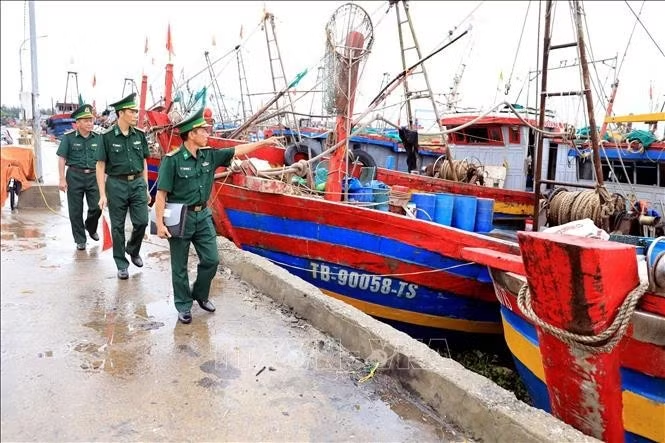
The Directorate of Fisheries has strengthened inter-sectoral and multi-level coordination with the navy, border guards, coast guard, local authorities, and media agencies.
Numerous forums, seminars, and training sessions have been organised; coordination mechanisms with enforcement bodies have been gradually refined; and vessel monitoring system (VMS) data has been shared, enhancing management effectiveness.
Communication efforts in recent years have played a crucial role in helping fishermen better understand national maritime and island sovereignty, as well as legal regulations on fisheries exploitation.
Ta Minh Phuong, Head of the Organisation and Force Building Office
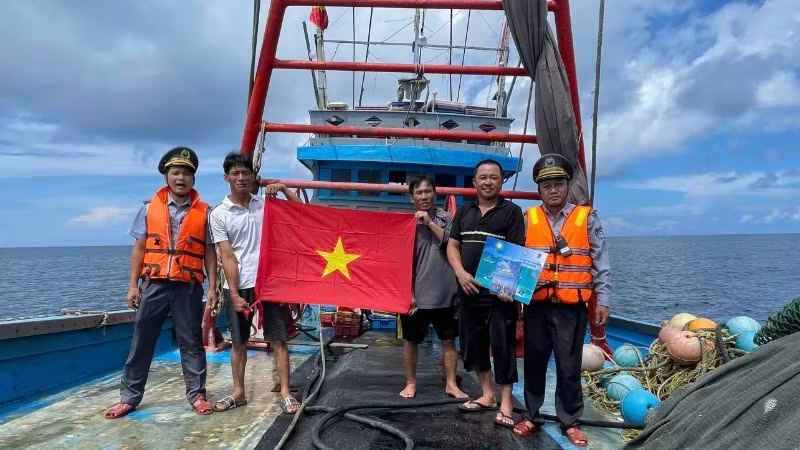
Communication has been delivered through diverse channels, including domestic media coverage and multilingual external communications. Tens of thousands of leaflets and sea manuals have been distributed free of charge to fishermen.
Campaigns emphasise Viet Nam’s sovereignty, sovereign rights, and jurisdictional claims over its maritime zones; fishermen’s responsibilities to comply with the law and combat IUU fishing; and safety measures for people and vessels at sea.
According to Ta Minh Phuong, Head of the Organisation and Force Building Office under the Directorate of Fisheries, communication efforts in recent years have played a crucial role in helping fishermen better understand national maritime and island sovereignty, as well as legal regulations on fisheries exploitation.
Improved awareness has led to tangible behavioural changes, from logging exploitation diaries and docking at designated ports to strict compliance with IUU fishing prevention regulations. Evidence shows violations in foreign waters have declined significantly; notably, Vietnamese fishing vessels no longer infringe upon the waters of Pacific island nations.
External communication has also consistently conveyed Viet Nam’s positions and policies, enhancing the country’s image and reputation, while effectively supporting diplomacy and the protection of maritime and island sovereignty.
Despite these achievements, limitations remain. Some fishing vessels still disconnect monitoring devices (VMS); resources for communication vary across localities; and the EC “yellow card” continues to pose a major challenge, requiring sustained and intensified efforts.
Looking ahead to 2026–2030, the East Sea is forecast to experience ongoing complexities, compounded by extreme weather events and severe storms driven by climate change. Fishermen and maritime enforcement forces will face heightened risks from natural disasters; traditional fishing grounds will be disrupted; and fishery resources will continue to decline.
In this context, the risk of IUU violations persists, exerting significant pressure on the goal of sustainable fisheries development.
Phuong emphasised that in the coming phase, communication must remain a key task, closely linked to law enforcement, fleet management, resource protection, and safeguarding national sovereignty at sea.
The harmonious combination of marine economic development with safeguarding national security and sovereignty remains the guiding principle of communication work in the period ahead.
The focus will be on effectively implementing the 2025–2030 IUU Fishing Communication Plan and mobilising fishermen to pledge not to violate foreign waters.
Communication methods will be further modernised through digital technology, social media, and the vessel monitoring system (VMS), ensuring fast, accurate, and accessible information for fishermen.
Inter-sectoral coordination among inspectors, navy, border guards, coast guard, and local authorities will be strengthened, while content on protecting maritime and island sovereignty will be integrated into sustainable fisheries development programmes.
Through lawful exploitation, fishermen not only contribute to economic growth but also directly reinforce national maritime and island sovereignty. The harmonious combination of marine economic development with safeguarding national security and sovereignty remains the guiding principle of communication work in the period ahead.
The 2022–2025 phase has laid a vital foundation for communication efforts to protect maritime and island sovereignty in the fisheries sector. With a systematic, coordinated, and innovative approach, the 2026–2030 period is expected to build on these achievements, reducing violations, combating IUU fishing, advancing sustainable fisheries, and firmly defending national interests at sea, Phuong stressed.