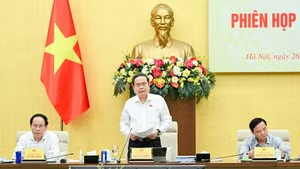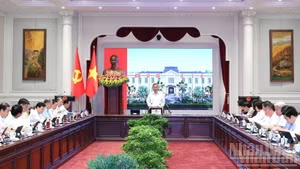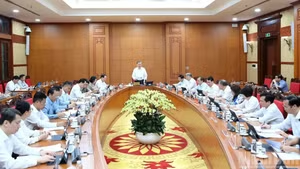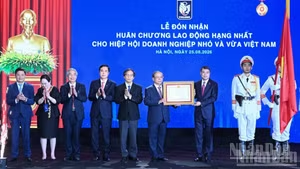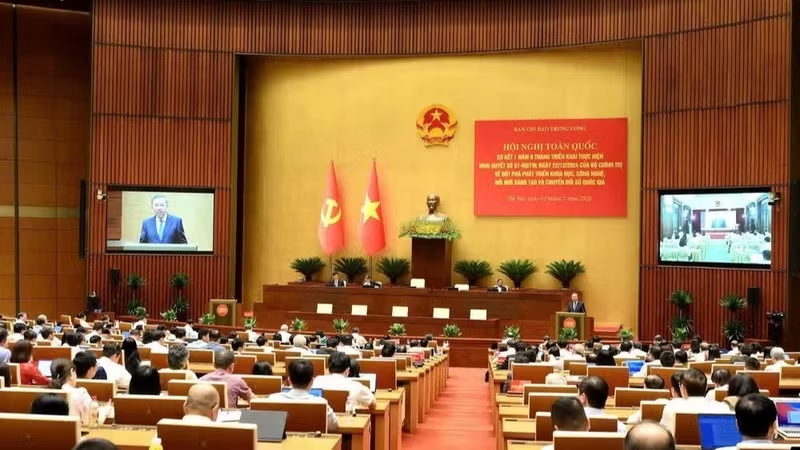
This directive is being translated into practice by Party committees and authorities at all levels through new and effective approaches, ranging from changes in governance methods and data development to restructuring production and expanding markets, thereby creating fresh momentum for growth, competitiveness and sustainable national development.
Turning policies into tangible results
The implementation of Resolution No. 57-NQ/TW has opened a new phase of national development, affirming that science and technology, innovation and digital transformation are no longer separate specialised fields, but have become methods of leadership and governance and key drivers of national development in the new era.
In Ha Noi, Action Plan No. 20-KH/BCD57, issued on January 19, 2026 by the municipal Steering Committee for Science and Technology Development, Innovation and Digital Transformation, identifies science and technology, innovation and digital transformation as important drivers for improving governance efficiency and the quality of public services, creating a favourable environment for businesses and enhancing urban management.
On that basis, the city is developing a task-based governance model suited to the two-tier local administration system, reducing intermediate levels and shortening the time needed to convey directions from the municipal level to the grassroots.
Each task has clearly defined responsibilities, deadlines and expected outcomes, gradually establishing a data-driven management approach. The city has put the HanoiWork platform into operation across the entire political system to monitor the responsibilities of individual agencies and officials and track work progress, alongside the use of performance assessment methods based on OKRs and KPIs. The system has been deployed at 179 agencies, with more than 77,000 officials participating and nearly 240,000 tasks created and monitored digitally.
The OKR/KPI-based governance model on the HanoiWork platform has helped shift management from administrative task assignment towards “digital governance based on objectives, progress, products and data”, using technology to transform the way work is organised, managed and assessed.
At the grassroots level, the drive to reform governance methods is also being implemented by communes and wards through the city’s document management and operational administration system. A pilot of the OKR/KPI method on the HanoiWork platform at five agencies has initially demonstrated greater efficiency in monitoring and evaluating work, helping reduce the time and costs involved in handling matters for people and businesses. These advances in science and technology, innovation and digital transformation are gradually improving governance and public services while generating tangible value for investment attraction and economic development in the capital.
In the first six months of 2026, Ha Noi attracted approximately 3.2 billion USD in foreign direct investment (FDI), mainly in science, technology and innovation. Production and business activities by enterprises in hi-tech parks and industrial parks remained stable, contributing about 11 trillion VND (421,05 million USD) to the city’s budget. The city’s gross regional domestic product (GRDP) grew 8.22% in the first half of the year, the highest rate in the past decade, providing a foundation for Ha Noi to pursue its target of double-digit growth in 2026.
Making products and efficiency the yardsticks of development
The implementation of Politburo Resolution No. 57-NQ/TW has laid foundations in terms of institutions, digital infrastructure, data and awareness. The central government now requires a transition to the next stage of development, creating concrete products that can operate in practice, are used by people and businesses, and generate new value for development.
General Secretary and State President To Lam has stressed the need to make a strong shift towards tangible and measurable results, with every task linked to a specific outcome and every programme contributing to the resolution of major development challenges facing the country. This directive is being translated into practice through a range of initiatives across localities.
Ho Chi Minh City is among the localities taking the initiative in developing an innovation market. The establishment of a venture capital fund with initial charter capital of 500 billion VND (19.14 million USD), with plans to increase it to 5 trillion VND (191.39 million USD) by 2030, demonstrates the city’s efforts to gradually build financial institutions to support innovation and mobilise additional resources for promising ideas, businesses and technologies.
In Dong Nai City, the Dong Nai Party Committee is focusing on building an innovation ecosystem from the grassroots level. The city has issued a directive on establishing, developing and preparing to put more than 20 innovation spaces at commune and ward level into operation. It is also completing planning for an innovation zone in Binh An Commune and a science and technology zone in Dong Xoai Ward, while accelerating legal procedures for the Long Thanh concentrated digital technology zone in An Phuoc and Binh An Communes.
These steps reflect a new approach to implementation by Party committees at all levels: rather than waiting for all conditions to be in place, they are taking the initiative based on practical needs to create new mechanisms, models and development spaces, linking innovation and digital transformation with solutions to real-world challenges.
In Thai Nguyen Province, the provincial Party Committee has called for digital transformation to be directly linked to the development of key agricultural products. The province has established a database of tea-growing areas linked to origin traceability. To date, 149 codes for tea-growing areas, covering more than 900 hectares, have been mapped using the Global Positioning System (GPS), with fresh tea-leaf output estimated at 11,300 tonnes. The establishment of growing-area codes provides a foundation for tea products to participate more deeply in high-quality agricultural value chains.
Following a similar approach, Lam Dong Province is applying science, technology and innovation to large-scale agricultural production, with more than 107,000 hectares of high-tech agricultural production. Numerous models using the Internet of Things (IoT), sensor systems, automation and artificial intelligence are proving effective, helping improve productivity, quality and production efficiency.
Ca Mau Province is developing circular and high-tech shrimp farming models, with a target of establishing 1,500 hectares of high-tech shrimp farming.
Dong Thap Province is implementing various digital transformation models in agriculture, ranging from QR-code-based traceability and cooperative management to the application of digital technologies in production. Many One Commune One Product (OCOP) products have been placed on e-commerce platforms, expanding their access to domestic and international markets.
A common feature of these models is that innovation starts with development needs, with technology applied to commercialise ideas, create new products and value for society, and enhance the competitiveness of the economy. Each locality has identified specific practical challenges to be addressed through science and technology, innovation and digital transformation.
This represents an important shift in the approach to implementing Resolution No. 57-NQ/TW. As General Secretary and State President To Lam has stressed, implementation results should not stop at the issuance of documents, the formulation of plans, the organisation of conferences or the establishment of administrative bodies. They must be demonstrated through mastery of technology, connected data, streamlined and simplified administrative procedures, higher productivity, business development, tangible benefits for people and society, and concrete contributions to economic growth.