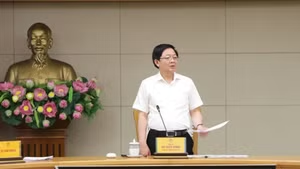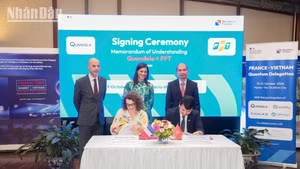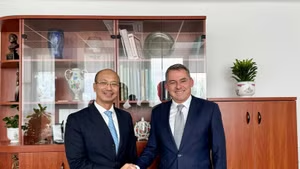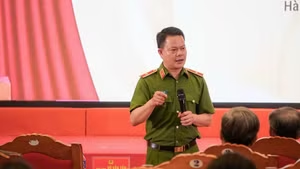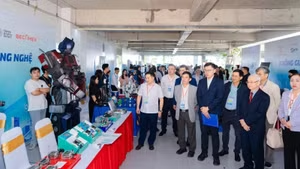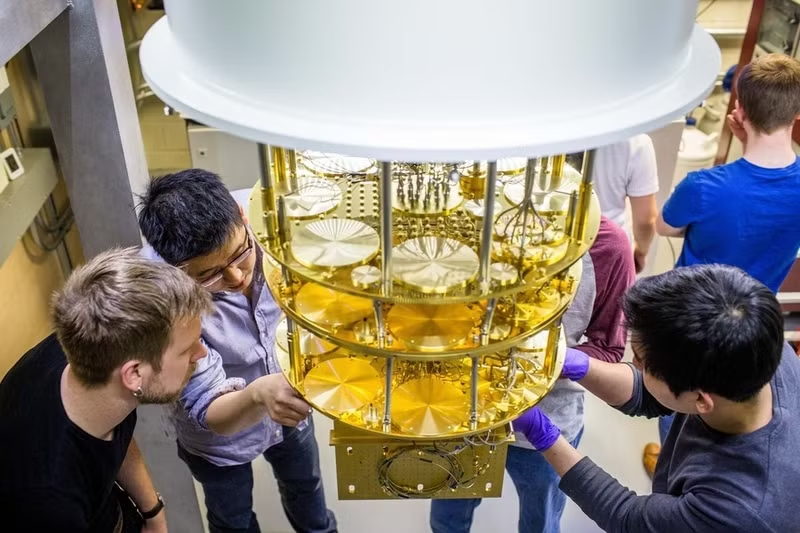
Earlier, at a working session on quantum technology development, the top leader stressed the need for a national programme to train a quantum technology workforce, alongside special mechanisms to attract and retain top talent.
Quantum technology and Viet Nam's workforce challenge
Among strategic technologies, quantum technology is emerging as a field closely linked to national strategic autonomy and data security. General Secretary and State President To Lam has repeatedly emphasised the importance of placing human resources and the innovation ecosystem at the centre of development. He called for a national programme to train quantum specialists, preferential policies to recruit and retain highly qualified experts, the establishment of strong domestic research groups, and closer international cooperation to attract overseas Vietnamese scientists and foreign experts to help build Viet Nam's quantum capabilities.
His directives come at a critical time as quantum technology becomes an increasingly competitive global race.
In this race, talent remains the greatest bottleneck. According to the Quantum Index Report 2025 published by the MIT Industrial Performance Centre, job postings requiring quantum-related skills in the US tripled between 2011 and mid-2024. Quantum technology requires expertise spanning physics, mathematics, computer science and systems engineering, making workforce development a long-term undertaking. Nevertheless, countries entering the field later still have opportunities to catch up if they begin preparing researchers, engineers and implementation specialists early.
Resolution creates opportunities as businesses roll out the red carpet for quantum talent
In strategic technology sectors, attracting top talent requires what industry leaders describe as three essential conditions: challenging problems worth solving, strong teams to collaborate with, and attractive, long-term support mechanisms.
FPT Chairman Truong Gia Binh has argued that, as the world enters a period of profound technological transformation, "there is no resource more valuable than people" and "no competitive advantage more sustainable than human capital."

Guided by this vision, FPT has adopted a three-pronged strategy to build Viet Nam's quantum workforce. The first focuses on recruiting leading quantum experts and PhD holders, both domestically and from overseas, to conduct research on core technologies.
The second is a strategic doctoral training programme across the group, providing financial support of up to 500 million VND (19,000 USD) for each doctoral candidate over four years in strategic technology fields, including artificial intelligence, quantum technology, cybersecurity, cloud computing and other priority areas. Around one quarter of the programme's participants are expected to specialise in quantum technology.
The third aims to cultivate the next generation of talent by identifying promising students and involving them in real-world research projects while they are still at university, under the supervision of leading experts.
Significantly, FPT has extended its talent development efforts beyond the company through partnerships with leading technology institutions, including the VNU University of Engineering and Technology, the Posts and Telecommunications Institute of Technology, the School of Information and Communication Technology under Ha Noi University of Science and Technology, the VNUHCM University of Information Technology, and FPT University.
These partnerships share a common goal: integrating education with research, connecting academic training with practical challenges, and enabling undergraduate, postgraduate and doctoral students to gain early exposure to quantum technology.
At Viet Nam National University Ho Chi Minh City, for example, FPT is providing academic consultation for the university's quantum curriculum while supporting the development of a dedicated research laboratory through its network of experts. According to the plan, the facility will become one of the first quantum laboratories within Viet Nam's university system.
A window of opportunity for Vietnamese quantum experts
One of FPT's leading figures in quantum technology is Dr Vo Van Tuan, Director of the group's Quantum Lab. After more than a decade of study and research in Japan, where he published numerous papers on statistical physics and quantum mechanics in prestigious journals such as Physical Review Letters and Physical Review Research, he decided to return to Viet Nam and join FPT.
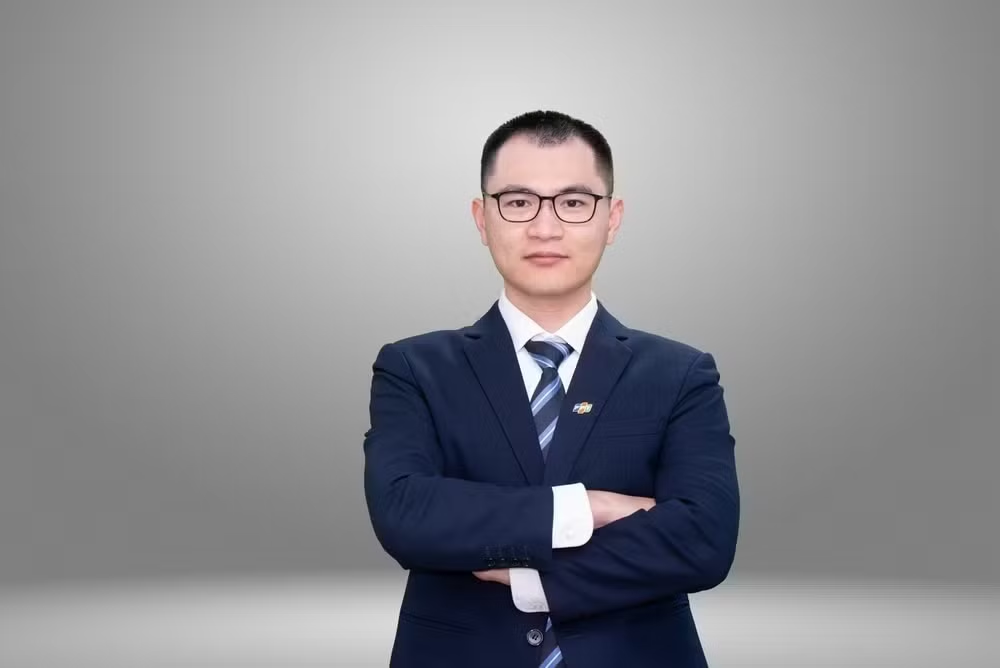
Dr Tuan believes Viet Nam is facing a unique window of opportunity, as quantum technology is moving from fundamental science to systems engineering. Many enabling technologies—including quantum software, simulation, post-quantum cryptography and quantum sensing—have matured sufficiently for latecomer countries to begin developing their own capabilities.
In his view, Viet Nam's greatest challenge is to build technological self-reliance by developing the capacity to understand, independently assess and select technologies, integrate them into national infrastructure, and gradually create its own intellectual property.
"If we wait until the technology is fully mature, Viet Nam may be able to buy the products, but it will struggle to master the technology itself," he said.
He added that quantum experts returning to Viet Nam are motivated not only by the prospect of pursuing personal research, but also by the opportunity to contribute to national priorities such as post-quantum cybersecurity and data sovereignty, quantum computing capabilities, algorithm design, circuit optimisation, compiler development, error correction, and integration with conventional computing infrastructure.
Their return could also strengthen links between businesses, universities and research institutes and the global scientific community, helping Viet Nam gain access to international standards, expertise and research networks.
Other overseas Vietnamese scientists have likewise argued that now is the right time to return home, while quantum technology worldwide is still in its formative stage.
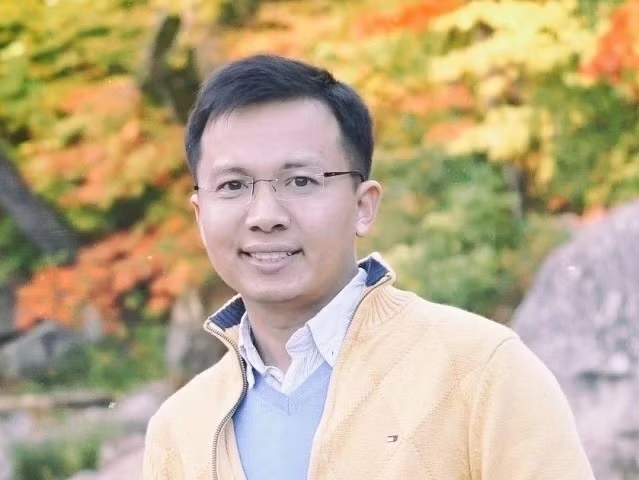
Dr Vu Thanh Long, who earned his PhD from the National University of Singapore with a dissertation on quantum control and quantum entanglement, previously conducted research at the Massachusetts Institute of Technology (MIT) and now works at the Pacific Northwest National Laboratory (PNNL) in the US. He shares Dr Tuan's view that Viet Nam must prioritise building independent technological capabilities.
"Viet Nam should pursue a strategy that combines investment in quantum technology infrastructure with workforce development, enabling the country to eventually master quantum technologies," he said.
Dr Long noted that investment in quantum infrastructure may not generate immediate economic returns. However, as more countries tighten export controls on quantum technologies, developing domestic capabilities early would reduce Viet Nam's strategic dependence on foreign core technologies for both research and education.
He added that this approach aligns with leading international quantum research and training programmes, which integrate theoretical education with hands-on laboratory work and hardware experimentation.
Professor Dr Nguyen Ngoc Tu, of Kennesaw State University (KSU) in the US, who has extensive research experience in quantum computing, quantum communications and post-quantum cryptography, believes Viet Nam should engage with quantum technology now, while the field is still in its formative stage, by participating alongside the global community in research, experimentation and technology evaluation.
Professor Tu said he hopes to contribute more actively to Viet Nam's efforts to develop its quantum workforce and innovation ecosystem. Drawing on his research experience in quantum computing and quantum communications in the US, he aims to help connect Vietnamese universities, research institutes and businesses with international networks of experts to promote collaborative research, knowledge transfer and the training of highly skilled personnel.
According to Professor Tu, Viet Nam has every opportunity to build a strong quantum community if it can establish close links among the Government, businesses, academia and the global network of overseas Vietnamese experts at an early stage. Such a collaborative ecosystem would provide a solid foundation for developing a core quantum workforce capable of supporting the country's long-term goals of technological self-reliance and enhanced national competitiveness.
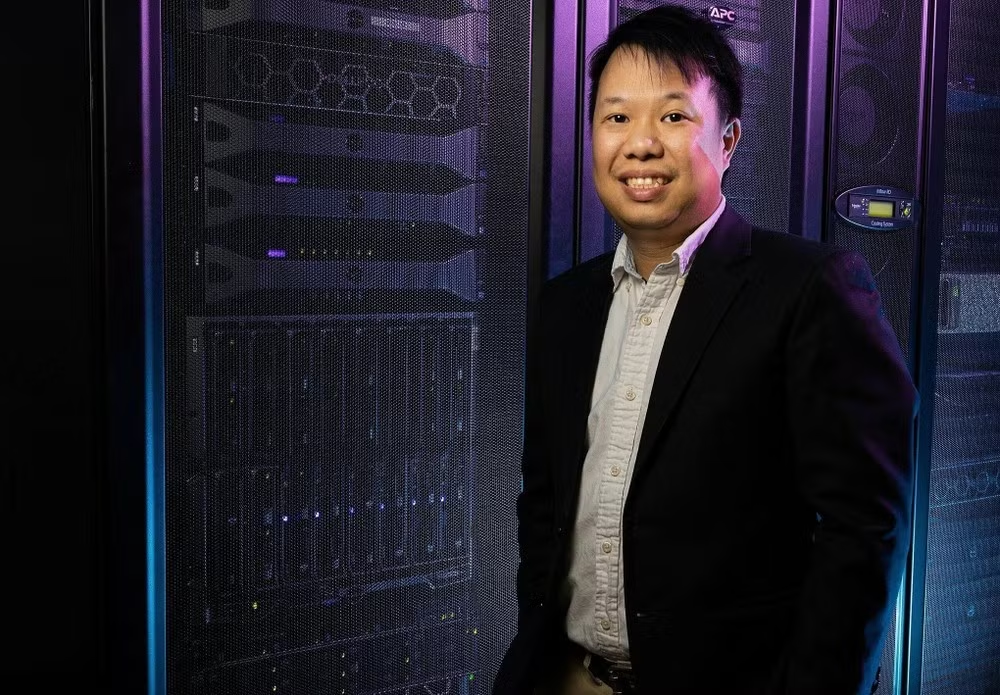
He also welcomed the proactive efforts of several domestic technology companies, including FPT, to invest in quantum research, talent development and partnerships with universities and research institutes. In his view, these initiatives will help create an environment attractive enough to encourage overseas Vietnamese experts to return home, thereby strengthening Viet Nam's quantum talent pool.
Quantum technology is a long-term endeavour that is technically demanding and requires substantial investment. Precisely because of these challenges, early, focused and sustained investment in human capital is essential. With the State providing strategic direction, universities and research institutes building strong education and research foundations, businesses committing resources, and overseas Vietnamese experts contributing their expertise, Viet Nam has an opportunity to become an active participant in the global quantum value chain rather than merely an observer of the next technological revolution.