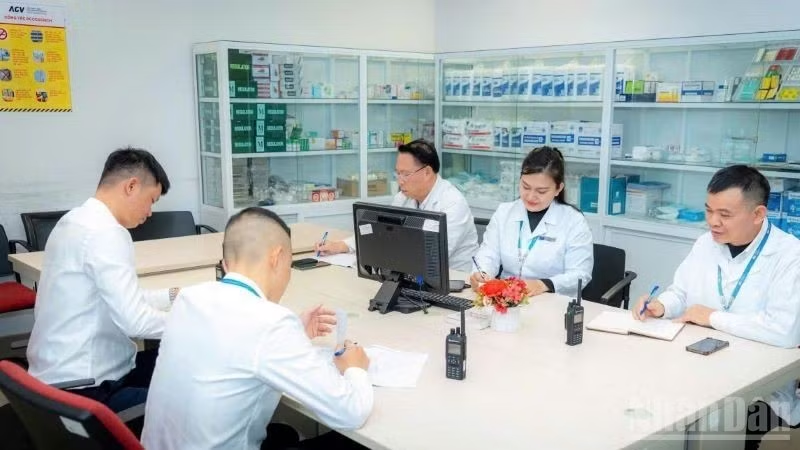
In the days leading up to Tet, the duty logbook of Noi Bai’s Emergency Medical Team was filled with dense entries on emergency cases, each one a story of human fate, moments where lives quite literally hung by a thread.
A lifeline for passengers at the airport
While tens of thousands of passengers count down the hours to reunite with their families, members of the Emergency Medical Team quietly hurry in the opposite direction, moving against the flow of the crowd. As passenger numbers swell day by day, the pressure on these safety “checkpoints” grows ever greater.
“Here, we don’t wait to watch fireworks at midnight. We stay on standby beside our walkie-talkies, awaiting emergency medical calls,” said Dr Ngo Ngoc Quyen, Head of the Emergency Medical Team at Noi Bai International Airport, as she began sharing stories about her colleagues who silently remain on the medical frontline to safeguard passengers’ health at the gateway to the capital.
In the days approaching Tet, the burden on the team’s members becomes heavier than ever as they serve as a vital health lifeline not only for passengers on board aircraft but also for those within the terminal itself.
A recent incident involving Dr Nguyen Thi Thuy Cam is a case in point. In the crowded departure area of Terminal T2, a young female passenger suddenly fainted just moments before her flight was due to depart.
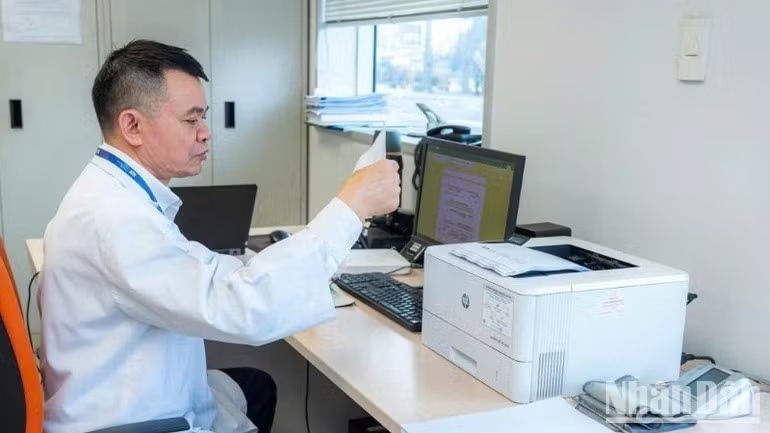
Upon receiving the alert from shift leader Pham Lan Huong, Dr Cam immediately rushed from the duty room. After weaving swiftly through the bustling crowd, she promptly administered first aid and provided attentive care until the passenger had fully recovered.
Thanks to her professionalism and dedication, the passenger was able to complete immigration procedures in time to travel with her family. With little time to spare before take-off, the grateful passenger left behind a hastily written but deeply moving note: “We are truly grateful for this dedicated and timely support.”
On January 31, 2026, another medical emergency occurred involving a 30-year-old passenger on a flight to Viet Nam from the Republic of Korea. The passenger experienced shortness of breath, panic, and muscle spasms in her limbs.
The on-duty team led by Dr Pham Lan Huong, together with Dr Pham Thi Thuy Ngan stationed at the emergency point on the first floor of Terminal T2, diagnosed the passenger with hypocalcaemia and decided to administer a slow intravenous injection of calcium chloride.
Earlier, the patient had been given a calcium tablet but had vomited it out. After five minutes, her breathing improved and the spasms gradually subsided. Following one hour of close monitoring, she made a full recovery and was cleared to return home to celebrate Tet with her family.
Earlier, on January 3, a critical situation unfolded on a flight from Hai Phong to Ho Chi Minh City. Shortly after take-off, a 74-year-old passenger became dizzy, fainted, and suffered breathing difficulties. Cabin crew administered first aid and oxygen, and the captain requested an emergency landing at Noi Bai Airport.
Upon receiving information from the control tower, the emergency command centre relayed flight details and the passenger’s initial condition to the airport’s emergency medical team so that personnel, equipment, and medicines could be prepared in advance.
The medical team on duty promptly arrived at the designated location as soon as the aircraft landed. The passenger, who had a history of diabetes and hypertension, was found to have limb weakness and urinary incontinence, indicating cerebral ischaemia and a very high risk of stroke.
Doctors urgently administered high-flow oxygen and bronchodilators and closely monitored vital signs. Thanks to the effective use of the golden time while still on board the aircraft, the patient’s condition was stabilised before being transferred to the National Hospital for Tropical Diseases.
Another dramatic rescue involved a 58-year-old Philippine female passenger, who was preparing to board a flight to Manila. With a 10-year history of chronic obstructive pulmonary disease, she developed severe shortness of breath, rapid breathing, and a fast pulse after boarding. The medical team led by shift leader Dr Pham Lan Huong arrived immediately, together with another on-duty doctor stationed on the third floor of Terminal T2.
Advanced emergency procedures were carried out on the spot, including bronchodilator medication, intravenous injection, and high-flow oxygen therapy. After 10 tense minutes, her breathing eased and her pulse stabilised. Although she had passed the immediate danger, the doctors decided in the interest of passenger safety not to allow her to continue the long-haul flight. Instead, she was transferred to Ha Noi Heart Hospital for further monitoring and treatment.
A medical “shield” at the aircraft door
Once a patient has passed the critical stage, doctors must take on another crucial task: assessing and advising on fitness to fly. Explaining these often difficult decisions, Dr Ngo Ngoc Quyen emphasised: “In reality, airport doctors do not directly decide whether a passenger may fly or not. We act as medical consultants, outlining the passenger’s current health status and potential risks associated with cabin pressure changes and recommending the safest course of action so that the airline and the passenger have a sound basis for their decision.”
If a passenger remains determined to travel, they must sign a liability waiver with the airline. At that point, clearance to board is the result of consensus among three parties: the passenger’s resolve, the airline’s regulations, and most importantly the doctors’ careful medical advice. This coordination process is carried out with strict professionalism, yet remains flexible and humane.
A typical example is the case of a 62-year-old Russian tourist on a flight from Nha Trang to Ha Noi, en route to Russia, in early July 2025. She suffered from hypotension, cold sweats, and numbness in her limbs. Upon arrival, the emergency medical team quickly warmed her, gave her ginger tea, and administered calcium supplements and the blood-pressure-raising drug heptaminol.
After 20 minutes of intensive treatment, her blood pressure rose to normal and her symptoms stabilised. Fully alert and with stable vital signs, she signed a liability waiver with the airline’s representative and was allowed to continue her journey home with her family.

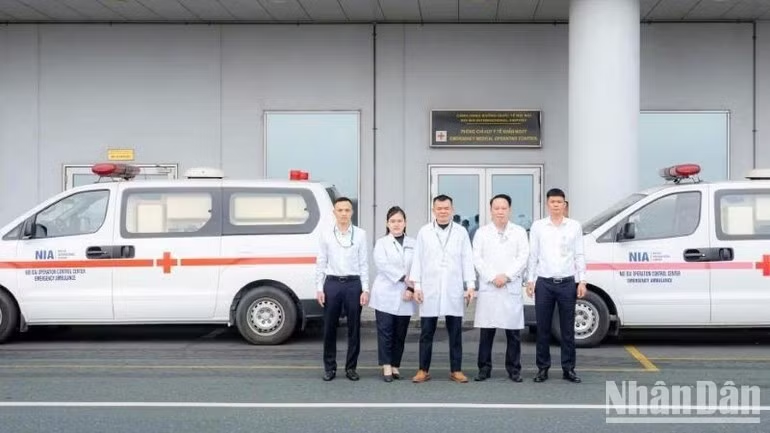
To ensure every Tet homecoming journey is safe and complete, emergency medical services at Noi Bai International Airport are staffed and ready 24/7. The team comprises 23 members — including doctors, nurses, and ambulance drivers — stationed at three key emergency rooms in Terminals T1 and T2, as well as the command duty room.
Day or night, specialised ambulances are always ready to move, ensuring that whenever passengers need medical assistance, doctors can be on the scene without delay.
The relentless pace of work makes the idea of a Tet holiday a luxury for these white-coated professionals. Duty rosters are packed to guarantee round-the-clock coverage. Many doctors and nurses put aside Tet preparations, entrusting their children to grandparents so they can devote themselves fully to their work. For them, New Year’s Eve may be a quiet moment with a meal box in the duty room, or spent rushing aboard an ambulance.
For these silent guardians, the joy of Tet lies in the safe passage of flights and the relieved smiles of passengers after surviving critical moments — the most precious reward of all. Wherever passengers are within the vast terminal, Noi Bai’s Emergency Medical Team is always there, ready to care with expertise and dedication, ensuring that every journey home is complete and safe.