Throughout implementation, the province has closely followed the roadmap for meeting the criteria of a Class-I urban area, aiming to become a centrally governed city before 2030.
Maximum effort on site clearance
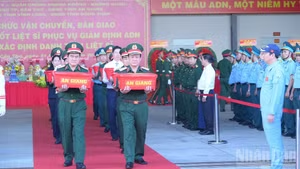
In the days leading up to Tet, work across communes, wards, and units involved in the Gia Binh International Airport project remained busy and operating at full capacity. To secure cleared land for the project, localities have been working “three shifts, four crews” through the Tet holiday. At this time, villages and communes are stepping up the relocation of graves, while contractors and construction teams are racing to complete all items at new cemeteries for handover before Tet.
Phu Ninh Hamlet was the first unit in Gia Binh Commune to “reach the finish line early” in handing over land for the airport project. By February 2, the hamlet had relocated 335 graves across a total area of one hectare to the commune’s new concentrated cemetery.
Earlier, 17 hectares of agricultural land were also handed over ahead of schedule. Nguyen Tien Nhuong, representing the Nguyen Tien clan, said that as the largest and longest-settled clan in the hamlet, they not only attended commune and hamlet meetings on the relocation plan, but also held their own clan meetings to mobilise support. With consensus secured, all 165 graves of the clan were relocated within two days, on January 31 and February 1.
Nguyen Van Hang, Secretary of the hamlet Party Cell, said that to ensure fairness and transparency, alongside mobilisation and outreach, the hamlet organised a lottery by clan for grave relocation. Local people strongly supported the policy of allocating land for the project. Although a third of the graves had not yet received compensation, within two days residents moved all graves to the new site that had already been planned and built with synchronised infrastructure.
According to Bac Ninh’s Land Fund Development Centre, as of February 6 it had declared and inventoried around 12,000 graves and paid compensation for 5,365 graves, with total funding of more than 96 billion VND. In Gia Binh Commune, advances were provided for nearly 4,400 graves (100%), while Nhan Thang reached 95%.
In parallel, works to rebuild public cemeteries for grave relocation are being carried out urgently. At Dong Cuu Commune cemetery, the contractor has completed the basic construction of nearly 5,000 graves as planned. To meet local demand, the cemetery in Ngoc Xuyen Hamlet, Gia Binh Commune has been expanded from 1.8 hectares to 10 hectares and is now rushing to complete its infrastructure. Located in Trinh Khe Hamlet, Trung Chinh Commune, the cemetery-park project is finishing its final items, designed to accommodate around 28,000 burial plots.
Accelerating restoration of technical infrastructure
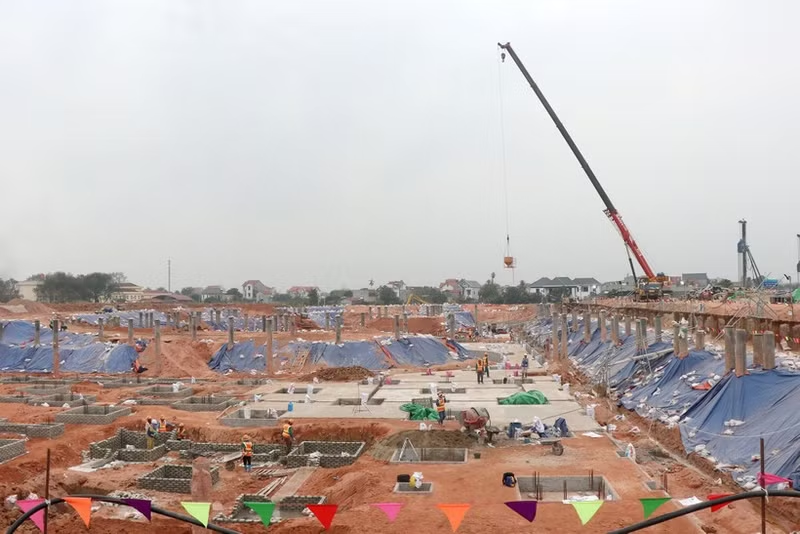
The Gia Binh International Airport project covers a total area of more than 1,959 hectares across four communes in Bac Ninh Province: Gia Binh, Nhan Thang, Luong Tai, and Lam Thao, with total investment exceeding 196 trillion VND. Statistics from the provincial Land Fund Development Centre show that within the planned boundary there are around 120 public works, totalling 53 hectares, that need to be relocated, including schools, agency headquarters, cultural houses, health stations, religious and belief facilities, cemeteries, irrigation works and more.
Luong Tai Commune has the largest site clearance area for the project, with more than 1,000 hectares across 20 hamlets, directly affecting 7,800 households. Ngo The Dua’s family in Bui Hamlet has more than 150 square metres of residential land and over 2,000 square metres of agricultural land subject to relocation for the airport. Dua said that after three briefings at commune level and two at hamlet level about the new resettlement zone plan, residents were highly supportive and ready to hand over land according to schedule.
Under the plan, the village communal house will be preserved with its core elements intact, and placed in a spacious and convenient location within the resettlement area and villagers hope the plan will be implemented as designed.
Do Dinh Huu, Director of Bac Ninh’s Land Fund Development Centre, said that the measurement and counting work for site clearance has largely been completed. The inventory of nearly 170 hectares of residential land involving more than 6,000 households was conducted openly and transparently, with strong public support.
The province and the investor are now focusing on reviewing and determining the scale and plan for restoring affected infrastructure systems and public works. During implementation, Bac Ninh has required the investor and local authorities to ensure that restoration of infrastructure and public works is calculated in a way consistent with local development planning.
The Gia Binh International Airport project covers a total area of more than 1,959 hectares across four communes in Bac Ninh Province: Gia Binh, Nhan Thang, Luong Tai, and Lam Thao, with total investment exceeding 196 trillion VND.
To safeguard livelihoods for people whose land is recovered, project documents indicate that construction will require around 1,200–1,500 workers, most of whom will be recruited locally. Once operational, the project commits to creating about 10,000 direct and indirect jobs, with at least 30% of the workforce drawn from local labour. The investor will coordinate with local authorities to establish a Gia Binh aviation training facility to provide ICAO/IATA-standard vocational certificates, creating opportunities for workers in the area to transition to new jobs.
With the determination to bring Gia Binh International Airport into operation to serve the APEC Leaders’ Meeting in 2027, Bac Ninh Province is rolling out work in phases, enabling early handover of cleared land for construction in key areas where conference-related facilities will be built.
In the immediate term, the province has asked relevant units to urgently review all available housing stock and facilities that could be used for temporary accommodation for affected households nearby, and to prepare support plans for safeguarding property throughout the temporary stay so residents can stabilise their living arrangements quickly after relocation.