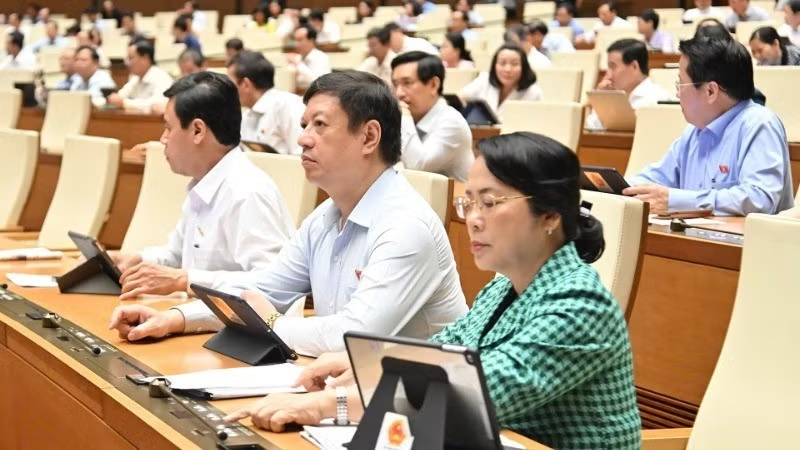
Under the Party’s comprehensive leadership, legislative thinking has in recent years been renewed to ensure the effectiveness of state management, while promoting innovation, unlocking development resources, and creating breakthroughs in effective, strict and unified law enforcement.
Fundamental shift in legislative thinking
The work of drafting and enforcing laws by the National Assembly, the Government, ministries and central agencies, as well as local authorities, has seen marked changes, both in mindset and in action.
Reporting to the National Assembly on the past term, National Assembly Chairman Tran Thanh Man stressed that legislative activities have undergone strong innovation in both thinking and drafting procedures, becoming more proactive, creative and dynamic, with early and forward-looking preparation to uphold the role of being “one step ahead in institutional development” in response to practical demands.
During this term, the National Assembly adopted a resolution amending and supplementing a number of articles of the 2013 Constitution in order to institutionalise major Party guidelines, particularly those relating to the reorganisation of the state apparatus towards greater streamlining, effectiveness and efficiency, while remaining close to the people and grounded in reality.
A large volume of legal documents and policies was also reviewed and revised to ensure the effective operation of the two-tier local government model. The National Assembly passed many forward-looking laws, such as the Law on Artificial Intelligence and the Law on the Digital Technology Industry, along with special mechanisms for education and healthcare, to establish a legal framework for emerging issues in the digital era.
According to Nguyen Thi Thuy, Deputy Chairwoman of the National Assembly’s Committee on Legal and Judicial Affairs, this represents a new approach to law-making: shortening timelines and procedures, redefining roles in drafting legislation, and renewing thinking on the removal of legal bottlenecks.
Instead of the previous requirement for laws to be highly specific and directly enforceable, recently enacted laws set out only framework and principle-based provisions within the National Assembly’s authority. Specific and frequently changing practical matters are delegated to the Government for regulation, enabling more flexible policy responses and creating growth momentum.
As the executive body, the Government has also introduced many innovations and greater flexibility in its legislative work. It has proactively proposed numerous draft laws with open and facilitative mechanisms and policies, contributing to the improvement of the socialist law-governed state and the socialist-oriented market economy, thereby promptly removing institutional bottlenecks and constraints.
During the COVID-19 pandemic, the Government submitted to the National Assembly a resolution on fiscal and monetary policies to support the socio-economic recovery and development programme. The resolution included unprecedented measures allowing the mobilisation of very large resources to swiftly address urgent issues. It contributed to effective COVID-19 prevention and control, the restoration of social life to normalcy, and economic recovery and growth.

The Government has regularly organised meetings on law-making to keep abreast of practical developments, promptly address difficulties and obstacles, and amend and supplement policies. Legislative thinking has shifted from “management” to “development facilitation”, and from “pre-inspection” to “post-inspection”. Discipline in law enforcement has been tightened, with greater emphasis placed on the responsibility of agency heads.
Guiding principle for law building and enforcement
To concretise the resolution of the 13th National Party Congress, in April 2025 the Politburo issued Resolution No. 66-NQ/TW on renewing the work of law-making and law enforcement to meet the country’s development requirements in the new era.
The Central Steering Committee on Institutional and Legal Improvement, under the Politburo and headed by General Secretary To Lam, was established to provide comprehensive leadership and direction in implementing solutions to refine institutions and laws.
After a period of implementation, the resolution has brought about clear changes, with many breakthroughs in building and improving institutions and laws to meet development needs. Difficulties and obstacles arising from legal regulations have been explicitly identified for focused resolution according to their urgency.
By the end of December 2025, the target of basically eliminating legal bottlenecks by 2025 had been achieved.
A roadmap for improving the structure of the legal system has also been developed, including reducing the number of forms of normative legal documents based on the principle that each authority issues only one type of such document. This contributes to a streamlined, transparent and accessible legal system.
Policies have been designed in line with the principle of placing citizens and businesses at the centre of policy design, including a sharp reduction of around 800 data-based administrative procedures, thereby removing barriers for enterprises and the public.
In line with the spirit of promoting digital technology application in renewing legislative thinking and law enforcement under Resolution No. 66-NQ/TW, many processes for drafting, reviewing and formulating legal documents have integrated artificial intelligence (AI) and open data. This enables authorities to conduct faster and more comprehensive policy impact assessments, and to detect early inconsistencies in form and overlaps in content, thereby minimising legal conflicts.
National Assembly Chairman Tran Thanh Man noted that during the final four sessions of the 15th National Assembly, the spirit of innovative legislative thinking was clearly demonstrated, alongside the application of science and technology. The National Assembly 2.0 application, with significant improvements and an integrated AI virtual assistant, has enabled the legislative body to pass a large number of laws and resolutions during its sessions.
Nguyen Thanh Phuong, a National Assembly deputy from Can Tho City, stated that without digital transformation and AI applications, it would have been very difficult to handle such a heavy workload.
Digital transformation has not only brought a fresh impetus to law-making but has also delivered impressive results in policy implementation. More than 230,000 questions have been submitted to the AI Legal Assistant application on the National Legal Portal, achieving a satisfaction rate of 84% after just a few months of operation.
More than 8 trillion VND in civil enforcement related to the Van Thinh Phat case has been transferred into the accounts of over 40,000 bondholders, instead of issuing tens of thousands of paper documents as before. The entire civil enforcement process now operates on a digital platform. AI helps automate data extraction, task allocation and progress monitoring, while citizens can easily interact, check case files and receive notifications via QR codes and VNeID.
According to the Central Steering Committee on Institutional and Legal Improvement, these results are only an initial step. Practice continues to pose new requirements, calling for stronger and more effective implementation of Resolution No. 66-NQ/TW, in the spirit that “what is good must be made even better”.
![[Infographic] Key points from General Secretary and President To Lam’s opening remarks at the 14th PCC’S 4th plenum](https://en-cdn.nhandan.vn/images/j0QNt7m_5iy1OXpnUKiwG61aYhTv_B140GWhfriF26JwZbNNJ8LWetfvXUhz4Az6/1-8220.jpg.avif)