For Kim Sang-sik and his players, the 2027 Asian Cup finals ahead are not only a test of capability but also a stepping stone to shape ambitions of reaching continental level and moving towards the dream of the 2030 World Cup.
After officially signing a two-year contract with the Vietnamese Football Federation in April 2024, Kim Sang-sik quickly made a strong impression with notable achievements from the U23 team to the national team.
A measure of continental class
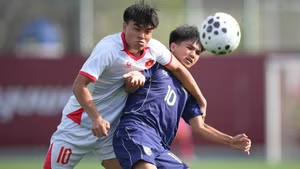
During this period, the Korean strategist has achieved a series of impressive successes with Vietnamese football. However, most of these achievements have so far been within the Southeast Asian region, in familiar tournaments such as the AFF Cup, the Southeast Asian U23 Championship, and the SEA Games. At the continental level, his most notable achievement to date has been reaching the finals of the 2026 AFC U23 Asian Cup, considered the first clear test of his managerial ability against top Asian opponents. Following the bronze medal at that tournament with a promising generations of young footballers, fans are hopeful that he can replicate such success at the national team level.
In this context, the 2027 Asian Cup finals, scheduled for January 2027, will be a true test for Kim Sang-sik and his team. In fact, since taking charge of the Vietnamese national team, the Korean coach has only led his players in four matches against opponents outside Southeast Asia. Apart from Nepal, who are not highly rated, the “Golden Star Warriors” have faced teams of equal or higher level such as Iraq, India, and Russia, but have not secured a victory. As a result, expectations for Kim and his players continue to grow.
According to former coach and football expert Doan Minh Xuong, the Vietnamese national team currently possesses a promising generation of players, with a harmonious transition between young talents and experienced figures. Players at their peak such as Nguyen Hoang Duc, Nguyen Quang Hai, and Nguyen Hai Long are performing well, while naturalised players, notably Nguyen Xuan Son and Do Hoang Hen, bring additional options and healthy competition within the team. This gives fans a solid basis to hope for potential surprises at this important continental tournament.
Experts believe that regional tournaments in 2026 will play a role as crucial stepping stones, helping the Vietnamese national team’s coaching staff to shape the core squad and refine personnel structure in preparation for continental tournaments over the next three years.
Experts believe that regional tournaments in 2026 will play a role as crucial stepping stones, helping the Vietnamese national team’s coaching staff to shape the core squad and refine personnel structure in preparation for continental tournaments over the next three years. After the return leg against Malaysia in the 2027 Asian Cup qualifiers, the Vietnamese national team will set specific targets at tournaments such as the AFF Cup or the ASEAN Cup 2026. These tournaments are not only about results but are also stepping stones to build a new, more complete team in terms of playing style and identity. The most important objective is long-term goals, towards the 2027 Asian Cup finals and, further ahead, the 2030 World Cup qualifiers.
“These are the tournaments that truly measure class, and with good preparation and a clear roadmap, the Vietnamese national team can absolutely create a new image and be competitive at the continental level,” Xuong shared.
Towards the 2030 World Cup
At the 2023 Asian Cup finals, the Vietnamese national team were eliminated in the group stage after three defeats to Japan, Iraq, and Indonesia. This was clearly an unsatisfactory result, especially considering that four years earlier the team had reached the quarter-finals. The failure at the 2023 Asian Cup reflected significant changes in the squad as well as difficulties during the generational transition at that time. However, the current squad picture has gradually become brighter, as a new generation of players is maturing along with experienced key figures, providing a basis for optimism ahead of the 2027 Asian Cup.
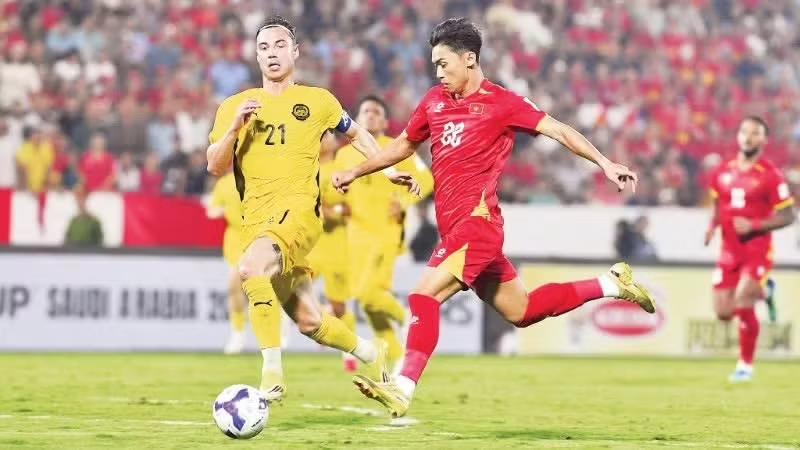
A clear example is the convincing performance in Viet Nam’s 3–1 victory over Malaysia in their final Group F match of the 2027 Asian Cup qualifiers. Kim Sang-sik’s decision to give opportunities to naturalised players Xuan Son and Hoang Hen created a clear turning point in the team’s playing approach. Their presence significantly improved connectivity between lines. While Hoang Hen was deployed in midfield, bringing creativity, skill, and a strong Brazilian style, Xuan Son demonstrated his scoring instinct with sharp positioning and finishing. The effective combination of these two Brazil-born naturalised players has partly transformed the face of the Vietnamese national team.
“Hoang Hen is a very high-quality player who has proven himself over many years. His presence on the pitch gives confidence not only to me but to the whole team,” midfielder Hoang Duc shared.
In the match against Malaysia, Do Hoang Hen provided an assist for Xuan Son to make it 2–0. It was a move that showed their understanding, and it was also his 11th assist for Xuan Son in their careers.
“We don’t need to speak; just by looking, I know how Xuan Son will move, so it is very easy to combine,” Hoang Hen said after the victory.
According to football expert Le Minh Dung, who was part of the Vietnamese national team coaching staff at the 2023 Asian Cup finals, to create a real “boost” at the continental level, the team needs thorough preparation in all aspects. First of all, it is essential to build a consistent mindset in preparation. This process cannot be stretched over many years, as the squad is always subject to changes due to injuries or form. Therefore, establishing a core squad around six months before the tournament is crucial. At the same time, the coaching staff should proactively expand the player pool to ensure sufficient alternatives for any unexpected situations.
To create a real “boost” at the continental level, the team needs thorough preparation in all aspects. First of all, it is essential to build a consistent mindset in preparation. This process cannot be stretched over many years, as the squad is always subject to changes due to injuries or form. Therefore, establishing a core squad around six months before the tournament is crucial. At the same time, the coaching staff should proactively expand the player pool to ensure sufficient alternatives for any unexpected situations.
Football expert Le Minh Dung
In addition, the Vietnamese national team’s coaching staff must carefully prepare for all possible variables throughout the 2027 Asian Cup finals, as this is a highly competitive tournament where many teams can produce surprises due to the difficulty in fully assessing their squad and playing style. Therefore, opponent analysis plays a key role, not only in tactical preparation but also in building playing style, selecting personnel, and managing players’ mentality. At the same time, the ability to make timely adjustments during the tournament will be decisive for the final outcome.
“Vietnamese players actually have great determination and passion. As long as we build a united team that fights for one another, we can always create surprises,” Dung commented.
It can be said that the 2027 Asian Cup finals will play as an important run-up before the Vietnamese national team embarks on the journey of the 2030 World Cup qualifiers, which are expected to take place in 2028. The team’s identity will become clearer through this tournament, which will also be the most accurate measure of their ability to compete for a place at the 2030 World Cup.