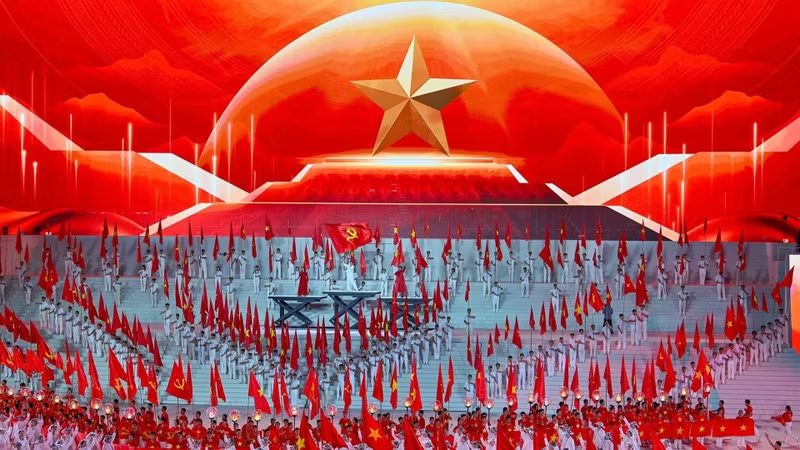
An increasing number of songs composed by young artists expressing patriotism, national pride, gratitude towards President Ho Chi Minh, and confidence in the leadership of the Communist Party of Viet Nam have attracted widespread public attention.
Free from ostentation or imposition, songs such as La co (The flag) by Ta Quang Thang; Viet tiep cau chuyen hoa binh (Continuing the story of peace) and Tu hao tiep buoc tuong lai (Proudly stepping into the future) by Nguyen Van Chung; Ho Chi Minh – Mat troi chan ly (Ho Chi Minh – The sun of truth) and Loi Dang hieu trieu trai tim (The Party’s call to the heart) by Hoang Hong Ngoc; Kiep sau van la nguoi Viet Nam (In the next life, still Vietnamese) by Tuan Cry; Nha toi co treo mot la co (There is a flag hanging in my home) by DTAP; and, more recently, Y Dang, long dan (The Party’s will, the people’s hearts) by Hoang Hong Ngoc have spread widely across digital platforms.
What is particularly noteworthy is their approachable, everyday perspective, placing grand values in a natural relationship with personal emotions and lived experience. In the past, many works about the Party and President Ho Chi Minh were often expressed in epic, solemn musical forms. By contrast, today’s younger generation of composers perceive the image of the Fatherland, the Party and Uncle Ho through deeply human, intimate emotional resonances.
La co is an expression of pride and gratitude for the silent sacrifices of previous generations; Viet tiep cau chuyen hoa binh evokes a sense of responsibility among today’s generation to safeguard the fruits of the revolution. It is precisely this sincerity of emotion and psychologically attuned expression that has created the strong resonance of these songs among young audiences.
It is not difficult to see young people covering, sharing and using these songs during major national holidays, Youth Union activities, community events, or simply as a way of expressing personal feelings. Music thus becomes a natural yet effective bridge, helping to nurture life ideals, awaken pride, and strengthen a sense of responsibility towards the country.
At a time when young people have countless entertainment choices, the fact that many young artists consciously turn to themes of the Party, President Ho Chi Minh, the Fatherland and national development aspirations carries particular significance. This is not a fleeting response to trends, but the result of reflection, internalisation and deliberate choice of core values to embed in artistic creation—an admirable manifestation of cultural integrity and civic responsibility.
Looking across the history of Viet Nam’s revolutionary music, from songs born amid the flames of war that inspired the struggle for independence, to works created during the periods of national construction and defence, music has always accompanied the nation, reflecting the aspirations, ideals and emotional life of each generation.
Songs such as Tuoi tre the he Bac Ho (The youth of Uncle Ho’s generation) by Trieu Dang, Thanh nien lam theo loi Bac (Young people following Uncle Ho’s teachings) by Hoang Hoa, Nhu co Bac trong ngay dai thang (As if Uncle Ho were with us on the day of great victory), and Dang cho ta mua xuan (The Party brings us spring) by Pham Tuyen have become precious spiritual legacies, cherished by generations of Vietnamese people and sung with pride at the nation’s most significant moments.
Today’s young artists are continuing this tradition through a modern artistic language suited to contemporary life, while still preserving core values and national identity. Historical and traditional values are not broken, but rather sustained and passed on in new contexts. Patriotic songs by young artists are not merely personal creations, but the collective voice of a broad segment of Vietnamese youth today.
However, reality also shows that whenever musical works praising the Party, President Ho Chi Minh and the country emerge, a number of individuals express extreme and hostile attitudes, levelling harsh criticism and attacks. From distorting lyrics and mocking messages with coarse language, to imputing motives by accusing artists of “self-interest” or “calculation”, and even launching personal attacks and insults on social media, such behaviour not only provokes public indignation but also creates an unhealthy debate environment, distorts cultural values and pollutes the community’s spiritual life.
A sober assessment reveals that twisting the meaning of artistic creations is a familiar tactic aimed at diminishing the social value of positive cultural trends, sowing doubt and distorting perceptions, thereby undermining social trust. If not promptly recognised and countered, such misguided viewpoints can disrupt the cultural space and erode the community’s spiritual motivation.
It must be clearly affirmed that artistic creation is a personal freedom protected by law. Every artist has the right to choose their themes, modes of expression and messages, provided they do not violate social norms or legal regulations. Young artists expressing patriotism, national pride, and respect and gratitude towards national history, President Ho Chi Minh and the Communist Party of Viet Nam should be viewed as a healthy manifestation of civic consciousness, of the moral principle of “when drinking water, remember its source”, and of responsibility towards the values painstakingly cultivated by previous generations.
From the perspective of human development and cultural environment building, in the current context of deepening international integration, the market economy and cyberspace exerting strong influences on the lifestyles of segments of youth, humanistic works that guide aesthetic sensibilities and life ideals play an especially important role.
From the standpoint of social reception, this phenomenon indicates that public aesthetic tastes are shifting towards valuing enduring, humanistic values closely linked to national history and destiny. Encouraging and promoting such works is therefore not only the responsibility of management agencies or the press, but a shared duty of society as a whole in safeguarding and fostering the positive values of national culture.
Viewed more broadly, the spread of patriotic songs composed by young artists shows that patriotism is not an abstract concept or a slogan, but something expressed through concrete choices in creativity and spiritual life. When young people choose to sing about the Fatherland, the Party and President Ho Chi Minh with genuine emotion, it is a vivid expression of belief, aspiration to contribute, and a sense of responsibility for the country’s future. In today’s development journey, these spiritual values continue to serve as a vital driving force, helping to strengthen social consensus, reinforce trust, and nurture the aspiration for progress of the Vietnamese nation.