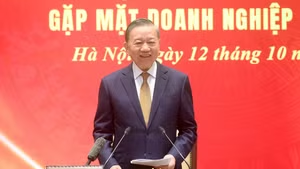
Presenting the Government’s proposal, Deputy Minister of Agriculture and Environment Dang Ngoc Diep said the draft law consists of six chapters and 76 articles covering integrated management of marine resources and space, protection of the marine and island environment, and the rights, obligations and responsibilities of relevant agencies, organisations and individuals.
The draft adds provisions on the management and use of marine space, mechanisms to address overlaps and conflicts in its use, division of responsibilities for administrative management at sea, and management of offshore structures.
It also establishes a mechanism for establishing and exercising rights to use marine areas. Such use must be economical, efficient and transparent while meeting national defence, security and foreign policy requirements.
According to a preliminary verification report by the NA’s Committee on Science, Technology and Environment, the committee mostly supports expanding the law’s scope to cover the management and use of marine space, said Chairman of the committee Nguyen Thanh Hai.
Hai proposed that the draft should also include preferential and support policies for developing economic activities that use marine space.
The committee stressed the need to clarify principles for applying the law to ensure that integrated management does not alter or overlap with the powers of specialised management agencies or create unnecessary administrative procedures.
It also asked law drafters to further clarify the core principles for the integrated management of marine resources and space and the protection of the marine environment.
Such management should ensure inter-sectoral coordination and help resolve conflicts in the exploitation and use of marine resources and space, while not replacing specialised management powers established under relevant laws.
The allocation of marine space must respect legally established rights, ensure communities’ access to the sea and respect the legitimate rights of other countries under the 1982 United Nations Convention on the Law of the Sea (UNCLOS), Hai added.
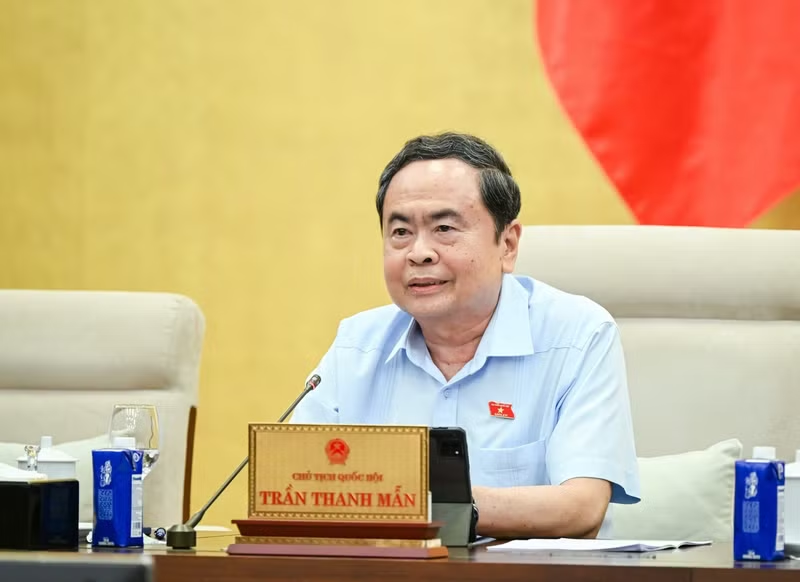
NA President Tran Thanh Man described the bill as particularly important, saying the revision is not simply about amending several provisions but represents a change in the model of marine governance.
He identified four major areas for attention: the legal framework, governance, the marine economy and the environment.
The revision comes at an appropriate time and is consistent with the Politburo and Party Central Committee’s policies on managing marine and island resources, he said.
The top legislator asked the drafting agency to provide clear answers to several core issues, including whether the right to use marine areas would become a clearly defined legal asset; whether the marine spatial plan would take precedence over sectoral licences; whether marine data would be genuinely open and shared rather than fragmented; and how the legal position of coastal communities would be defined.
Fewer projects subject to environmental impact assessment
The NA Standing Committee also discussed a bill amending and supplementing several articles of the Law on Environmental Protection.
The draft proposes major changes to regulations on strategic environmental assessment, environmental impact assessment (EIA) and environmental licences.
Under the draft, preliminary environmental impact assessment would be simplified from three to two groups of environmental criteria, with detailed regulations to be issued by the Government.
The classification of projects would also be reduced from four to three groups of criteria. The draft significantly narrows the list of those subject to EIA, adds more exempt from EIA and moves some to environmental registration.
It also simplifies EIA reports and appraisal procedures, while clarifying appraisal authority. The Government would be tasked with defining the scope and validity of decisions approving EIA appraisal results to avoid overlaps with other management tools.
Regarding environmental licences, the bill significantly reduces the number of projects required to obtain such licences under an approach that accepts controlled risks and shifts from pre-approval checks to stronger post-approval inspection.
It also simplifies licensing requirements and dossiers, extends the validity of environmental licences for certain projects and decentralises licensing authority to local administrations.
According to the preliminary verification report by the NA’s Committee on Science, Technology and Environment, the draft has streamlined project classification based on environmental criteria from four groups to three, together with a substantial reduction in the number of projects required to prepare EIA reports.
However, the verification body proposed further review and the inclusion of clear and quantifiable criteria for all sensitive environmental factors in the law, allowing people and businesses to look up themselves and reducing the risk of inconsistent application.
It also recommended that the Government be assigned to issue detailed lists of projects subject to EIA, projects requiring environmental licences and projects subject only to environmental registration.