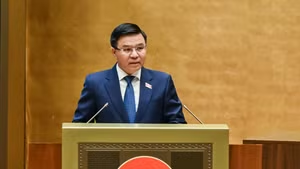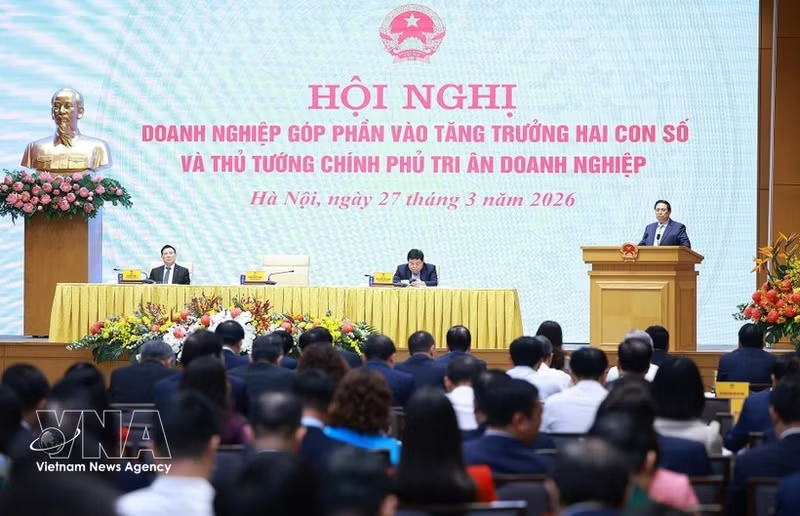
Speaking at a conference in Ha Noi, PM Chinh said the economy overcame challenges during 2021-2025 under the Party’s sound leadership, the National Assembly’s support, the Government’s drastic action, and joint efforts from the political system, businesses and the public. Performance improved steadily quarter by quarter and year by year, reshaping Viet Nam’s economic landscape and lifting its global standing.
Since late 2024, the Politburo has issued nine strategic resolutions, followed by others summited to the National Assembly by the Government to turn them into law quickly, laying a solid foundation for double-digit growth in the 2026-2030 period.
According to him, sci-tech, innovation and digital transformation must underpin Viet Nam’s development in the new phase, as the country targets high-income developed economy status, with firms playing a far more central role.
Entering the 2026-2030 period, the 14th National Party Congress reaffirmed an average annual growth target of 10% or higher. To hit that mark, he stressed that Viet Nam needs to renew traditional growth drivers while aggressively pushing new ones such as sci-tech, innovation, digital transformation, green transition, circular economy, creative industries, and low-altitude economy.
Viet Nam must expand into new development spaces, including the marine economy, space and underground infrastructure, a shift that demands changes in mindset, methodology and execution, he said.
While the Party and State will continue refining institutional framework, mechanisms and policies, he made clear that enterprises must be the main drivers of growth. He urged them to take greater responsibility for rapid and sustainable development, while actively contributing to institutional reform.
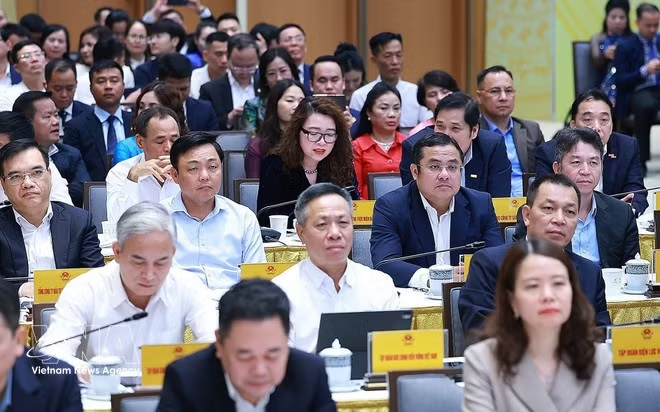
Delegates were pressed to focus discussions on accelerating the transition to a science-and-technology-driven growth model, which he described as both an objective requirement and a strategic choice.
He also pushed for the creation of globally competitive Vietnamese corporations, the formalisation of business households into proper enterprises, and the scaling up of small and medium-sized firms into large multinationals.
It is also equally vital to better leverage the digital and green economies, along with free trade agreements, to climb global value chains, deepen global integration, improve product quality, and strengthen self-reliance and strategic autonomy, he said.
Higher labour productivity and a workforce up to international standards are essential, he added, while openly asking what institutional and policy bottlenecks the State must clear to unlock breakthroughs for firms.
To steer the economy through global headwinds and deliver double-digit growth, every ministry and locality must also aim for double-digit expansion, he said, while spotlighting national unity and international cooperation to address global and external challenges.
In his view, Viet Nam must continue pursuing diversification and multilateralisation of foreign relations, being a reliable partner and responsible member of the international community while pooling external resources, including capital, governance expertise and technology.