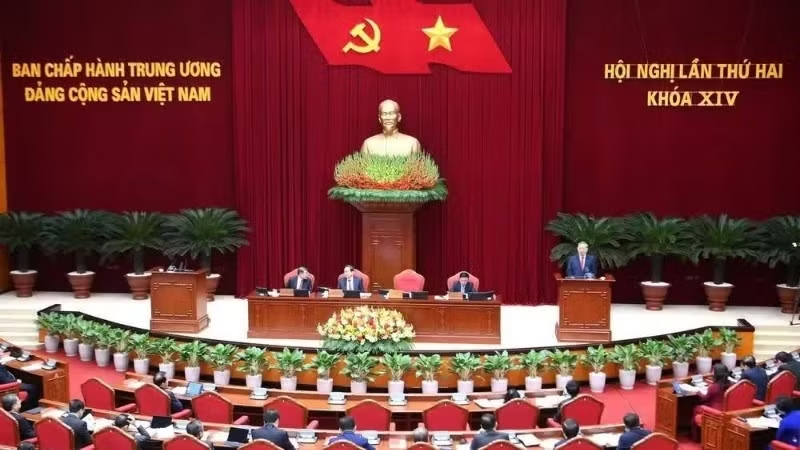
The Resolution of the 14th National Party Congress serves as a guiding compass for the thinking and actions of the entire political system, with a key requirement being to narrow the gap between the Resolution and tangible outcomes. General Secretary and State President To Lam stressed that turning the Resolution into concrete, visible results is the true measure of the Party’s leadership calibre and governing capacity.
More than 96 years under the Party’s leadership, particularly 40 years of the Doi Moi (Renewal) process, have demonstrated that every achievement of the nation has been associated with periods in which sound policies were implemented decisively, synchronously, and effectively. These accomplishments did not stem from resolutions on paper, but from the ability to organise implementation and transform policy directions into tangible development outcomes. For this reason, General Secretary and State President To Lam underscored the need to shift decisively from “administration based on directives” to “governance based on results.”
The Resolution of the 14th National Congress identifies five key priorities for implementation.
First, enhancing the capacity to institutionalise and translate Party resolutions into practical, stable, and transparent policies and laws.
Second, reforming implementation methods and strengthening enforcement discipline, with particular emphasis on placing substantive outcomes above all else and putting an end to the avoidance of responsibility, inertia, and buck-passing.
Third, regarding development effectiveness and public satisfaction as the highest measures of success, ensuring that every policy and decision addresses the genuine needs of the people.
Fourth, building a contingent of officials with the courage, intellect, and organisational capacity to implement policies effectively and take responsibility for the common good, while protecting those who dare to think differently, act boldly, and pursue innovation.
Fifth, linking the implementation of Party resolutions with reforms in the Party’s leadership methods and improvements in national governance, while building a modern, transparent, and effective socialist rule-of-law state.
These principles require not only a change in mindset but also decisive and consistent action from the central level to local authorities. In this regard, the frontline role of local governments is considered essential to narrowing the gap between resolutions and substantive outcomes. Local authorities cannot rely on rigid replication; they must demonstrate autonomy, creativity, initiative, and accountability. Time is a particularly valuable development resource, and delays in implementation not only waste resources but may also result in missed opportunities for growth.
The reform of leadership and results-based governance is also being advanced through a comprehensive system of inspection and supervision. The Party Central Committee provides strategic direction and oversight; the National Assembly improves the quality of legislation and supreme supervision; the Government and ministries shift their focus from policymaking to ensuring effective implementation; while the Viet Nam Fatherland Front and socio-political organisations participate in oversight from the grassroots to the national level. The entire political system must function as a coordinated mechanism in which every individual and organisation clearly understands and assumes responsibility for final outcomes.
Drawing lessons from the implementation of previous resolutions, General Secretary and State President To Lam emphasised that identifying the right issues for a resolution is the first critical step in determining the effectiveness of the Party’s leadership. A resolution that addresses the right issues must emerge from practical realities, reflect bottlenecks, constraints, and urgent social concerns, while also incorporating theoretical research, trend forecasting, and a comprehensive understanding of interrelated sectors. If a resolution fails to identify the core issues, it will struggle to produce meaningful results and may become merely symbolic and detached from reality.
The General Secretary and State President also highlighted a second crucial factor: the resolute and coordinated implementation of resolutions. No matter how accurate and well-targeted a resolution may be, without determined implementation, it risks remaining merely a document on paper.
The closer a resolution is to the concerns of the people and the more effectively it addresses practical needs, the greater the social momentum it can generate. For example, resolutions on agriculture, farmers, and rural development have delivered clear results when implemented decisively at the local level, improving living standards while mobilising the participation and oversight of the entire political system. Conversely, resolutions that are disconnected from reality and vague in their objectives and solutions are difficult to implement, undermine public confidence, and foster indifference among implementing bodies.
Narrowing the gap between resolutions and substantive outcomes also requires strict accountability. For instance, if a collective body fails to fulfil its assigned tasks, its leader must be held accountable. Individuals who fail to meet requirements must either voluntarily step aside or be considered for replacement. It is unacceptable for sound resolutions to be followed by weak implementation, delays, and poor results without anyone being held responsible. This is how the Party demonstrates its leadership capacity and ensures that the nation’s time, resources, and development opportunities are not squandered.
It can be affirmed that narrowing the gap between Party resolutions and tangible outcomes is not merely an administrative task but a vivid measure of the Party’s leadership and governing capacity. It requires the entire political system to operate in a coordinated manner, from the central level to local authorities and from senior leaders to every cadre and Party member. Every resolution, when implemented decisively, scientifically, and with a focus on substantive results, can address pressing social issues, thereby strengthening public trust, enhancing the Party’s prestige, and advancing the nation’s sustainable and comprehensive development.