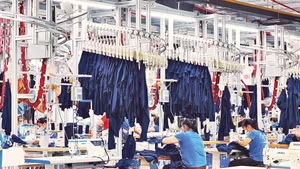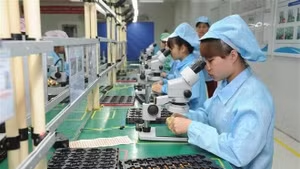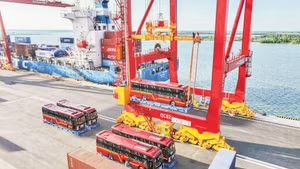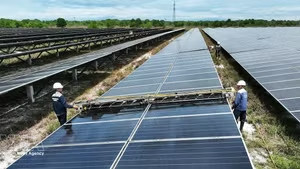
Specifically, the government agreed on the necessity of formulating the Law on Key Industries in order to institutionalise the Party’s guidelines and viewpoints on national industrialisation and modernisation, as well as to complete the legal framework to promote the development of key industrial sectors in line with the context of science, technology, and innovation, towards building an independent, self-reliant, and resilient industrial base.
This effort will contribute to rapid and sustainable economic development, enabling Viet Nam to become a developed, high-income country with a socialist orientation, meeting practical requirements and socio-economic development requirements in the coming period.
The government has basically agreed on two policy groups proposed by the Ministry of Industry and Trade. Policy 1: Encouraging domestic production and manufacturing of key industrial products; and Policy 2: Developing supporting industries.
The Ministry of Industry and Trade will take the lead, in coordination with relevant ministries and agencies, to study and incorporate the opinions from government members to finalise the policies of the Law on Key Industries in accordance with regulations, ensuring several key requirements such as institutionalising the Party’s guidelines and viewpoints on the development of key industrial sectors; and formulating policies and laws to address fundamental bottlenecks in the development of the key sectors, shifting from extensive development to intensive development, and from processing and assembly to research, design, and production in Viet Nam.
Efforts will be made to promote appropriate localisation to meet requirements and preferences related to rules of origin in international trade, keeping in line with bilateral and multilateral trade agreements as well as the requirements of major markets. Mechanisms will be designed to encourage Vietnamese enterprises to participate more deeply in global supply chains and to take advantage of incentives under new-generation free trade agreements by ensuring compliance with rules of origin. Regulations will also be developed to attract and manage Foreign Direct Investment (FDI) in key industrial sectors in a selective manner, prioritising high-technology and foundational industry projects, while linking them with technology transfer requirements and cooperation with domestic enterprises, thereby enhancing national production capacity.
A review of the implementation of current legal provisions will be conducted to develop content that is practical and feasible, addressing existing shortcomings, limitations, and obstacles; ensuring consistency with relevant international treaties to which the Socialist Republic of Viet Nam is a member; and aligning policy dossiers with related laws to ensure coherence and uniformity. Efforts will also focus on strengthening decentralisation and delegation of authority in state management of key industrial development; reducing and simplifying administrative procedures; and promoting the application of science and technology along with digital transformation.
On the basis of the completed policy dossier, ensuring constitutionality, legality, and consistency within the legal system, the Ministry of Industry and Trade will take the lead, in coordination with relevant ministries and agencies, to draft the Law on Key Industries and submit it to the government in accordance with regulations.