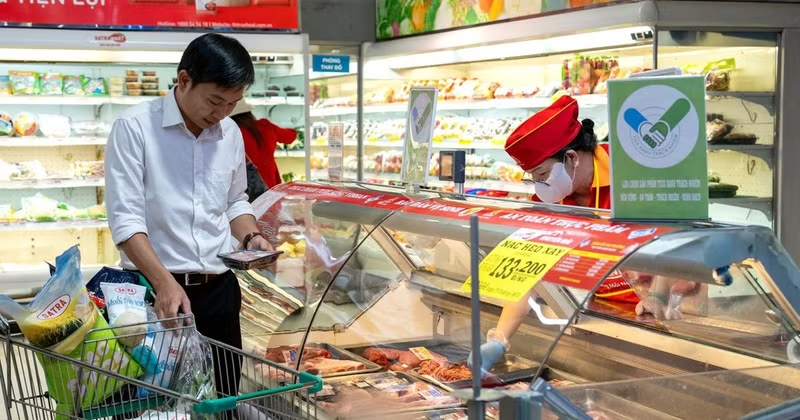
By participating in the ‘Responsible Green Tick’ programme, Saigon Trading Corporation (SATRA) has established a control system centred on three core risk groups: the origin and capacity of partners; product safety indicators; and storage and transport conditions across the entire system.
Responsibility commences with raw materials
Every day, school and hospital kitchens, industrial canteens, and meal-service providers utilise large quantities of food from multiple sources. If incoming ingredients lack information about growing areas, production facilities, or transport conditions, tracing the source of a problem can quickly reach a dead end.
Food quality control will therefore collapse if it is executed only at the processing stage. A genuinely safe chain must be seamless from suppliers through transport, storage, and distribution, ending at the kitchen. At every link, transparency and accountability are essential.
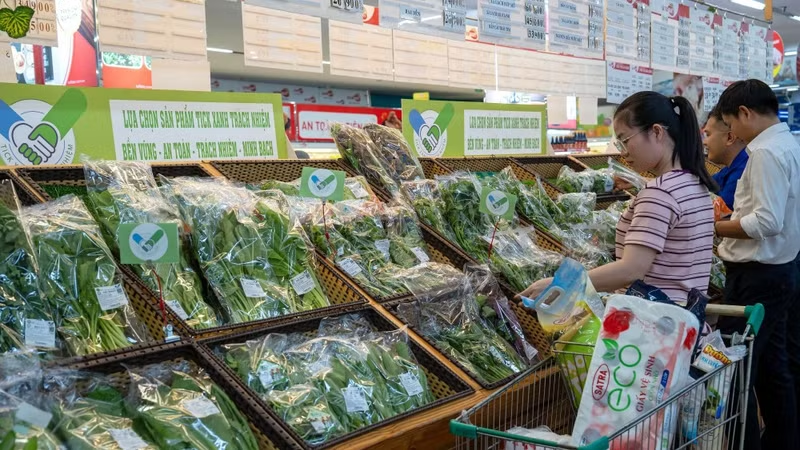
The ‘Responsible Green Tick’ programme, launched by the Ho Chi Minh City Department of Industry and Trade in March 2024, has so far enlisted 12 retail chains, successfully connected nearly 500 suppliers, and approved nearly 6,000 products meeting the required standards for the market.
For suppliers, the ‘Green Tick’ is a passport enabling their goods to access a broad distribution network. For consumers, it is an easily recognisable sign that products have undergone rigorous controls. More than a conventional label, the ‘Green Tick’ is creating an effective cross-monitoring mechanism across the market.
SATRA’s multi-layered screening of partners
As one of the pioneering participants, SATRA’s retail system currently works with 34 suppliers, bringing 287 ‘Green Tick’ products to four Satramart supermarkets and nearly 150 Satrafoods stores. SATRA has established a control system centred on three core risk groups: the origin and capacity of partners; product safety indicators; and storage and transport conditions throughout the system.
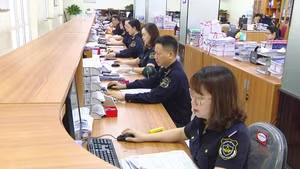
To join the chain, suppliers must meet five criteria: financial capacity, products, quality management, services, and communications. Only applications achieving at least 60% of the total score are entertained for cooperation. All legal documents, food safety conditions, test certificates, and product labels are carefully scrutinised by the procurement and quality management departments before goods are accepted.
To encourage and deepen engagement with its partners, SATRA extends an array of special incentives and provides maximum communications support to suppliers that have obtained the ‘Responsible Green Tick’. It also facilitates their promotion of the Green Tick label at SATRA’s points of sale. These suppliers are given priority under the system’s procurement policies and allocated the most prominent display areas, enabling their products to reach consumers quickly and effectively.
Vu Duong Quan,
Director of Market Research and Retail System Management at SATRA
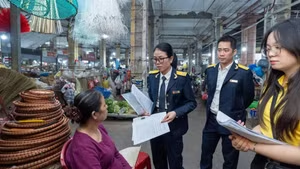
At points of sale, products continue to be scrutinised for appearance, expiry dates, and storage conditions. Notably, SATRA conducts quarterly cross-assessments and random sampling of high-risk products, including meat, vegetables, and fresh produce. Any batch showing signs of non-compliance is immediately removed from shelves, isolated, and sent for independent testing.
Suppliers face sanctions ranging from penalties and destruction of goods to permanent termination of cooperation. At the same time, the information is immediately shared with regulatory authorities and other distribution chains. This interconnected mechanism eradicates the scenario where products rejected by one point of sale are diverted to another channel, compelloing suppliers to maintain consistent quality throughout their cooperation with the system.
Backing from distribution and processing ecosystem
SATRA’s competitive advantage lies not only in retail but also in its closed ecosystem encompassing production, wholesale markets, and logistics.
Pork supplied by Viet Nam Meat Industries Corporation (VISSAN) guarantees a stable supply and complete traceability from raw materials through processing. Meanwhile, Coastal Economic Development Corporation (COFIDEC) supplements the supply of quality produce by leveraging its existing raw-material areas.
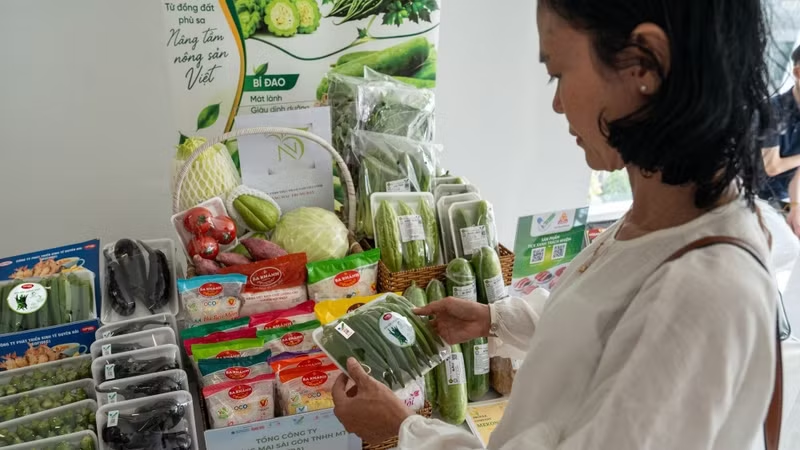
In particular, Binh Dien Wholesale Market and the SATRA Distribution Centre serve as major transit hubs. Their ability to consolidate large volumes of agricultural produce and food allows kitchens to access concentrated sources of raw materials more easily, eliminating the risks associated with piecing together supplies from numerous dispersed sources.
Building on its framework of 287 standard-compliant products on retail shelves, SATRA is formulating a plan to supply ‘Green Tick’ ingredients directly to school and hospital kitchens, industrial canteens, and dormitories.
The system enables direct connections between suppliers and kitchens; deliveries can be organised according to menus and required volumes, while batch information is managed from the central warehouse to the receiving location. QR traceability codes are synchronised across the entire chain, allowing managers or parents to verify information transparently at any time.
Vu Duong Quan, Director of Market Research and Retail System Management at SATRA, said: “To encourage and deepen engagement with our partners, SATRA extends an array of special incentives and provides maximum communications support to suppliers that have obtained the ‘Responsible Green Tick’, creating favourable conditions for them to promote the Green Tick label at SATRA’s points of sale. These suppliers are given priority under the system’s procurement policies and allocated the most prominent display areas, enabling their products to reach consumers quickly and effectively.”
Thanks to its in-house logistics ecosystem, SATRA minimises intermediary stages while closely controlling transport times, temperatures, and expiry dates. Goods must navigate multiple rounds of “testing”: at the receiving hub, upon delivery to supermarkets, and throughout the display process.