According to data released by the National Statistics Office under the Ministry of Finance, retail sales and consumer service revenue increased 12.9% year on year, reflecting the recovery of domestic consumption and showing that it continues to be an important driver of the economy.
Growth in the retail market has been supported by improving incomes, an expanding middle class, a young population structure, the recovery of tourism and accommodation services, and urbanisation spreading beyond central areas.
Improving occupancy rates — F&B and entertainment drive leasing demand
A report by Cushman & Wakefield showed that retail occupancy in Ha Noi reached 87.9% in the second quarter of 2026, up 1.5 percentage points quarter on quarter and 2.6 percentage points year on year.
In Ho Chi Minh City, the core area (the former city area) reached 97%, while the expanded area (the former Binh Duong and Ba Ria-Vung Tau areas) maintained occupancy rates of 93.6-95.1%.
Notably, this increase was not driven by a flood of new supply entering the market but mainly reflected strong absorption of existing supply, indicating that actual leasing demand is growing.
In terms of retail segments, food and beverage (F&B) and entertainment continued to be the two leading drivers of leasing demand in both Ha Noi and Ho Chi Minh City, alongside lifestyle and fashion-accessories.
In Ha Noi, the first half of the year saw many brands open their first stores or largest flagship stores in their chains, including Bershka, Wilson, IWC Schaffhausen, Roborock, and Bach Hoa Xanh.
The list spans fast fashion, sports, luxury watches, and essential-goods retail, showing that tenants’ preferences are becoming increasingly diverse.
Experiential shopping models and lessons from developed markets
Looking ahead, as the supply of space in central areas remains limited, capital and tenant interest will continue to shift beyond traditional central business districts (CBDs).
In Ha Noi, most new supply in the first half of the year was concentrated on the fringes of the central area, together with retail podiums in the western area and central districts.
Shopping centres continue to account for a large share, contributing around 85% of total supply, and are closely linked to newly formed residential areas, offices, and infrastructure.
From now until 2028, Ha Noi is expected to receive around 314,000 square metres of additional retail space, concentrated outside the centre, particularly in the western and suburban areas.
In the core area of Ho Chi Minh City, the eastern and northern areas have been identified as the main development directions, with around 286,500 square metres of supply expected by 2029.
The continued expansion of integrated urban areas is expected to further strengthen decentralised retail centres and support long-term leasing demand. Meanwhile, the former Binh Duong area has emerged as the key growth market in the expanded area, with around 174,000 square metres of new supply.
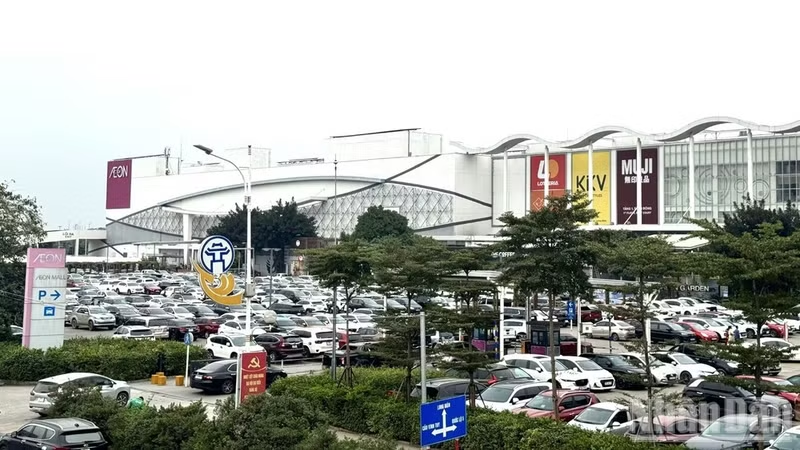
Continued growth in supply is intensifying competition among developers. Many international investors, including Keppel, AEON, Lotte, and Takashimaya, are expanding in the Vietnamese market.
The market has room for growth not only from shopping activities but also from demand for dining, entertainment, healthcare, socialising, and experiences among young, tech-savvy consumers with a wide range of choices.
Against this backdrop, the market is entering a race for the quality of experience. Cushman & Wakefield forecasts that destination retail models, combining shopping with food and beverage, entertainment, and other amenities, will drive growth in the Vietnamese market over the next two to three years.
Speaking to Nhan Dan Newspaper, Hoang Nguyet Minh, Director of Cushman & Wakefield Viet Nam, said that competition in the coming period would not simply be a race for space or rental prices but a race to remain relevant to consumers.
Shopping centres need to continually answer the question: why should customers come here instead of another project, or instead of staying at home and shopping online? The answer lies in the ability to create experiences that customers want to participate in, share, and return to. This can come from an appropriate mix of F&B and entertainment, community events, flexible spaces, convenient services, or natural connections with surrounding residential and office areas.
According to Minh, this is not a trend unique to Viet Nam. Across the Asia-Pacific region, physical stores are evolving from places of pure transactions into platforms for content, community, and brands, as much of the process of discovering and evaluating products takes place before customers enter a store.
Gen Z is currently leading the trend of returning to in-store shopping, accounting for 64% of consumers who prefer shopping in physical stores. Flexible pop-up business models now account for nearly one-third of the global market, or 32.4%, generating around 4.8 billion USD in revenue in 2025.
Meanwhile, Sona Aggarwal, Cushman & Wakefield’s Executive Director and Head of Retail in Asia Pacific, said that what is changing is not the importance of physical retail but what these spaces are expected to deliver. Consumers today form their views of a brand before they even enter a store, so stores must be able to deliver on the brand promise made online.
The Republic of Korea and Japan are two examples of the direction the Vietnamese market is gradually approaching.
In the Republic of Korea, Myeongdong and Seongsu integrate retail, lifestyle, and beauty and medical services into a single destination, maintaining sustainably low vacancy rates of 5.6% and 3.7%, respectively.
The retail ecosystems there are designed to meet multiple consumer needs within a single space, encouraging customer interaction and repeat visits rather than stopping at simple transactions.
In Japan, the Dior Bamboo Pavilion in Tokyo combines retail, accommodation, and dining to create a deeper brand experience. Together with Singapore and Shanghai, Tokyo is considered one of the region’s starting points for high-end experiential retail models.
Overall, location still creates the initial opportunity for a retail project, however, positioning, experience, and operational capabilities are the factors that determine its ability to retain customers and create long-term value.
The retail market’s race is therefore shifting; it is no longer simply a question of who has more space but who can provide a more compelling reason for consumers to step away from their screens, visit a specific place, and want to return again.