A fundamental shift in thinking and implementation methods
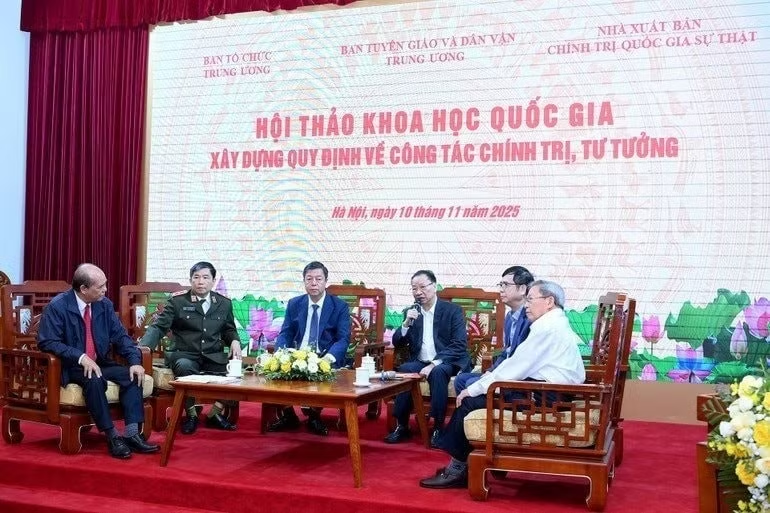
Grounded in Marxism–Leninism, Ho Chi Minh Thought, and the Party’s guidelines, political and ideological work in recent years has undergone fundamental shifts in thinking and organisational methods, moving from a “transmission” approach to a “guiding” approach, from one-way to “multi-dimensional with orientation”, with persuasiveness, effectiveness, and outreach placed at the centre.
The content of study and dissemination of the Party’s resolutions and directives, as well as communication materials, has been renewed to be concise, easy to understand, easy to remember, and easy to share. Digital-based communication methods — including technology-integrated products such as short videos, infographics, and podcasts — provide official information that is rapid and persuasive, marking a clear shift in practice.
Thanks to these renewal efforts, political and ideological work is no longer a formalistic activity but has become a genuine driving force which motivates action among cadres and Party members.
At many agencies and localities, political and ideological work has been organised by Party committees in a practical way, closely aligned with reality and linked to Party building and socio-economic development tasks. In Quang Ninh, the Provincial Party Committee identifies ideological work as a regular, central task, tied to the locality’s development requirements.
Nguyen Hong Duong, member of the Standing Board of the Quang Ninh Provincial Party Committee and Head of the Provincial Party Committee’s Commission for Information, Education and Mass Mobilisation, stated that the Provincial Party Committee has implemented methodical, focused, and scientific approaches: studying and disseminating resolutions in a streamlined, practical manner linked to the specific tasks of each level and sector. Notably, the thematic activity model “Party cell 35”, piloted since the third quarter of 2024, has yielded positive results and become an important channel for capturing public opinion and countering false and hostile information.
The thematic activity “Party cell 35” aligns with the thematic meeting procedures set out by the Party Central Committee’s Commission for Organisation on improving the quality of cell-level meetings. It focuses on two key areas: defending the Party’s ideological foundation and combating harmful, toxic information and hostile viewpoints. Particular emphasis is placed on combining “building and preventing”, in which “building” is fundamental and “preventing” is essential and urgent. The pilot implementation of “Party cell 35” has contributed to renewing and improving the quality of political and ideological activities, creating unity in awareness and action among Party committees, organisations, and cadres at all levels in strictly upholding revolutionary ethical standards in the new period.
Thanks to these renewal efforts, political and ideological work is no longer a formalistic activity but has become a genuine driving force which motivates action among cadres and Party members.
Promoting the exemplary role of cadres and Party members
Practical experience in many localities shows that a prominent highlight in renewing political and ideological work within Party organisations is the strengthening of the exemplary role of cadres and Party members, especially those in leadership positions. Examples of cadres who are close to the people, respect the people, and wholeheartedly serve the people; exemplary individuals in studying and following Ho Chi Minh’s thought, morality, and style; and creative, effective models in serving the public are promptly highlighted and widely promoted, generating strong societal impact.
In Lam Dong Province, as the locality undergoes a strong transformation towards becoming one of the dynamic growth poles of the south-central region, the Provincial Party Committee consistently identifies Party building, especially promoting the exemplary role of cadres and Party members, as a core, continuous task. The spirit of responsibility and exemplary conduct has been institutionalised into specific criteria, forming part of cadre evaluation, classification, planning, and appointment.
In leadership and management, responsibility and exemplary conduct are most clearly demonstrated through the attitude and working style of leaders. Party Secretaries and Chairpersons of People’s Committees at all levels have directly engaged in dialogue with citizens, promptly resolving concerns at the grassroots level, proactively rectifying work discipline, administrative order, and accelerating administrative reforms, linking individual responsibility with work effectiveness. As a result, the responsibility and exemplary role of leaders at various levels have become increasingly evident, reinforcing their position as centres of unity within Party committees.
However, according to Vo Thanh Binh, member of the Standing Board of the Lam Dong Provincial Party Committee and Head of the Provincial Party Committee’s Commission for Information, Education and Mass Mobilisation, reality in the province presents several issues requiring continued attention: some cadres and Party members still lack full awareness and self-discipline in setting an example; responsibility among certain leaders remains insufficiently clear; and cell-level activities sometimes lack the necessary vigour.
In light of these issues, Vo Thanh Binh added that promoting responsibility and exemplary conduct must be approached from a new perspective — as a system of leadership values and culture, maintained consistently and supported by transparent oversight and evaluation mechanisms. At the same time, cadres and Party members in Lam Dong are required to be “both virtuous and competent”, willing to innovate, be creative, and act for the common good.
Renewal efforts in political and ideological work reflect a new spirit: comprehensive renewal from content to methods of communication; and renewal aimed at ensuring that political and ideological work truly becomes “the firm bond linking the Party’s will with the people’s hearts”. When political and ideological work fulfils this role, it not only strengthens the Party’s ideological foundation but also becomes a powerful spiritual driving force for national development in the new period.