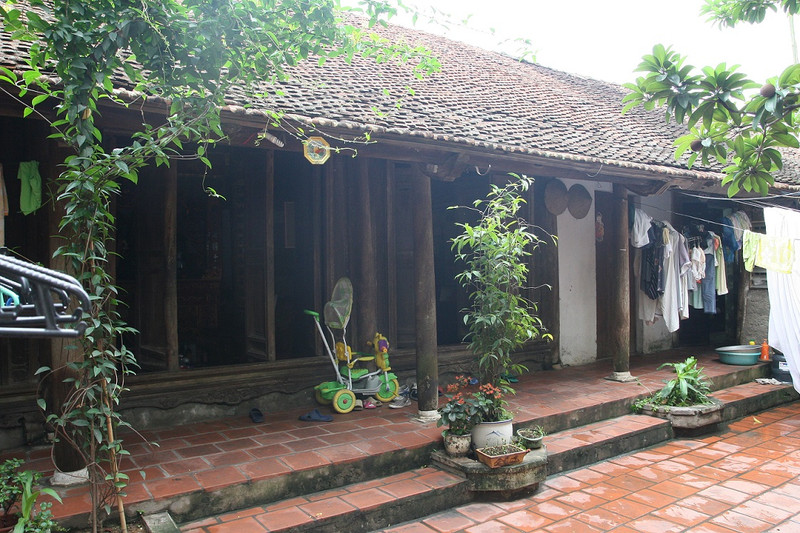
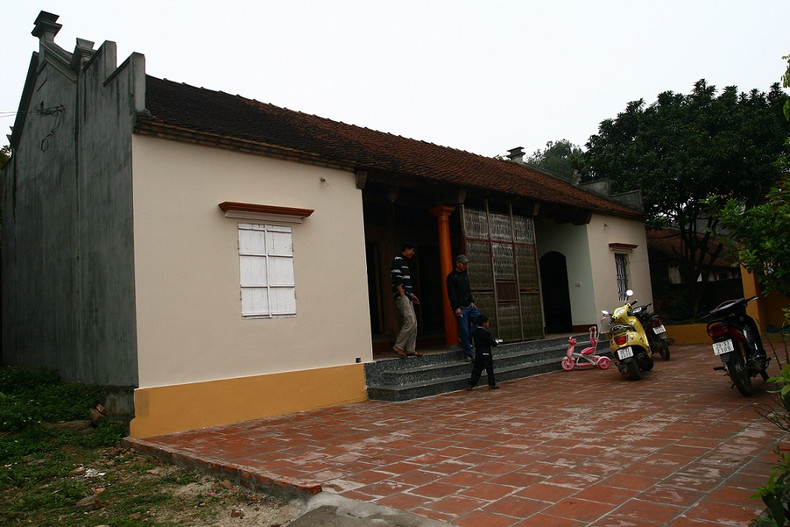
Vu Minh Ha’s house is crowded today. It is because his’s six siblings are gathering to decide on the reconstruction of his house, which is also the family’s ancestor-worshipping house, built nearly 100 years ago.
Before passing away, Ha’s father gave his last will that the ancient house would be reconstructed only when it became too shabby.
However, the house is now in good condition and can shelter the family for at least several decades more.
The house is typical of a Vietnamese rural traditional house, with its details connected by wood tenons. The walls are made of baked earthen brick. The house, which traditionally faces south to receive fresh wind from the south, has three compartments. It has windows on the right and left.
On the right side of the yard of the house, which is surrounded by an orchard, there is a straw-roofed annexe, earmarked for holding farm tools and rice. On the left of the house sits an earth well.
“But the house needs reconstructing because it has become too tight. We want to live in a bigger house,” Ha says to his siblings.
Two of Ha’s brothers, who are about to get married, also need the land to be divided, so that they will have their land to build their own houses.
Within a month, the house will be reconstructed and the land will be cut into parts.
The story of Ha’s family is found in Mo Dao commune, in the northern province of Bac Ninh’s Que Vo district. It can also be seen largely in many rural areas in the Red River Delta, where traditional architectural traits are on the wane.
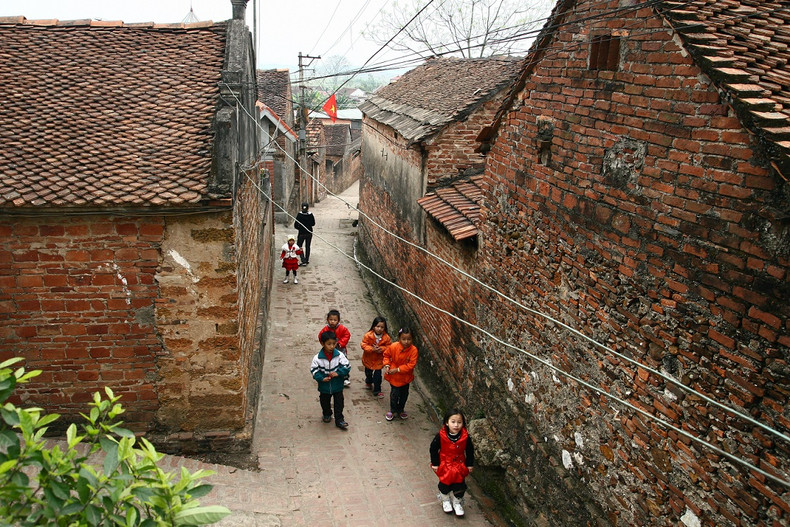
In Huu Bang commune in Thach That district, of the former Ha Tay province (present-day expanded Hanoi), a 200-metre-long road made of old bricks is being covered by concrete.
“I don’t know when this road was constructed. But since I was small, the village’s roads were covered by bricks contributed, as a fine custom, by girls who married those living outside the village. The brick-paved roads have been our deep memory,” says Pham Van Minh, a resident.
The 80-year-old man says all roads in the village have been covered by concrete. “The custom was buried years ago,” he says sadly.
He also says the village was once filled with ancient houses with the age of hundreds of years. “However, nothing is left. Houses here look like those found in the city.”
 |
Strong transformation
Living with an agricultural civilisation, Vietnamese people have settled in the villages in the middle of the rice fields as centres. When they went to the south, their villages expanded along roads or channels.
Traditionally, the rural architecture is characterised by the banyan tree and the landing wharf, the dinh (village’s communal hall), the bamboo ramparts, ponds and orchards. In these places, one could find a peaceful life.
Since the 1990s, agricultural and rural development, including rural architecture, has been affected by industrialisation, modernisation, and urbanisation.
Thanks to industrialisation and urbanisation, many rural areas have good roads, power grids, water supply systems, schools and health stations. However, thousands of hectares of agricultural land have been reclaimed for industrial zones, new residential areas, golf courses, and tourist sites.
Over the last few years, Vietnam’s key economic areas have witnessed the highest rate of withdrawn land, occupying half of the nation’s total withdrawn land area. The Red River Delta has the highest rate, with 4.4% of agricultural land, while the rate is 2.1% in the south-eastern region and 0.5% cent in other regions.
According to the Ministry of Agriculture and Rural Development, around 10,000 hectares of agricultural land are earmarked for other purposes such as roads, works and industrial parks each year. Each hectare of land withdrawn can influence the job of 13 rural labourers on average. Over the past years, some 7 million farmers have been influenced following the withdrawal of about 400,000ha of agricultural land, accounting for about 4% of the total agricultural land area, which is in use nationwide.
The narrowing of farmland also means farmers are compensated with a big sum of money. Improved living conditions and the pressure of modern life have resulted in a remarkable change in rural architecture. Many families have rebuilt new houses with their compensation money or with money they earn from selling their land. Meanwhile, roads have also been opened and replaced villages’ wells and ponds. For example, in Huu Bang, which used to have many ponds and lakes, only one pond in front of the village dinh remains.
As a result, rural land per capita is being narrowed. Traditional houses are also being replaced by tight houses and concrete blocks. Rural life quickly changes day by day without traditional traits being kept.
“We cannot imagine how quickly the village has been transformed!” says Minh from Huu Bang commune.
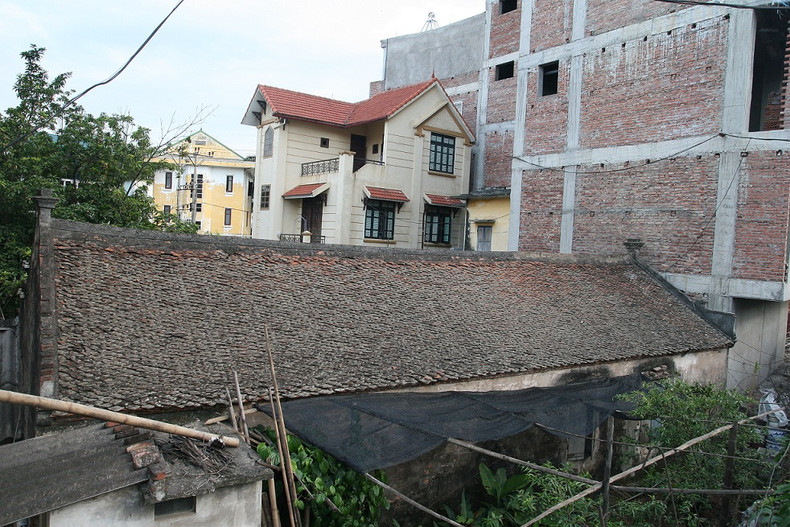
“Our village is being turned into a new urban area. Tunnel-shaped and high-storey houses are no longer rarely found in the village now,” Minh says. “People’s living conditions have been improved. That means they also need to live in more modern houses.”
“But it is a sad fact that they build their new houses by copying what is available in the city or even from abroad,” he says.
“Houses have different styles, from Vietnam to Thailand, India and even mimic those of Russia and the Middle East,” he shakes his head.
In the ancient village of Duong Lam in former Ha Tay province, newly-built 2-3 storey houses are mushrooming besides ancient houses, several hundreds of years old. Local people say they have to replace the old houses with new ones, to have more spacious living spaces for newly-married couples.
In Hanoi’s Dong Ngac village, home to many ancient houses, people also tend to live in new houses with modern facilities. “We have had no rice fields for a long time. While the number of families keeps going up, we need to build new houses,” says 75-year-old Chu Thuc Oanh, a resident.
Another resident Pham Anh Mau says many houses in the village have been replaced by new ones. “However, I will keep my 60-year-old house to remind my children of our ancestors’ labour,” Mau says.
“That is a 100-year-old worship house of a Pham-surname clan. It will be kept forever by the family as required by all people in the clan. But next to it lies a newly-built house of the clan’s head. The new and the old will continue to intermix,” he says while pointing to a worship house next to his house.
 |
No architectural planning
“Even urban architecture has no proper planning. Planning for rural architecture is just a daydream,” says architect Le Thanh Son from Ho Chi Minh City University of Architecture.
Son says architecture planning is a very complicated problem related to many factors such as politics, economy, history, culture, arts and technique.
“It will take years and costs to plan rural architecture. Who will be responsible for planning such architecture?” he wonders.
At present, planning rural architecture involves many ministries, especially the Ministry of Construction and the Ministry of Agriculture and Rural Development.
With poor people whose average income is just VND500,000 ($21.7) per month. “With such a small income, they cannot build even a house,” Son says.
No agencies and documents can instruct country folks to build houses in a way suitable to their economic conditions and to the rural environment.
In 1964-1965, the late architect Hoang Nhu Tiep, who was head of the Institute for Rural and Urban Architecture Planning, introduced a construction plan for the Tam Thien Mau area in the northern province of Hung Yen. Under this plan, besides rice fields, irrigation systems, breeding facilities, orchards, and fish ponds, there are public works like the people’s committee house, schools, kindergartens, cultural houses and health stations. All of these works are connected by a system of roads. This is seen as the first model of a new rural community in Vietnam, based on China’s rural town model.
However, this plan was not completely carried out. Since then, the countryside has been changing a lot, but rural architecture has been neglected.
Vietnam has implemented many rural and agricultural development programmes, such as changing agricultural economic structure, building power grids, and irrigation systems, but there is still no rural architecture plan.
 |
Meanwhile, there is a big construction planning institute under the Ministry of Construction. This agency gathers dozens of architects, engineers, professors and doctors, who are trained at home and abroad. In addition, there are many architecture and construction centres, universities and hundreds of consulting and architecture companies.
An architect from the Vietnam Association for Architects says that the story about rural architecture is a long story, with joy, anger, love and hate, just like human life.
“Seeking a new model for rural architecture requires not only talent but also large hearts of managers, architects and the participation of the whole society,” he says.