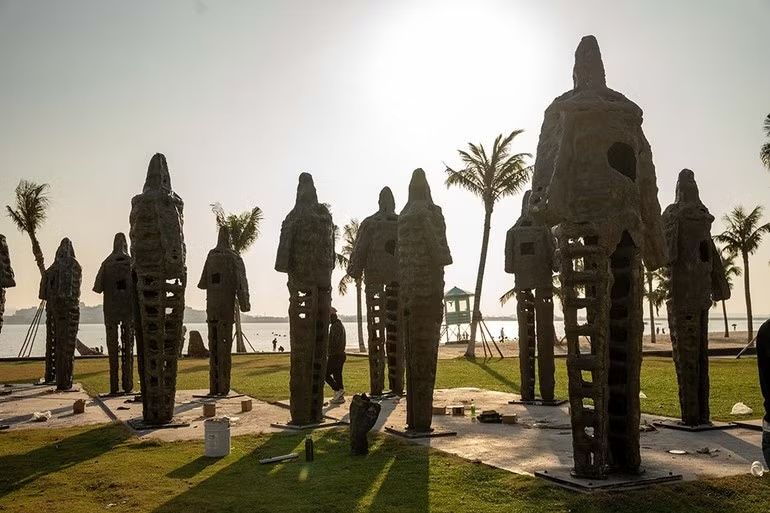
The installation exhibition Bach Dang is not merely a fine-art event, but a contemporary artistic dialogue with the nation’s historical heritage. Notably, this open-air exhibition space leaves a strong impression as it is situated by the shore of Ha Long Bay — a world heritage site.
Bach Dang is the result of many years of meticulous preparation, while the artistic concept itself had been nurtured by Le Huu Hieu for decades beforehand. The artist once shared that his first time seeing the Bach Dang stake field with his own eyes left a profound and lasting impression on him: its beauty lay not in grandeur, but in strategic intelligence, in the extraordinary fusion of nature and the Vietnamese people at life-and-death moments of history.
From that moment, Bach Dang became a recurring symbol throughout his creative journey, representing national resilience, Vietnamese intellect, and the depth of memory accumulated over time.
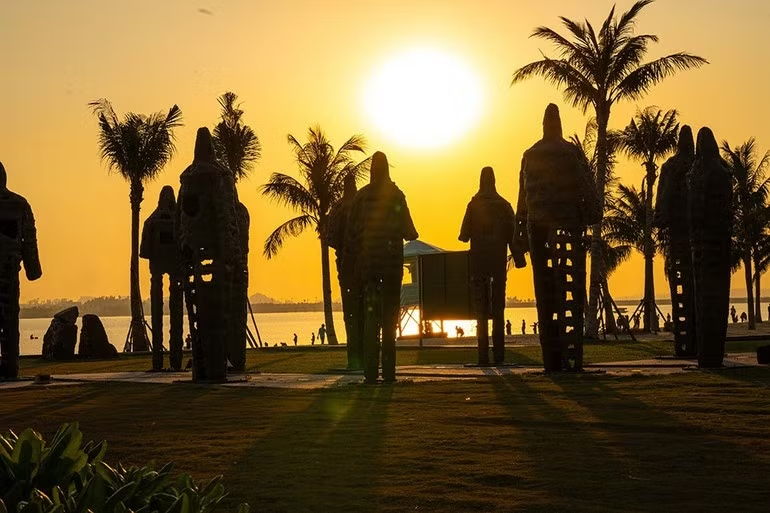
This Bach Dang installation exhibition in Ha Long continues that creative thread while expanding the dialogue between history and the present. Rather than illustrating history in a narrative manner, Le Huu Hieu chose to construct a three-dimensional artistic space in which viewers can enter, move, feel, and reflect. Here, history is not a closed chapter, but a current that continues to flow.
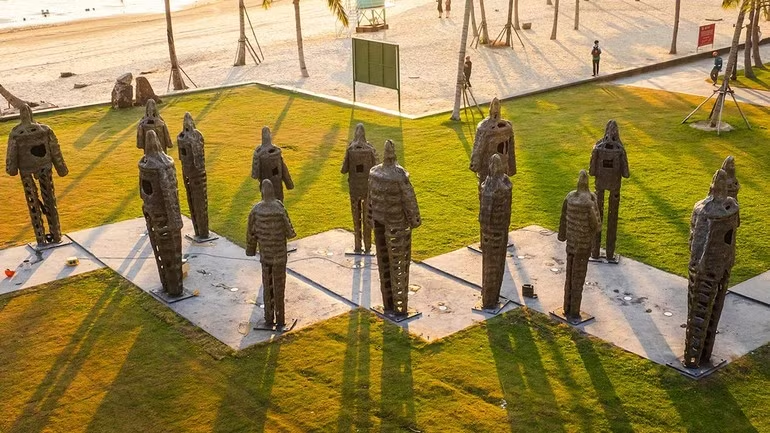
Commenting on the Bach Dang installation sculpture ensemble, art advisor Do Tu Anh noted that in this presentation, Le Huu Hieu’s sculptural language is clearly expressed through distinct structural elements. It demonstrates a harmonious mastery of construction techniques and materials together with an aspiration towards greatness. The artist employs an allusive style for the figures to pay tribute to all the heroes of the Bach Dang feat.
Within the exhibition space, the human figure is treated in a non-individualised manner. For Le Huu Hieu, history does not belong to a number of exceptional individuals but is the achievement of an entire nation. Therefore, every Vietnamese person who took part in the Bach Dang feat deserves to be honoured as a monument.
Further explaining this sculptural concept, Do Tu Anh analysed that in Le Huu Hieu’s view, human beings are part of history, and regardless of whether they were farmers, soldiers, or civil and military officials, all those who participated in the Bach Dang feat deserve to stand as monuments. Their simplified forms are elevated and solid, with squared shoulders and backs, strong like ancient tree trunks rising from the earth.
This large-scale public art ensemble commemorating the Bach Dang Victory is displayed on a long-term basis in a coastal urban space, opening a dialogue between history, heritage, and contemporary life at a dynamic cultural and tourism destination in Quang Ninh.
The exhibition comprises 18 metal soldier sculptures, ranging from 3.3 to 4.5 metres in height. Before being displayed in Ha Long, the works were presented at Nguyen Hue Pedestrian Street in Ho Chi Minh City as part of activities marking the 50th anniversary of the Liberation of the South and National Reunification, attracting widespread public attention.
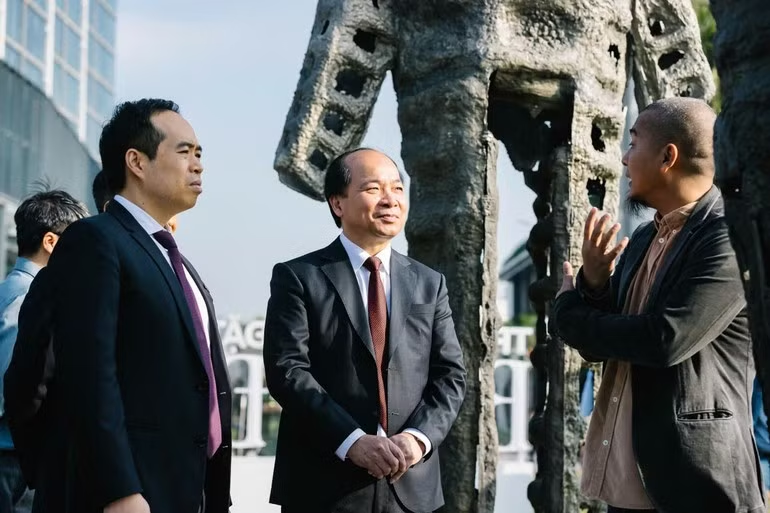
A representative of the People’s Committee of Bai Chay Ward remarked that the exhibition not only enhances the coastal public space but also spreads a spirit of national pride, while adding a new cultural highlight for Bai Chay, as well as for Quang Ninh tourism in general.
The massive, steadfast sculptures create a sense of enclosure and protection. As viewers walk through the installation, they no longer stand outside history as observers but seem to be placed within its very core.
According to art advisor Do Tu Anh, it is precisely the uniformity and non-individualised nature of the forms that opens a sense of temporal depth for the work.
One of the distinctive elements that gives Bach Dang its weight is Le Huu Hieu’s choice and treatment of materials. Do Tu Anh observed that exploration, research, and material handling are among Hieu’s almost unparalleled strengths. The artist does not conceal his desire for his works to endure for a hundred years. Only materials inherited from earlier generations, whose permanence has been proven over time, are persuasive enough for him to use.
Through sculpture and installation, art forms that allow direct interaction, Bach Dang elevates the viewer’s emotions to a new level. The monumental scale of the work transforms the artistic experience from a purely visual one into a physical and spiritual encounter.
The Bach Dang exhibition in Ha Long follows naturally from Le Huu Hieu’s installation exhibition “From the Bach Dang Victory to the Great Victory of April 30, 1975” at Nguyen Hue Pedestrian Street — an event that attracted millions of visitors and generated strong media impact both domestically and internationally, demonstrating the reach of a contemporary artistic approach to history.
Such sustained contributions have brought Le Huu Hieu international recognition. On October 17 in Tokyo, Japan, he was honoured by the Viet Nam Federation of UNESCO Associations and the Japan Federation of UNESCO Associations with the title “Pioneering Artist on the UNESCO Heritage Journey 2025”.
According to the organisers, this recognition contributes to the implementation of UNESCO’s 2003 Convention for the Safeguarding of Intangible Cultural Heritage, while affirming the role of artists as keepers of memory and cultural identity.
In a globalised context where art can easily be swept along by short-term trends, Le Huu Hieu has chosen a slow, deep, and enduring path. With Bach Dang, he not only reconstructs a historical memory, but also affirms a rigorous artistic approach, ensuring that heritage does not remain fixed in the past but continues to live and resonate in contemporary life and collective consciousness.
Born in Nghi Xuan, Ha Tinh Province in 1982, and currently living and working in Ha Noi, Le Huu Hieu is a familiar figure in Vietnamese contemporary art, with decades of exhibitions both domestically and internationally.
His career includes the solo exhibition Mac in 2014 at the Viet Nam Fine Arts Museum; participation in the National Fine Arts Exhibition in 2015; participation in Spectrum – Miami Art Fair 2016 and Contemporary Art Projects USA in 2016; the Tam Tau exhibition in 2017 at the Viet Nam National Institute of Culture and Arts Studies; participation in the 11th Florence Biennale at Fortezza da Basso, Florence, Italy, in 2017; a solo exhibition titled “Soul Energy” in Italy in 2021; and most recently, on April 19, 2025, the installation exhibition “From the Bach Dang Victory to the Great Victory of April 30, 1975” in Ho Chi Minh City.