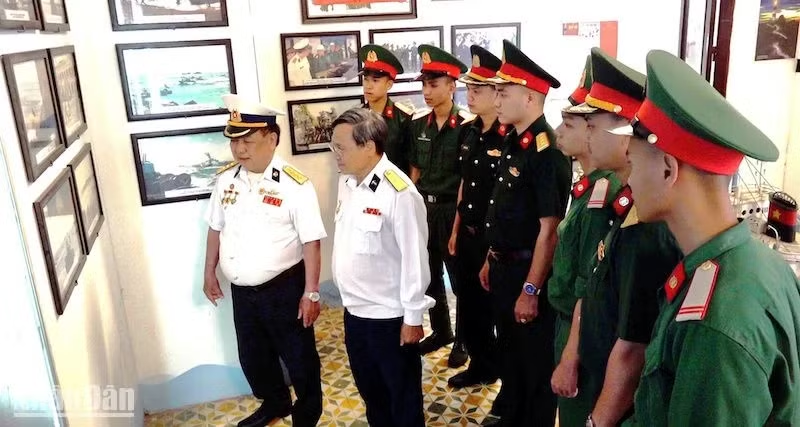
Each April, the Military Zone 5 Museum in Da Nang welcomes thousands of visitors. In the Viet Nam's Sea and Islands Exhibition Area, beside the model of the ship 19-5, stories of the Truong Sa liberation campaign are brought to life by war veterans Pham Ngoc Cuu and Phan Xuan Ap—those who were there. Their recollections revive a time of fire and steel, glory and sacrifice.
A Journey Across the Waves
“After the liberation of Da Nang on March 29, 1975, Viet Nam's Water Commando Battalion 471 under Military Zone 5 was ordered to take control of the Da Nang Military Port. A little over a week later, 36 officers and soldiers in our unit were assigned a special mission: pack up and board a ship. Only when the ship left port were we informed of our mission—to liberate the Truong Sa Archipelago,” recalled veteran Pham Ngoc Cuu, former Chief of the 15W Communications Station, with a proud gleam in his eyes despite his silver hair.
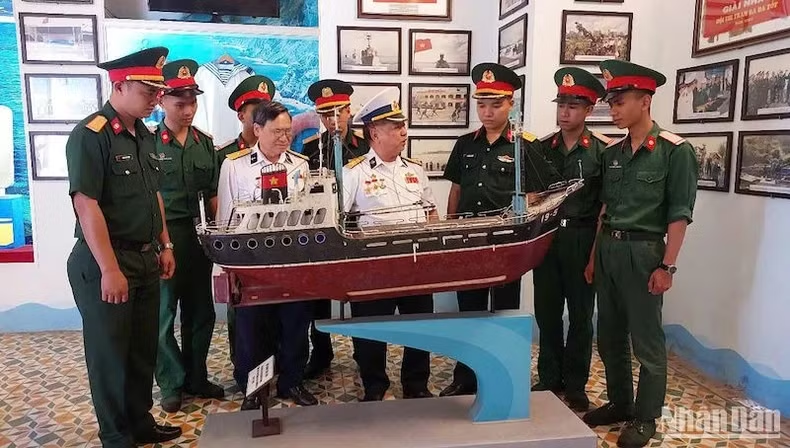 |
| Beside the model of ship 19-5 at the Viet Nam's Sea and Islands Exhibition Area, Military Zone 5 Museum, war veterans Pham Ngoc Cuu and Phan Xuan Ap recall the Truong Sa liberation campaign. |
For soldiers trained for combat in rivers and on land, this was an unprecedented challenge—heading out to sea, battling waves, and seizing islands deep in the open ocean. With support from Regiment 38, Regiment 95 (Division 2), Naval Group 126, and other allied units, the task force set out from the Da Nang military port aboard three vessels disguised as fishing boats. The sailors wore the clothes of fishermen, while the commandos lay quietly in the hold of the ship in the middle of the ocean filled with warships and enemy planes lurking in the sky.
After days at sea, the unit reached a rendezvous point and received orders to attack Song Tu Tay Island—one of the largest and most strategically important islands in the archipelago. From the early hours of April 14, 1975, stationed dozens of kilometers from the island, the waterborne commandos split into three units. They silently crossed sharp coral reefs and crashing waves to approach the island undetected. The US troop was completely surprised. After nearly an hour of fierce fighting, Vietnamese forces took full control of Song Tu Tay, capturing the island commander and more than 30 US troops and seizing all weapons and equipment.
On April 25, the unit moved to liberate Son Ca Island. Just before the final assault, a B40 rocket took out the enemy watchtower. All 22 US troops stationed on the island surrendered.
By April 27, Vietnamese forces launched an attack on Nam Yet Island, where the enemy had left behind a heavily fortified defense system, including claymore mines and anti-aircraft machine guns. At this point, the Ho Chi Minh Campaign was reaching its climax, and the defensive lines around Sai Gon had been breached. Demoralised, the US troops on the islands began abandoning their posts and retreating.
By April 29, the forces had secured the islands of Sinh Ton, Truong Sa Lon, and An Bang. The flag of the National Front for the Liberation of South Viet Nam fluttered proudly above the islands amid the open sea. Tears of joy welled up in the sun-darkened faces of the battle-hardened soldiers.
Liberation of Truong Sa - a wise decision
“The liberation of Truong Sa was a wise and visionary decision by the Politburo, reflecting a strategic vision regarding national maritime sovereignty,” said war veteran Pham Ngoc Cuu. “At that time, several foreign ships appeared offshore, seemingly eyeing the islands. But when they saw the flag of the National Front for the Liberation of South Viet Nam flying over them, they backed off. One ship even released a self-destructing buoy to cause disturbances at Song Tu Tay and Nam Yet, but none dared take direct action.”
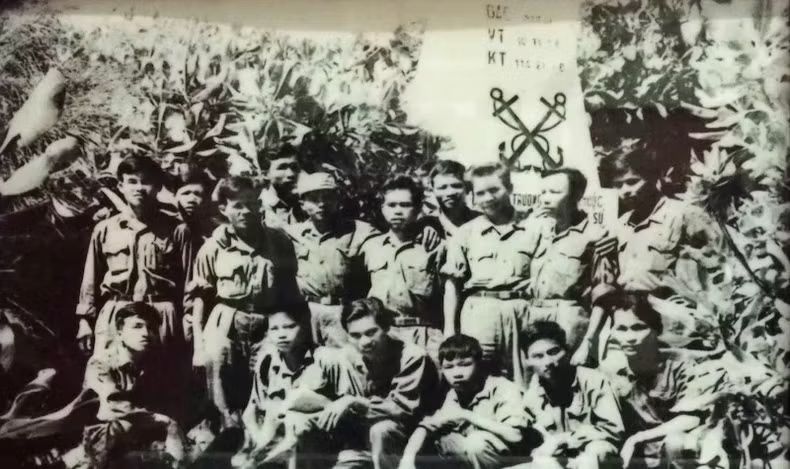 |
| Officers and soldiers from Regiment 38 who participated in the 1975 liberation of Truong Sa. (Photo: File photo) |
In the memory of Colonel Phan Xuan Ap, former Operations Assistant of Battalion 471, holding the islands after liberation was just as daunting. “We remained stationed in the open sea to guard the newly liberated territories, while the mainland celebrated the victory. Some nights, the sea roared fiercely. Some days, massive waves engulfed our temporary camps. But we all understood—this was the call of the Fatherland,” he recalled.
Through the stories of these veterans—living witnesses to the liberation of Truong Sa—the atmosphere of the Viet Nam's Sea and Islands Exhibition Area seemed to fall into a solemn hush. Especially poignant was the moment when the two men described raising the liberation flag: “The sight of the flag waving high against the blue sky, atop a coconut tree, moved us all. Amid the overwhelming joy was a heavy silence as we remembered the comrades who had fallen just before the moment of reunion. From now on, our country was free of foreign invaders, our land united from North to South”. It was a moment that stirred a deep pride and sense of honour in all who heard it.
That day, visitors—young and old, including international tourists—listened in silence. Some quietly wiped away tears.
Fifty years may have passed, but the memory of those sailors who sailed on a mission like no other remains as powerful as ever. It was not only a military victory but also a historic assertion of Viet Nam’s inviolable sovereignty over the East Sea/South China Sea.