Promoting the role of national key press agencies
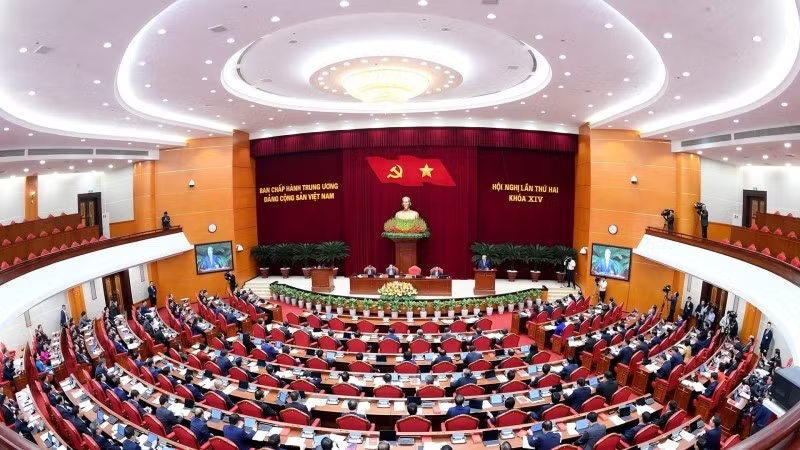
In his closing remarks at the second plenum, General Secretary To Lam stressed, at the very outset, that Party building in political and ideological terms in the new period must continue to be given due attention and further strengthened. This, he said, would provide a solid foundation for enhancing the Party’s mettle, vanguard role, fighting spirit, and leadership and governing capacity. At the same time, Moreover, rapid and complex developments in the world and the region continue to pose pressing demands for further strengthening the Party’s direct and comprehensive leadership over key sectors.
Against that backdrop, consolidating and restructuring the national key press agencies in line with the Party’s policy is both necessary and well-founded, especially as the media environment is changing rapidly and information competition in the digital space is becoming ever more intense.
Commenting on this matter, Nguyen Thanh Lam, member of the Party Central Committee and Director General of Viet Nam Television (VTV), said this was a move of clear strategic significance. Bringing the key press agencies under the direct authority of the Party Central Committee, he noted, is not merely a change in management model, but also reflects a renewed approach in the Party’s leadership of ideological and communications work in the new situation. This, he added, further underscores the need to uphold the “four steadfast principles” as directed by General Secretary To Lam, while enabling the press to better perform its role in connecting the Party with the people.
“This is not only an opportunity but also an inevitable requirement for VTV to streamline its organisational apparatus and focus more deeply on its core strengths, thereby turning its future plans into reality,” Nguyen Thanh Lam said.
The VTV chief also underscored the parallel importance of innovating journalistic methods and applying technology, “so as to ensure political and analytical depth while also meeting society’s increasingly diverse information needs”. In its new positioning, VTV has clearly identified its role as a core force in carrying out the Party’s political and ideological work across television and multi-platform media.
Emphasising the important task of maintaining and enhancing standards, credibility and steadfastness in political stance, while also pursuing strong innovation in presentation and audience engagement, VTV’s leadership affirmed that it would continue to fulfil its responsibility to safeguard the Party’s ideological foundation, combat and refute false information, and at the same time spread positive and humane values, thereby helping build social consensus.
Seizing new opportunities
Many have observed that the shift in the management model of the national key press agencies carries strategic significance for the development of Viet Nam’s revolutionary press.
Do Tien Sy, member of the Party Central Committee and Director General of the Voice of Viet Nam (VOV), said that placing the three national key press agencies under the direct authority of the Party Central Committee once again affirms the Party’s renewed thinking and leadership approach towards ideological work, journalism and communications.
Placing the three national key press agencies under the direct authority of the Party Central Committee once again affirms the Party’s renewed thinking and leadership approach towards ideological work, journalism and communications.
Do Tien Sy, member of the Party Central Committee and Director General of the Voice of Viet Nam
At the recent meeting of the Party Central Committee, the Central Committee also adopted the Regulations on political and ideological work within the Party, thereby reaffirming the especially important position and role of this work in the Party’s leadership and governance, particularly in the context of pursuing the strategic vision, the two centenary goals, and implementing the Resolution of the 14th National Party Congress together with other Party resolutions.
Vu Viet Trang, Director General of the Viet Nam News Agency (VNA), also stressed that the three national press and media agencies — VTV, VOV and VNA — are pillars of the national information and communications system, playing a leading role in disseminating and promoting, and contributing to the building and safeguarding of the Party’s line and guidelines, the State’s policies and laws, as well as the country’s and the world’s achievements; guiding public opinion; spreading and ensuring official information; and carrying out both domestic and foreign information work, thereby enhancing the country’s image and standing.
Under the new model, the national press agencies will all directly participate in the formation and development of ideology, a core sphere closely tied to the Party’s leadership role. Therefore, designating these agencies as public non-business units under the Party Central Committee will be consistent with the political tasks of the new period, ensuring the Central Committee’s direct, comprehensive and unified leadership over this key ideological sphere, while fully bringing into play the role of the leading press agencies in publicising and disseminating the Party’s guidelines, line and ideology, and in guiding public opinion.
In reality, the traditional press is facing ever greater competitive pressure. In the digital environment, alongside the domestic press, the increasingly extensive presence of cross-border platforms, international media conglomerates and many new forms of information is directly reshaping the way the public receives information.
According to Nguyen Manh Hung, Deputy Director General of the Voice of Viet Nam, this trend is not only changing the ways content is produced and distributed, but also posing challenges to preserving the revolutionary press’s role as the mainstream source of information. It is therefore an objective necessity to renew management thinking, operational organisation and working methods at the key national press agencies.
Ready to renew thinking in organisation and management
Prof. Dr. Tran Hong Thai, member of the Party Central Committee and President of the Viet Nam Academy of Science and Technology, stressed that the Party Central Committee’s approval in principle of the transfer of five major bodies to become public non-business units under the Party Central Committee was a decision of profound strategic significance. These five bodies represent key pillars in national communications, social sciences, and science and technology.
“Placing these pillars under the Party’s direct leadership shows that the Party regards these as foundational areas of soft power and national competitiveness, which need to be led in a unified manner at the highest level. This will help strengthen the Party and enable the country to develop faster and more robustly,” Thai said.
Analysing more clearly the role of the five bodies as representatives of the foundational pillars of national strength in the new era — namely ideological orientation, social knowledge, and science and technology —Thai emphasised that the Party’s decision to place these pillars under its direct leadership demonstrates its determination to lead fields that are crucial to the nation’s destiny in this period of breakthrough development. He also affirmed that this policy is the result of a serious process of awareness-building, practical review and policy advice by Party agencies at the central level.
Prof. Dr. Le Van Loi, member of the Party Central Committee and President of the Viet Nam Academy of Social Sciences, expressed confidence that the academy would have the opportunity to build more systematic channels of co-operation to disseminate social science knowledge to the public more broadly and with higher quality. In his words, “this is precisely the path to raising public intellectual standards, which we have always regarded as an important mission”.
“Ready to embrace this transition with the highest spirit of readiness and determination, we are striving truly to become a strategic think tank, providing sharp, timely and highly forward-looking arguments for the Party and the State,” the President of the Viet Nam Academy of Social Sciences stressed.
Ready to embrace this transition with the highest spirit of readiness and determination, we are striving truly to become a strategic think tank, providing sharp, timely and highly forward-looking arguments for the Party and the State.
Prof. Dr. Le Van Loi, President of the Viet Nam Academy of Social Sciences
According to the expectations voiced by the leadership and scientists of the two academies, this means that experts, scientists and journalists will be able to receive assignments directly from the Politburo and the Secretariat; take part in researching new and major national issues in line with strategic national development orientations; and contribute directly, substantively and systematically to the development and protection of the Party’s ideological foundation.
Looking ahead to the implementation of Politburo Resolution No. 57-NQ/TW, Vu Viet Trang, VNA Director General said that VNA had already developed a digital architecture framework with clearer standards and criteria. VNA’s leadership hopes to continue receiving investment attention from the Party and the State in order to bring to life projects related to infrastructure, data, artificial intelligence applications, safety and cybersecurity.
Addressing financial mechanisms, the VNA Director General proposed that the competent authorities create suitable mechanisms to ensure resources for carrying out political tasks. At the same time, the national news agency needs to continue promoting its dynamism and creativity, develop more media services and products to serve social needs, and generate legitimate revenue in order gradually to improve the livelihoods of its public employees and workers.
Regarding the shift in the management model and the new mode of operation, Nguyen Thanh Tung, Chief of the Party Committee Office of the Viet Nam Academy of Social Sciences (VASS), said that alongside the advantages mentioned above, the transition in the management model also presents VASS with many challenges.
Tung analysed that the transition period is very short, requiring rapid implementation and likely involving many complex legal procedures. According to the Central Committee’s conclusion, completing the transition before April 1, 2026 will require swift adjustments to organisational regulations, financial mechanisms, personnel management, and the transfer of assets and records. Without urgency and close co-ordination, there is a risk of temporary disruption to research activities, contract signing, budget disbursement, and ongoing projects, programmes and research topics.