Q: In your opinion, what is the significance of this visit at a time when bilateral ties are growing stronger, especially given that this year marks the 50th anniversary of diplomatic relations between the two countries?
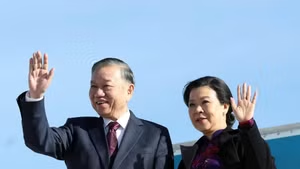
A: General Secretary and President To Lam’s official visit to Thailand from May 27 to 29 is of considerable historical significance.
Firstly, this is General Secretary and President To Lam’s first visit to Thailand in his new position.
Secondly, the visit will further strengthen bilateral relations, particularly against the current backdrop of global uncertainty. Both countries are members of ASEAN and part of the Mekong sub-region, and the comprehensive strategic partnership between Viet Nam and Thailand can be advanced further given the vast potential of both nations.
Thirdly, the visit coincides with a landmark occasion: the 50th anniversary of diplomatic relations between the two countries. It is expected to generate new momentum and deepen the comprehensive strategic partnership between the two nations.
Q: How should the two countries give greater substance to their comprehensive strategic partnership so that cooperation becomes even more effective for the benefit of both peoples, and for peace and stability in the region and the world?
A: Firstly, Thailand and Viet Nam should pursue mutually beneficial cooperation in support of stability, security, and peace in the region and the world.
For example, in industry, Thailand has strengths in automobiles, with numerous domestic automotive parts manufacturing plants; petrochemicals, with major companies such as SCG and PTTGC; and machinery. Viet Nam has strengths in electronics; assembly manufacturing, supported by competitive labour costs; and technology, buoyed by a recent surge in foreign direct investment.
One practical approach would be to establish supply chain linkages, with Thailand manufacturing components for assembly in Viet Nam before products are exported globally. In the agricultural sector, the two countries should move from competition toward joint brand-building. Viet Nam has strengths in affordable agricultural raw materials, while Thailand has strengths in branding and holds the trust of international consumers.
Secondly, both countries hold great potential for cooperation in supply chain development, transport connectivity, logistics, and Mekong sub-regional collaboration. Thanks to their strategic geographic locations, both countries are well placed to become regional connectivity hubs in the Indo-Pacific.
Thirdly, Thailand is home to a large Vietnamese expatriate community, particularly in its north-eastern region. The two countries also share rich common ground in tourism, culture, language, and the creative arts, with deep historical, social, and archaeological connections. This shared heritage will contribute to the long-term development of bilateral relations.
Q: What achievements have been made in bilateral cooperation through the “Three Connections” initiative between Viet Nam and Thailand?
A: Supply chain connectivity, local economic linkages and alignment on green growth strategies are set to generate significant new momentum in bilateral cooperation.
At present, Thailand is Viet Nam’s largest trading partner within ASEAN, with two-way trade reaching approximately 22 billion USD in 2025. Thailand imported nearly 9 billion USD worth of goods from Viet Nam and exported more than 13 billion USD worth to Viet Nam. Thai exports to Viet Nam include machinery and industrial equipment, fully assembled vehicles and automotive parts, household electrical appliances, and electronic components.
Thailand’s high-tech products, such as household electrical appliances and automotive parts, continue to be favoured by Vietnamese consumers. This trend is reflected in the strong annual growth in bilateral trade. The two economies are becoming increasingly integrated within regional supply chains.
In terms of investment, Thailand ranks eighth among the largest foreign investors in Viet Nam, with more than 15 billion USD committed across nearly 800 projects, most from Thailand’s leading companies. Many Thai investors are actively planning to expand their presence through increased production capacity and new investments in energy, food processing, retail, logistics, and infrastructure.
Thank you very much.
![[In Pictures] General Secretary and President To Lam and his spouse visit and present books to Royal Library of Belgium](https://en-cdn.nhandan.vn/images/3NY4Z6Du1Md1PrS_s0ZZOrwc5xDfq4rRua69depr-TBkwatGjBcD9lagzrI2BmGDo4nKYA9qjKDjuB3-yYloL_1KbNBr00klMZQFyHQxQ6Jq6GzFfAiY0m5agKw6jNtArN4QnVntX8RQeUmD7pdCq7nwvn3e235v3kufpokBN_s/1-tong-bi-thu-chu-tich-nuoc-va-phu-nhan-tham-tang-sach-cho-thu-vien-hoang-gia-bi.jpg.avif)