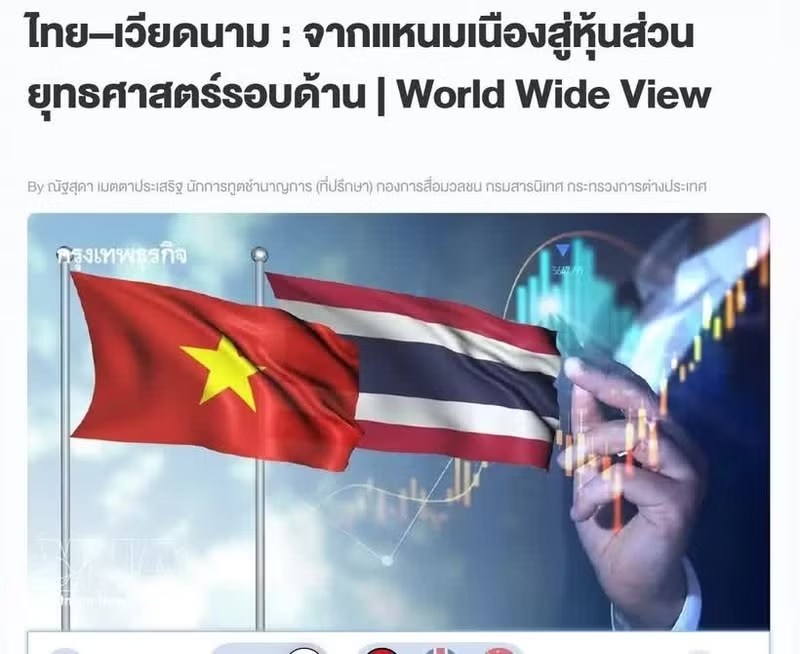
The article featuring the Thailand-Viet Nam Comprehensive Strategic Partnership was written by Nattasuda Metaprasert, a senior diplomat from the Department of Information under Thailand’s Ministry of Foreign Affairs.
The author noted that bilateral relations have developed rapidly in recent years, with the upgrade from a Strategic Partnership in 2013 to an Enhanced Strategic Partnership in 2019, and a Comprehensive Strategic Partnership in 2025 - one of the highest tiers of diplomatic relations.
Viet Nam is currently Thailand’s sixth-largest trading partner globally and its second-largest within ASEAN after Malaysia. In return, Thailand remains Viet Nam’s largest trading partner in ASEAN.
Beyond trade, the two countries are becoming increasingly integrated into shared industrial production and supply chains. Thai exports to Viet Nam, including electronic components, machinery, steel and chemicals, are being used in Vietnamese manufacturing before being exported to global markets. More than 700 Thai companies are operating in Viet Nam across sectors such as food processing, energy, retail and industrial estate development, reflecting Viet Nam’s growing strategic significance to Thailand in the region.
The article also observed that Thai consumers have become increasingly familiar with Vietnamese brands and enterprises, particularly VietJet Air, which is rapidly expanding air connectivity between the two countries. More than 250 direct flights each week currently link Bangkok, Chiang Mai and Phuket with major Vietnamese destinations including Ha Noi, Ho Chi Minh City and Da Nang, and Nha Trang in Khanh Hoa province, contributing to stronger tourism, investment and business exchanges.
According to the author, the growing closeness between Thailand and Viet Nam stems not only from economic indicators but also from deep cultural similarities reflected in everyday life, particularly cuisine. Vietnamese grilled pork sausage, widely enjoyed in Thailand’s northeastern region due to the presence of the Vietnamese community there, was described as more than simply a popular dish. Rather, it symbolises the cultural exchange that has long connected communities along the Mekong River through shared lifestyle, language and culinary culture.
The article further noted that local-level cooperation is being actively promoted, helping strengthen exchanges in trade, education, tourism and culture between their people.
Concluding the article, the author remarked that from familiar dishes along the Mekong River to more than 250 weekly direct flights, from small cafés in Ha Noi to multi-billion-dollar investments, Thailand–Viet Nam relations enjoy increasingly deep and broad development and are closely connected to the daily lives of people in both countries.