The year 2026 was the first year of implementing the programme “Supporting pupils and students in entrepreneurship for the 2026–2035 period”, which aims to shift from a “movement-based” approach to one focused on effectiveness, using products and real-world applicability as key benchmarks.
Spreading value
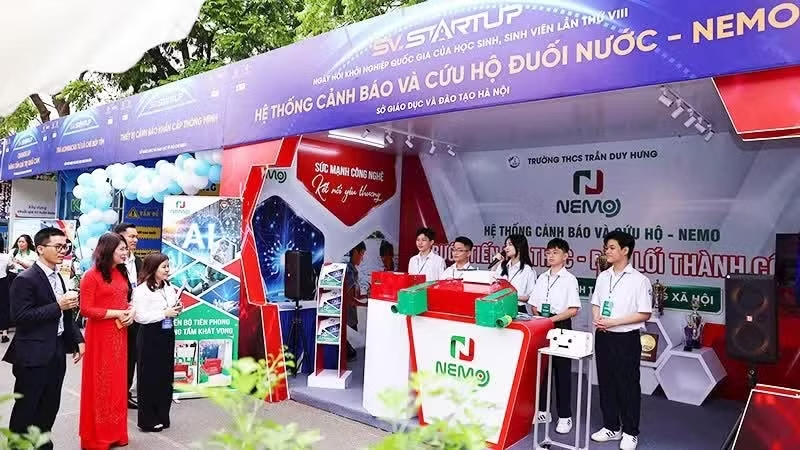
In the exhibition area of the 2026 National Startup Day for pupils and students, which was recently organised by the Ministry of Education and Training and the Ho Chi Minh Communist Youth Union Central Committee, in coordination with the Ministry of Science and Technology and the Viet Nam Chamber of Commerce and Industry, a group of students from the School of Chemistry and Life Sciences at Ha Noi University of Science and Technology are still carefully adjusting their biocomposite material model made from agricultural by-products. Thin, light brown samples pressed from rice husks and bagasse are neatly arranged on the display table. “We have redone the demo five times already because yesterday’s sample did not meet durability requirements,” says Nguyen Duc Anh, a fourth-year student and team member, while checking parameters on a mini press machine.
Behind these modest booths are not just ideas, but the first steps of a generation of young people choosing to create value for themselves and for society.
According to observations at the eighth National Startup Day for pupils and students 2026, within just two months of launch, as many as 880 projects were submitted across a wide range of fields, including technology, agriculture, healthcare, education, and social-impact business. This figure clearly reflects the growing appeal of entrepreneurship among young people, as more pupils and students proactively seek to create value rather than simply look for jobs.
After eight years of implementing support programmes, around 300 enterprises have been incubated within educational environments, with many projects successfully raising capital, entering the market, and establishing a foothold. Entrepreneurship is therefore no longer a short-term movement but is gradually forming a structured ecosystem. Notably, an increasing number of youth-led startups are achieving both economic success and tangible social impact.
Abivin Joint Stock Company, founded by young couple Nguyen Hoang Anh and Pham Nam Long and based in Ha Noi, is a typical example. Starting from the challenge of logistics optimisation, Abivin has developed an artificial intelligence-based platform that helps businesses optimise delivery routes, reduce costs, and shorten delivery times. The product won first prize at the Startup World Cup 2019. In its early days, the founders had to personally persuade transport companies to pilot the system. Today, Abivin serves hundreds of enterprises in Viet Nam and the region, demonstrating that ideas rooted in real needs can expand to international markets.
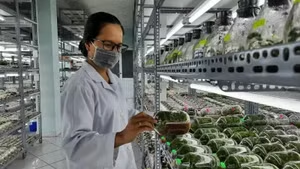
Similarly, in Da Lat Ward, Lam Dong Province, Nguyen Minh Thuan has built a high-tech clean mushroom cultivation model. Initially a small experimental project, it has grown thanks to the application of controlled temperature and humidity processes and traceability systems. His products are now supplied to supermarket chains and exported. Beyond generating stable income, the model has created jobs for dozens of local workers and contributed to transforming agricultural production towards a more modern approach.
In the field of education technology, Marathon Education—a startup founded by Vietnamese overseas students and headquartered in Ho Chi Minh City—deserves mention. The platform offers online courses with personalised learning methods, connecting high-quality teachers with students nationwide. Amid the rapid development of digital education, Marathon has attracted significant investment and expanded quickly, proving that education startups can both generate profit and improve learning quality.
These successful models go beyond individual achievements to create wider ripple effects. Entrepreneurship not only generates jobs for founders but also for others. More importantly, it fosters innovation, as each idea offers a new solution to existing problems, and contributes to reshaping the mindset of young people.
Speaking at the opening ceremony, Minister of Education and Training Hoang Minh Son stressed: “It is time to change how we measure success. The success of a university or college should not only be the proportion of graduates employed in their field, but how many can become job creators—individuals capable of generating new value and opportunities for others.”
Deputy Prime Minister Le Tien Chau emphasised the need to shift entrepreneurship from a “movement” to a “substantive” approach, with products and commercialisation capacity as benchmarks. Startup projects, he noted, must be aligned with market demand, have prototypes, and the potential to develop into enterprises. The Government also calls for stronger business involvement in training and incubation, alongside improved mechanisms for intellectual property, technology transfer, and financial support.
Nurturing the aspiration to contribute
At the event, many young participants shared that the greatest challenge is not generating ideas but implementing them. Lack of capital, experience, and market connections remain major barriers. One student involved in a startup competition said: “We need a real environment to experiment, to fail, and to improve, rather than just competing and stopping there.”
Delivering remarks at the event, Deputy Prime Minister Le Tien Chau affirmed that a country seeking rapid and sustainable development must build a strong innovation ecosystem and cultivate a young workforce with creative thinking, capable of developing new products, services, and models, and adapting quickly to change. He assigned the Ministry of Science and Technology to work closely with the Ministry of Education and Training to support educational institutions in connecting with innovation centres to incubate science and technology enterprises. At the same time, efforts should be strengthened in consultancy, technology transfer, and in proposing mechanisms to help student projects access science and technology, investment funds, experts, and markets more easily.
Highlighting the significance of the event, the Deputy Prime Minister noted that what matters is not awards or rankings, but the process through which students grow, accumulate knowledge, affirm themselves, and nurture their aspiration to contribute.
According to Minister Hoang Minh Son, promoting entrepreneurship is not about organising more competitions, but about restructuring the philosophy of education and training. The focus must shift from managing education to governing an innovation ecosystem.
Educational institutions should serve as platforms connecting schools, businesses, and the state. Universities and vocational institutions must become central nodes — “strategic infrastructure” where knowledge is created, tested, and commercialised within the system. Teachers should not only transmit knowledge but also act as “agents of the knowledge economy”, guiding students in turning research outcomes into real products and services.
Experts note that despite its potential, Viet Nam’s startup ecosystem still faces challenges such as weak connections between schools, businesses, and investors; inflexible regulations on capital, intellectual property, and startup support; and limited management, marketing, and market development skills among young people. Some projects focus mainly on competitions without long-term strategies. For entrepreneurship to truly become a driver of development, a complete ecosystem is needed — one that links education with practice, strengthens the role of businesses, improves support policies, and fosters a culture that accepts risk. More importantly, a shift in mindset is required: entrepreneurship is not a movement but a long-term process that demands persistence and substance