In terms of institutions, the Law on Science, Technology and Innovation 2025, along with related laws, resolutions, and decrees, is gradually removing bottlenecks in procedures, financial mechanisms, intellectual property handling, public procurement, and policy testing mechanisms (sandbox).
Furthermore, ecosystem governance tools have been developed, helping to objectively and transparently evaluate and promote creative competition among entities.
According to experts, as the country enters a new stage of development requiring a new growth model, innovative entrepreneurship cannot be limited to the technology business community alone, but must become a national strategy, a shared endeavour of the entire political system and the whole population in this new era.
Nationwide innovative entrepreneurship means everyone has the opportunity to offer new solutions, access new knowledge, and apply new technologies to life. A farmer applying digitalisation in production, a worker improving a production line, a teacher creating a new learning model, or a housewife running a small business on a digital platform, all are links contributing to the national innovation ecosystem.
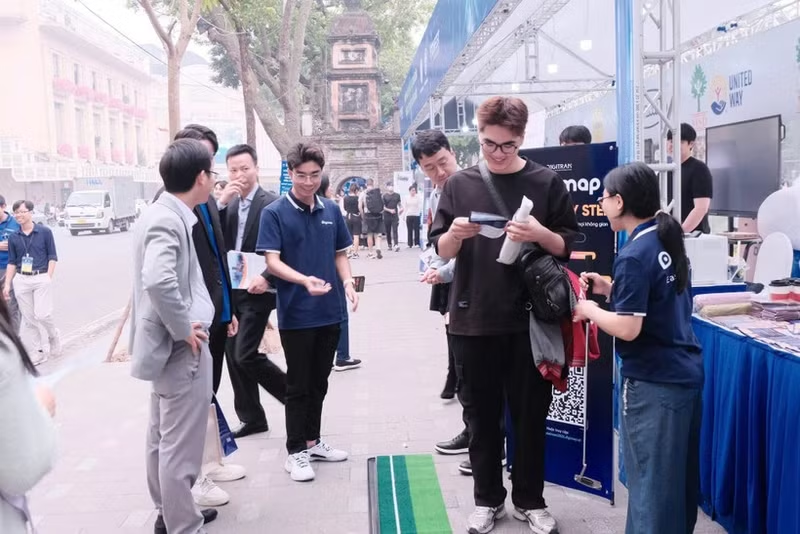
In this context, the 2025 National Innovation and Entrepreneurship Festival (Techfest), after 10 years of organisation, also reached a new milestone by becoming a community-based innovation festival for the first time.
Right in the middle of Hoan Kiem Lake Pedestrian Street, people could experience innovative technologies and business models, ask questions to startups, and find their own opportunities in the innovation journey. This conveyed a strong message that anyone can contribute to the innovation ecosystem and has a responsibility for the future of the country.
Innovative entrepreneurship has become a central strategy of most dynamic economies around the world, demonstrated through the development of national strategies or programs on innovative entrepreneurship to enhance competitiveness, attract talent, capital, and global technology.
Successful nations share a common characteristic: they all create mechanisms to mobilise broad social participation, with science and technology, innovation, and digital transformation as core foundations.
Viet Nam is pursuing this vision through its draft national strategy on innovative entrepreneurship, currently being submitted to the government. The strategy aims to have 5 million business entities and 10,000 innovative startups by 2030; at least 300 innovation centres and locations nationwide; a ranking among the top 40 countries in the Global Innovation Index (GII); and at least 5 innovative startups with a valuation of 1 billion USD or more. It also aims for the venture capital market size to reach 3 billion USD.
According to experts, to assert its new position on the international innovation map, besides supporting the development of innovative startups and the national innovation infrastructure, Viet Nam has no other way than to unleash the creativity of the entire society.
In this regard, the “one-person enterprise” model is a new strategic direction — where an individual or small business can operate almost all business activities on a digital and artificial intelligence platform.
This is the key to bringing millions of people into formal economic activity, promoting the entrepreneurial spirit among all social strata, and putting micro-business models on a sustainable development trajectory.
In addition, it is necessary to promote the establishment of national and local venture capital funds as directed in Resolution No.57/NQ-TW to attract investment capital from the entire society for startup businesses.
Most importantly, it is also necessary to build a culture of innovation that dares to think, dares to act, dares to try, and is tolerant of failure. This is the spiritual foundation for every citizen to become a creative force, and for nationwide creative entrepreneurship to become a national strength in the new phase of development.