In the context of today’s digital economy with widespread electronic transactions, the lump-sum tax model is no longer appropriate. In reality, this model fixes tax liabilities based on manual estimates and rudimentary record-keeping. While easy to implement, it gives rise to a lack of transparency and even creates “inertia” among many business households.
Moreover, maintaining the old model leads to limitations in management, poses potential legal risks, and undermines fairness among business entities. This is because the current lump-sum level is built on estimates by tax authorities and does not require business households to issue invoices for each transaction. This mechanism creates loopholes for under-reporting actual revenue, failing to record all transactions, and evading personal income tax and value added tax, allowing such practices to proliferate unchecked.
It is worth recalling a recent case in which the police investigation agency (Ministry of Public Security) decided to initiate criminal proceedings on October 4. According to investigators, Hoang Huong Pharmaceutical Joint Stock Company and other companies and business households established and directed by Hoang Thi Huong seriously violated accounting regulations. Initial investigation results determined that from January 2021 to June 2025, Hoang Thi Huong kept nearly 1.8 trillion VND (approximately 69 million USD) “outside the accounting books” and incorrectly declared value added tax on revenue of nearly 2.1 trillion VND (approximately 80 million USD).
This case is not merely the story of an individual, but a vivid illustration of the significant loopholes that have long existed in the lump-sum tax mechanism. When actual business operations are large-scale, diverse and generate substantial revenue, simply operating under the guise of a “lump-sum household” allows some individuals to illicitly gain trillions of Vietnamese dong, while the loss of tax revenue to the state budget is self-evident.
Internationally, the abolition of lump-sum taxation and the adoption of revenue-based tax declaration have long been implemented by many countries. Applying the declaration-based method to business households and individuals will ensure tax fairness under the principle of “the more you earn, the more you pay; the less you earn, the less you pay”. Legitimate business households will be protected, and tax authorities will have a clear basis for inspection grounded in concrete data.
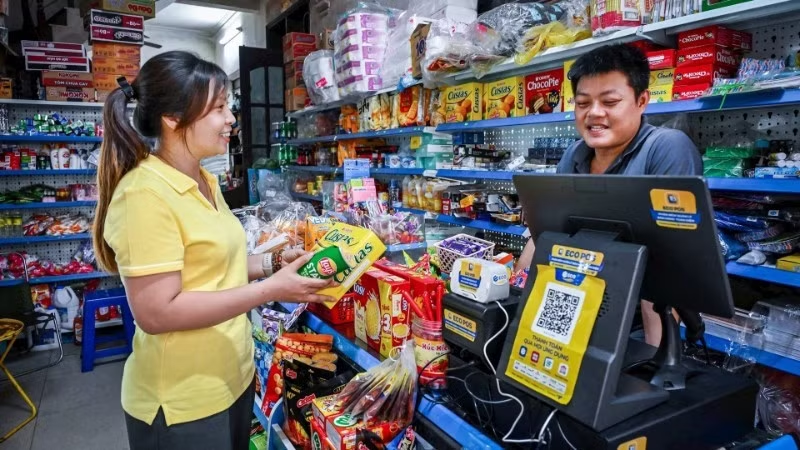
At present, no developed country retains a mechanism of “estimated revenue” or lump-sum taxation. Instead, they rely on compulsory invoicing, monthly or quarterly declarations, transaction data systems, POS machines and similar tools. This is regarded as a breakthrough in thinking, in line with the development trend of a modern economy.
Viet Nam, a country undergoing strong development towards a digital economy, all the more needs to keep pace with this management trend. Shifting business households to the declaration-based regime is no longer a matter of choice, but an inevitable path and mandatory trend, and a means of ensuring transparency and fairness in tax obligations, protecting legitimate business households and safeguarding the national budget.
Of course, to achieve the desired outcomes, the relevant authorities – in this case, each tax office and each tax official – must act as companions to business households, removing obstacles and difficulties with dedication and commitment, actively supporting and guiding them to adapt to the new management method, master tax declaration tools and issue electronic invoices.