According to the Ministry of Agriculture and Environment, current official orientations target average export growth of 6–8% per year in the 2026–2030 period, alongside improvements in institutions, sustainable supply chains, green finance, logistics, deep processing, and brand building.
However, to achieve that goal, the most important task is not to increase output as rapidly as possible, but to transform the growth model.
Speaking to Nhan Dan Newspaper, Nguyen Minh Tien, Director of the Agricultural Trade Promotion Centre under the Ministry of Agriculture and Environment, said that the first priority is to continue making a strong shift from the mindset of “agricultural production” to that of “an agricultural economy aligned with market signals”.
All decisions on commodity development need to begin with consumer demand, standards trends, market forecasts, and opportunities to enter higher-value segments. Production must be linked to orders; raw material areas must be linked to processing; processing must be linked to distribution; and trade promotion must be tied to a long-term brand strategy.
According to Tien, market diversification and risk diversification must be treated as strategic requirements. At a time when the world still faces latent conflicts, strategic competition among major economies, logistics volatility, and the possible emergence of new non-tariff barriers, overdependence on only a few markets or distribution channels would pose major risks. Market development in the coming period must aim not only to firmly retain major markets, but also to expand into promising ones, while increasing the presence of Vietnamese products in modern retail systems, cross-border e-commerce, and distribution chains capable of enhancing brand value.
At the same time, agricultural trade promotion must be upgraded in a more professional, in-depth, and modern direction. In the new phase, trade promotion can no longer stop at organising fairs, facilitating business matching, or promoting images on a case-by-case basis. It must become a strategic tool to support market expansion, anticipate policy changes early, analyse consumer trends, build brands, and connect Vietnamese enterprises directly with international buyers.
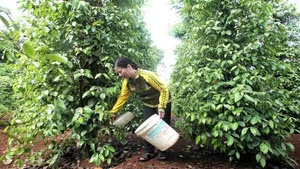
In addition, enterprises must be placed at the centre of efforts to upgrade value chains, while the State, local authorities, industry associations, and the trade promotion system must play a facilitating role. Stronger support is needed for businesses in developing raw material areas, investing in deep processing, cold storage, and logistics, as well as in intellectual property, geographical indications, green certification, traceability, and digital transformation. Only when Vietnamese enterprises are better able to master the value chain can Vietnamese agricultural brands move to a more deserving position in international markets.
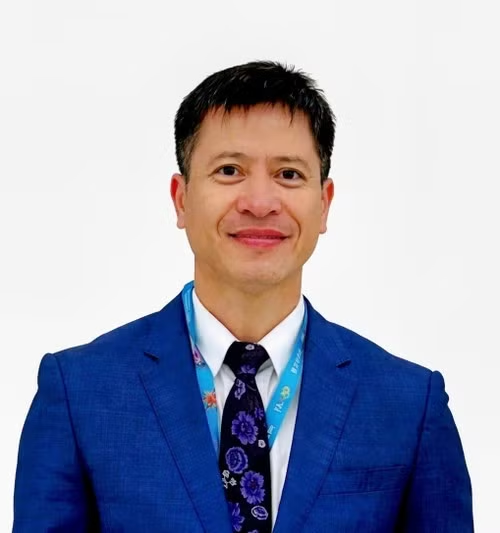
Tien also stressed that building the brand of Vietnamese agricultural products must be recognised as an integral part of the national brand. When the world speaks of Vietnamese farm produce, it should not think only of a country with large output, but of one that offers high-quality, safe, and transparent products, acts responsibly towards the environment, and is capable of meeting the highest standards of modern trade. This is the foundation for Viet Nam not only to increase exports, but also to elevate its national image in a global economy that is rapidly shifting towards green and digital models.
Developing markets and building Vietnamese agricultural brands within global value chains is no longer an optional recommendation, but an imperative of the new development stage. This is not merely a trade issue, but a strategic national question concerning the growth model, adaptability, competitiveness, and the country’s capacity for international integration.
The export achievement of 70.09 billion USD in 2025 is a proud milestone, but it is not the limit of Vietnamese agriculture. The old limit is gradually being replaced by a higher new demand: to enter global markets not merely as a supplier of goods, but as a country with recognised brands, green standards, digital capability, and responsibility within global value chains.