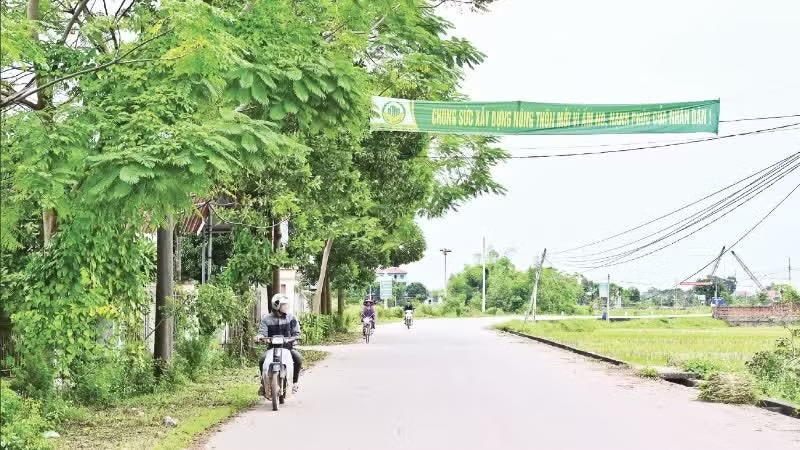
In this process, many localities have effectively implemented the “model rural village” approach, with Bac Ninh as a typical example. Following the process of merger and restructuring of development space, Bac Ninh Province has demonstrated clear breakthroughs in both thinking and practice in developing agriculture, farmers, and rural areas. Based on 452 model villages, the province continues to aim towards building modern rural areas.
A notable feature in the development of model rural villages in Bac Ninh is the change in the approach to criteria for evaluating villages and residential groups. Previously, new rural development was largely implemented uniformly, applying a single set of criteria. Now, Bac Ninh has shifted to a more flexible approach, tailored to the characteristics of each area. Lowland areas are oriented towards development closer to urban standards, while mountainous areas focus on ecological factors, conservation, and sustainable development. The differentiation based on specific criteria helps overcome dispersion and improves the practical effectiveness of each criterion.
Clearly recognising the impacts of urbanisation and industrialisation on rural areas, Bac Ninh has developed the model of “rural areas within urban settings”. In this model, traditional values are preserved alongside solutions to meet modern living standards. Through spatial planning linking villages with green belts and expanding urban areas, along with synchronised infrastructure systems, the province has created a new rural landscape that is both modern and retains the cultural identity of Kinh Bac. In particular, transport, electricity, water supply, schools, healthcare stations, and especially digital infrastructure and cultural institutions have been invested in, enabling people to access information and services and improve their quality of life. The goal is for model rural villages not only to be “beautiful” but also “convenient” and “smart”.
In practice, Bac Ninh shows that the “model rural village” approach has opened up many new opportunities for the rural economy. The combination of developing OCOP (One Commune One Product) goods with agricultural, ecological, and community-based tourism has fundamentally changed thinking towards a modern approach. Rural areas are no longer merely places to live but have become destinations for cultural experiences, generating additional income for residents. At the same time, this model promotes the application of science and technology and the development of clean and organic agriculture, increases production value, and moves towards sustainable development. According to Deputy Director of the Department of Agriculture and Environment Bui Quang Phat, this is also the direction for Bac Ninh to strive for 10% of its communes to be recognised as meeting modern new rural standards during the 2026–2035 period.
From the effective preservation of village spaces within urban areas, with attention to conserving and promoting the value of historical sites, traditional architecture, and natural landscapes, Party committees and authorities at all levels in Bac Ninh have demonstrated the combined strength achieved by mobilising the entire political system, people, and businesses to share responsibility in preserving local identity and fostering endogenous motivation for development.